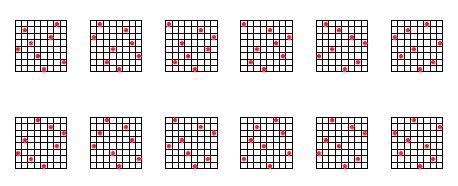
Also available in PDF and as a BibTeX file.
Remarks and additions are welcome!
| Author(s) | Title | Year | Journal/Proceedings | Reftype | DOI/URL |
|---|---|---|---|---|---|
| Abramson, B. and Yung, M. | Divide and Conquer under Global Constraints: A Solution to the $n$-Queens Problem | 1989 | Journal of Parallel and Distributed Computing Vol. 6, pp. 649-662 |
article | DOI |
| Abstract: Configuring $n$ mutually nonattacking Queens on an $nn$ chessboard is a classical problem that was first posed over a century ago. Over the past few decades, this problem has become important to computer scientists by serving as the standard example of a globally constrained problem which is solvable using backtracking search methods. A related problem, placing the $n$-Queens on a toroidal board, has been discussed in detail by Poyla and Chandra. Their work focused on characterizing the solvable cases and finding solutions which arrange the Queens in a regular pattern. This paper describes a new divide-and-conquer algorithm that solves both problems and investigates the relationship between them. The connection between the solutions of the two problems illustrates an important, but frequently overlooked, method of algorithm design: detailed combinatorial analysis of an overconstrained variation can reveal solutions to the corresponding original problem. The solution is an example of solving a globally constrained problem using the divide-and-conquer technique, rather than the usual backtracking algorithm. The former is much faster in both sequential and parallel environments. | |||||
BibTeX:
@article{Abramson1989,
  author = {B. Abramson and M.M. Yung},
  title = {Divide and Conquer under Global Constraints: A Solution to the $n$-Queens Problem},
  journal = {Journal of Parallel and Distributed Computing},
  year = {1989},
  volume = {6},
  pages = {649-662},
  doi = {http://dx.doi.org/10.1016/0743-7315(89)90011-7}
}
|
|||||
| Abramson, B. and Yung, M. | Construction Through Decomposition: A Divide-and-Conquer Algorithm for the $n$-Queens Problem [BibTeX] |
1986 | Proceedings of 1986 ACM Fall Joint Computer Conference, pp. 620-628 | inproceedings | |
BibTeX:
@inproceedings{Abramson1986,
  author = {B. Abramson and M.M. Yung},
  title = {Construction Through Decomposition: A Divide-and-Conquer Algorithm for the $n$-Queens Problem},
  booktitle = {Proceedings of 1986 ACM Fall Joint Computer Conference},
  year = {1986},
  pages = {620-628}
}
|
|||||
| Ahrens, W. | Encyklopädie der Mathematischen Wissenschaften, Erster Band in Zwei Teilen. Zweiter Teil [BibTeX] |
1902 | book | ||
BibTeX:
@book{Ahrens1902,
  author = {W. Ahrens},
  title = {Encyklopädie der Mathematischen Wissenschaften, Erster Band in Zwei Teilen. Zweiter Teil},
  publisher = {B. G. Teubner},
  year = {1902}
}
|
|||||
| Ahrens, W. | Mathematische Unterhaltungen und Spiele [BibTeX] |
1901 | book | URL | |
BibTeX:
@book{Ahrens1901,
  author = {W. Ahrens},
  title = {Mathematische Unterhaltungen und Spiele},
  publisher = {B.G. Teubner},
  year = {1901},
  url = {http://www.archive.org/details/mathunterhaltung00ahrerich}
}
|
|||||
| Alavi, Y., Lick, D. and Liu, J. | Strongly Diagonal Latin Squares and Permutation Cubes [BibTeX] |
1994 | Proceedings of the Twenty-fifth Southeastern International Conference on Combinatorics, Graph Theory and Computing, pp. 65–70 | inproceedings | |
BibTeX:
@inproceedings{Alavi1994,
  author = {Y. Alavi and D.R. Lick and J. Liu},
  title = {Strongly Diagonal Latin Squares and Permutation Cubes},
  booktitle = {Proceedings of the Twenty-fifth Southeastern International Conference on Combinatorics, Graph Theory and Computing},
  year = {1994},
  pages = {65–70}
}
|
|||||
| Allison, L., Yee, C. and McGaughey., M. | Three-Dimensional Queens Problems | 1989 | (89/130) | techreport | URL |
| Abstract: The two-dimensional $N$-queens problem is generalised to three dimensions and to $N^2$-queens. There are non-toroidal and toroidal variants. A computer search has been carried out for (non-toroidal) solutions up to $N=14$. We conjecture that toroidal solutions exist iff the smallest factor of $N$ is greater than 7. | |||||
BibTeX:
@techreport{Allison1988,
  author = {L. Allison and C.N. Yee and M. McGaughey.},
  title = {Three-Dimensional Queens Problems},
  year = {1989},
  number = {89/130},
  url = {http://www.csse.monash.edu.au/~lloyd/tildeAlgDS/Recn/Queens3D/}
}
|
|||||
| Alvis, D. and Kinyon, M. | Birkhoff's Theorem for Panstochastic Matrices [BibTeX] |
2001 | The American Mathematical Monthly Vol. 108(1), pp. 28-37 |
article | DOI |
BibTeX:
@article{Alvis20001,
  author = {D. Alvis and M. Kinyon},
  title = {Birkhoff's Theorem for Panstochastic Matrices},
  journal = {The American Mathematical Monthly},
  year = {2001},
  volume = {108(1)},
  pages = {28-37},
  doi = {http://dx.doi.org/10.2307/2695673}
}
|
|||||
| Ambrus, G. and Barát, J. | A Contribution to Queens Graphs: A Substitution Method | 2006 | Discrete Mathematics Vol. 306, pp. 1105-1114 |
article | DOI |
| Abstract: A graph $G$ is a queens graph if the vertices of $G$ can be mapped to queens on the chessboard such that two vertices are adjacent if and only if the corresponding queens attack each other, i.e. they are in horizontal, vertical or diagonal position. We prove a conjecture of Beineke, Broere and Henning that the Cartesian product of an odd cycle and a path is a queens graph. We show that the same does not hold for two odd cycles. The representation of the Cartesian product of an odd cycle and an even cycle remains an open problem. We also prove constructively that any finite subgraph of the rectangular grid or the hexagonal grid is a queens graph. Using a small computer search we solve another conjecture of the authors mentioned above, saying that $K_3,4$ minus an edge is a minimal non-queens graph. | |||||
BibTeX:
@article{Ambrus2006,
  author = {G. Ambrus and J. Barát},
  title = {A Contribution to Queens Graphs: A Substitution Method},
  journal = {Discrete Mathematics},
  year = {2006},
  volume = {306},
  pages = {1105-1114},
  doi = {http://dx.doi.org/10.1016/j.disc.2006.03.002}
}
|
|||||
| Andrews, W. | Magic Squares and Cubes [BibTeX] |
1960 | book | ||
BibTeX:
@book{Andrews1960,
  author = {W.S. Andrews},
  title = {Magic Squares and Cubes},
  publisher = {Dover Publications Inc., NewYork},
  year = {1960},
  edition = {2nd}
}
|
|||||
| Atkin, A., Hay, L. and Larson, R. | Enumeration and Construction of Pandiagonal Latin Squares of Primeorder | 1983 | Computers and Mathematics with Applications Vol. 9, pp. 267-292 |
article | DOI |
| Abstract: A complete enumeration and algebraic description is given of all pandiagonal Latin squares of order $leq 13$. For $n = 5$, 7 and 11 there are (up to equivalence) exactly the $n-3$ cyclic squares. For $n = 13$ there are 12,386 inequivalent squares; of these 10 are cyclic (in all directions) and 1560 are semi-cyclic (cyclic in a single direction). Systematic methods are given for constructing semi-cyclic pandiagonal Latin squares of any prime order $> 11$. | |||||
BibTeX:
@article{Atkin1983,
  author = {A.O.L. Atkin and L. Hay and R.G. Larson},
  title = {Enumeration and Construction of Pandiagonal Latin Squares of Primeorder},
  journal = {Computers and Mathematics with Applications},
  year = {1983},
  volume = {9},
  pages = {267-292},
  doi = {http://dx.doi.org/10.1016/0898-1221(83)90130-X}
}
|
|||||
| Ball, W. | Mathematical Recreations and Essays [BibTeX] |
1892 | book | URL | |
BibTeX:
@book{Ball1892,
  author = {W.W.R. Ball},
  title = {Mathematical Recreations and Essays},
  publisher = {Macmillan and Co., London},
  year = {1892},
  url = {http://www.gutenberg.org/etext/26839}
}
|
|||||
| Barr, J. and Rao, S. | The $n$-Queens Problem in Higher Dimensions [BibTeX] |
2006 | Elemente der Mathematik Vol. 61, pp. 133-137 |
article | URL |
BibTeX:
@article{Barr2006a,
  author = {J. Barr and S. Rao},
  title = {The $n$-Queens Problem in Higher Dimensions},
  journal = {Elemente der Mathematik},
  year = {2006},
  volume = {61},
  pages = {133-137},
  url = {http://www.ems-ph.org/journals/show_pdf.php?issn=0013-6018&vol=61&iss=4&rank=1}
}
|
|||||
| Barwell, B. | Solution to Problem 811 [BibTeX] |
1980 | Journal of Recreational Mathematics Vol. 13, pp. 61 |
article | |
BibTeX:
@article{Barwell1980,
  author = {B. Barwell},
  title = {Solution to Problem 811},
  journal = {Journal of Recreational Mathematics},
  year = {1980},
  volume = {13},
  pages = {61}
}
|
|||||
| Beasley, J. | The Mathematics of Games [BibTeX] |
1989 | Recreations in Mathematics, volume 5 | incollection | |
BibTeX:
@incollection{Beasley1989,
  author = {J.D. Beasley},
  title = {The Mathematics of Games},
  booktitle = {Recreations in Mathematics, volume 5},
  publisher = {The Clarendon Press - Oxford University Press},
  year = {1989}
}
|
|||||
| Behmann, H. | Das gesamte Schachbrett unter Beachtung der Regeln des Achtköniginnenproblems zu Besetzen [BibTeX] |
1910 | Mathematisch-Naturwissenschaftliche Blätter. Organ des Arnstädter Verbandes mathematischer und naturwissenschaftlicher Vereine an Deutschen Hochschulen Vol. 8, pp. 87-89 |
article | |
BibTeX:
@article{Behmann1910,
  author = {H. Behmann},
  title = {Das gesamte Schachbrett unter Beachtung der Regeln des Achtköniginnenproblems zu Besetzen},
  journal = {Mathematisch-Naturwissenschaftliche Blätter. Organ des Arnstädter Verbandes mathematischer und naturwissenschaftlicher Vereine an Deutschen Hochschulen},
  year = {1910},
  volume = {8},
  pages = {87-89}
}
|
|||||
| Beineke, L., Broere, I. and Henning, M. | Queens Graphs | 1999 | Discrete Mathematics Vol. 206, pp. 63-75 |
article | DOI |
| Abstract: The queens graph of a $(0,1)$-matrix $A$ is the graph whose vertices correspond to the 1's in $A$ and in which two vertices are adjacent if and only if some diagonal or line of $A$ contains the corresponding 1's. A basic question is the determination of which graphs are queens graphs. We establish that a complete block graph is a queens graph if and only if it does not contain $K_1,5$ as an induced subgraph. A similar result is shown to hold for trees and cacti. Every grid graph is shown to be a queens graph, as are the graphs $K_nP_m$ and $C_2nP_m$ for all integers $n,mgeq 2$. We show that a complete multipartite graph is a queens graph if and only if it is a complete graph or an induced subgraph of $K_4,4$, $K_1,3,3$, $K_2,2,2$ or $K_1,1,2,2$. It is also shown that $K_3,4−e$ is not a queens graph. | |||||
BibTeX:
@article{Beineke1999,
  author = {L.W. Beineke and I. Broere and M.A. Henning},
  title = {Queens Graphs},
  journal = {Discrete Mathematics},
  year = {1999},
  volume = {206},
  pages = {63-75},
  doi = {http://dx.doi.org/10.1016/S0012-365X(98)00392-6}
}
|
|||||
| Bell, J. | An Introduction to SDR's and Latin Squares | 2005 | Morehead Electronic Journal of Applicable Mathematics Vol. 4(MATH-2005-03) |
article | URL |
| Abstract: In this paper we study systems of distinct representatives (SDR's) and Latin squares, considering SDR's especially in their application to constructing Latin squares. We give proofs of several important elementary results for SDR's and Latin squares, in particular Hall's marriage theorem and lower bounds for the number of Latin squares of each order, and state several other results, such as necessary and sufficient conditions for having a common SDR for two families. We consider some of the applications of Latin squares both in pure mathematics, for instance as the multiplication table for quasigroups, and in applications, such as analyzing crops for differences in fertility and susceptibility to insect attack. We also present a brief history of the study of Latin squares and SDR's. | |||||
BibTeX:
@article{Bell2005,
  author = {J. Bell},
  title = {An Introduction to SDR's and Latin Squares},
  journal = {Morehead Electronic Journal of Applicable Mathematics},
  year = {2005},
  volume = {4},
  number = {MATH-2005-03},
  url = {http://www.liacs.leidenuniv.nl/~kosterswa/nqueens/papers/bellmejam.pdf}
}
|
|||||
| Bell, J. and Stevens, B. | A Survey of Known Results and Research Areas for $n$-Queens | 2009 | Discrete Mathematics Vol. 309, pp. 1-31 |
article | DOI |
| Abstract: In this paper we survey known results for the $n$-Queens problem of placing $n$ nonattacking Queens on an $nn$ chessboard and consider extensions of the problem, e.g. other board topologies and dimensions. For all solution constructions, we either give the construction, an outline of it, or a reference. In our analysis of the modular board, we give a simple result for finding the intersections of diagonals. We then investigate a number of open research areas for the problem, stating several existing and new conjectures. Along with the known results for $n$-Queens that we discuss, we also give a history of the problem. In particular, we note that the first proof that n nonattacking Queens can always be placed on an n×n board for $n > 3$ is by E. Pauls, rather than by W. Ahrens who is typically cited. We have attempted in this paper to discuss all the mathematical literature in all languages on the $n$-Queens problem. However, we look only briefly at computational approaches. | |||||
BibTeX:
@article{Bell2009,
  author = {J. Bell and B. Stevens},
  title = {A Survey of Known Results and Research Areas for $n$-Queens},
  journal = {Discrete Mathematics},
  year = {2009},
  volume = {309},
  pages = {1-31},
  doi = {http://dx.doi.org/10.1016/j.disc.2007.12.043}
}
|
|||||
| Bell, J. and Stevens, B. | Results for the $n$-Queens Problem on the Möbius Board [BibTeX] |
2008 | Australasian Journal of Combinatorics Vol. 42, pp. 21-34 |
article | URL |
BibTeX:
@article{Bell2008,
  author = {J. Bell and B Stevens},
  title = {Results for the $n$-Queens Problem on the Möbius Board},
  journal = {Australasian Journal of Combinatorics},
  year = {2008},
  volume = {42},
  pages = {21-34}
}
|
|||||
| Bell, J. and Stevens, B. | Constructing Orthogonal Pandiagonal Latin Squares and Panmagic Squares from Modular $n$-Queens Solutions | 2007 | Journal of Combinatorial Designs Vol. 15(3), pp. 221-234 |
article | DOI |
| Abstract: In this article, we show how to construct pairs of orthogonal pandiagonal Latin squares and panmagic squares from certain types of modular $n$-Queens solutions. We prove that when these modular $n$-Queens solutions are symmetric, the panmagic squares thus constructed will be associative, where for an $nn$ associative magic square $A = (a_ij)$, for all $i$ and $j$ it holds that $a_ij + a_n-i-1,n-j-1 = c$ for a fixed $c$. We further show how to construct orthogonal Latin squares whose modular difference diagonals are Latin from any modular $n$-Queens solution. As well, we analyze constructing orthogonal pandiagonal Latin squares from particular classes of non-linear modular $n$-Queens solutions. These pandiagonal Latin squares are not row cyclic, giving a partial solution to a problem of Hedayat. 2007 | |||||
BibTeX:
@article{Bell2007a,
  author = {J. Bell and B. Stevens},
  title = {Constructing Orthogonal Pandiagonal Latin Squares and Panmagic Squares from Modular $n$-Queens Solutions},
  journal = {Journal of Combinatorial Designs},
  year = {2007},
  volume = {15(3)},
  pages = {221-234},
  doi = {http://dx.doi.org/10.1002/jcd.20143}
}
|
|||||
| Bennett, B. and Potts, R. | Arrays and Brooks [BibTeX] |
1967 | Journal of the Australian Mathematical Society Vol. 7, pp. 23-31 |
article | DOI |
BibTeX:
@article{Bennett1967,
  author = {B.T. Bennett and R.B. Potts},
  title = {Arrays and Brooks},
  journal = {Journal of the Australian Mathematical Society},
  year = {1967},
  volume = {7},
  pages = {23-31},
  doi = {http://dx.doi.org/10.1017/S144678870000505X}
}
|
|||||
| Bennett, G. | The Eight Queens Problem (or Super Imposable Solutions for $88$ Boards) [BibTeX] |
1910 | The Messenger of Mathematics Vol. 39, pp. 19 |
article | |
BibTeX:
@article{Bennett1910,
  author = {G.T. Bennett},
  title = {The Eight Queens Problem (or Super Imposable Solutions for $88$ Boards)},
  journal = {The Messenger of Mathematics},
  year = {1910},
  volume = {39},
  pages = {19}
}
|
|||||
| Berge, C. | Graphes et Hypergraphes [BibTeX] |
1970 | Monographies Universitaires de Mathématiques, 37 | incollection | |
BibTeX:
@incollection{Berge1970,
  author = {C. Berge},
  title = {Graphes et Hypergraphes},
  booktitle = {Monographies Universitaires de Mathématiques, 37},
  publisher = {Dunod, Paris},
  year = {1970}
}
|
|||||
| Bernhardsson, B. | Explicit Solutions to the $n$-Queens Problems for all $n$ | 1991 | ACM SIGART Bulletin Vol. 2, pp. 7 |
article | DOI |
| Abstract: The $n$-queens problem is often used as a benchmark problem for AI research and in combinatorial optimization. An example is the recent article teSosic1990 in this magazine that presented a polynomial time algorithm for finding a solution. Several CPU-hours were spent finding solutions for some $n$ up to 500,000. | |||||
BibTeX:
@article{Bernhardsson1991,
  author = {B. Bernhardsson},
  title = {Explicit Solutions to the $n$-Queens Problems for all $n$},
  journal = {ACM SIGART Bulletin},
  year = {1991},
  volume = {2},
  pages = {7},
  doi = {http://dx.doi.org/10.1145/122319.122322}
}
|
|||||
| Bernhold, H. | Die Lösung des 8-Damen-Problems [BibTeX] |
1942 | Deutsche Schachzeitung Vol. 97, pp. 38-40 |
article | |
BibTeX:
@article{Bernhold1942,
  author = {H. Bernhold},
  title = {Die Lösung des 8-Damen-Problems},
  journal = {Deutsche Schachzeitung},
  year = {1942},
  volume = {97},
  pages = {38-40}
}
|
|||||
| Bezzel, F. | Proposal of Eight Queens Problem [BibTeX] |
1848 | Berliner Schachzeitung Vol. 3, pp. 363 |
article | |
BibTeX:
@article{Bezzel1848,
  author = {F.W.M. Bezzel},
  title = {Proposal of Eight Queens Problem},
  journal = {Berliner Schachzeitung},
  year = {1848},
  volume = {3},
  pages = {363}
}
|
|||||
| Bitner, J. and Reingold, E. | Backtrack Programming Techniques | 1975 | Communications of the ACM Vol. 18, pp. 651-656 |
article | DOI |
| Abstract: The purpose of this paper is twofold. First, a brief exposition of the general backtrack technique and its history is given. Second, it is shown how the use of macros can considerably shorten the computation time in many cases. In particular, this technique has allowed the solution of two previously open combinatorial problems, the computation of new terms in a well-known series, and the substantial reduction in computation time for the solution to another combinatorial problem. This article deals with the basics of backtracking. | |||||
BibTeX:
@article{Bitner1975,
  author = {J.R. Bitner and E.M. Reingold},
  title = {Backtrack Programming Techniques},
  journal = {Communications of the ACM},
  year = {1975},
  volume = {18},
  pages = {651-656},
  doi = {http://dx.doi.org/10.1145/361219.361224}
}
|
|||||
| Blumenthal, L. | Discussions: An Extension of the Gauss Problem of Eight Queens [BibTeX] |
1928 | The American Mathematical Monthly Vol. 35(6), pp. 307-309 |
article | DOI |
BibTeX:
@article{Blumenthal1928,
  author = {L.M. Blumenthal},
  title = {Discussions: An Extension of the Gauss Problem of Eight Queens},
  journal = {The American Mathematical Monthly},
  year = {1928},
  volume = {35(6)},
  pages = {307-309},
  doi = {http://dx.doi.org/10.2307/2298678}
}
|
|||||
| Bode, J.-P. and Harborth, H. | Independent Chess pieces on Euclidean Boards [BibTeX] |
2000 | Journal of Combinatorial Mathematics and Combinatorial Computing Vol. 33, pp. 209-223 |
article | |
BibTeX:
@article{Bode2000,
  author = {J.-P. Bode and H. Harborth},
  title = {Independent Chess pieces on Euclidean Boards},
  journal = {Journal of Combinatorial Mathematics and Combinatorial Computing},
  year = {2000},
  volume = {33},
  pages = {209-223}
}
|
|||||
| Bozinovski, A. and Bozinovski, S. | $n$-Queens Pattern Generation: An Insight into Space Complexity of a Backtracking Algorithm | 2004 | ACM International Conference Proceeding Series; Proceedings of the 2004 International Symposium on Information and Communication Technologies, pp. 281-286 | inproceedings | |
| Abstract: It is proposed a method for tracking partial solutions while executing a backtracking algorithm. That enables observation of space requirements of a backtracking algorithm. To illustrate the method, the well known benchmark $n$-Queens problem is considered. Results of the experiments are shown and discussed. | |||||
BibTeX:
@inproceedings{Bozinovski2004,
  author = {A. Bozinovski and S. Bozinovski},
  title = {$n$-Queens Pattern Generation: An Insight into Space Complexity of a Backtracking Algorithm},
  booktitle = {ACM International Conference Proceeding Series; Proceedings of the 2004 International Symposium on Information and Communication Technologies},
  year = {2004},
  pages = {281-286}
}
|
|||||
| Bratko, I. | Prolog Programming for Artificial Intelligence [BibTeX] |
1986 | book | ||
BibTeX:
@book{Bratko1986,
  author = {I. Bratko},
  title = {Prolog Programming for Artificial Intelligence},
  publisher = {Addison-Wesley},
  year = {1986}
}
|
|||||
| Bruen, A. and Dixon, R. | The $n$-Queens Problem | 1975 | Discrete Mathematics Vol. 12, pp. 393-395 |
article | DOI |
| Abstract: We present some new solutions to the problem of arranging n queens on an $n n$ chessboard with no two taking each other. Recent related work of other authors is also discussed. | |||||
BibTeX:
@article{Bruen1975,
  author = {A. Bruen and R. Dixon},
  title = {The $n$-Queens Problem},
  journal = {Discrete Mathematics},
  year = {1975},
  volume = {12},
  pages = {393-395},
  doi = {http://dx.doi.org/10.1016/0012-365X(75)90079-5}
}
|
|||||
| Burger, A., Cockayne, E. and Mynhardt, C. | Domination and Irredundance in the Queens' Graph | 1997 | Discrete Mathematics Vol. 163, pp. 47-66 |
article | DOI |
| Abstract: The vertices of the queens' graph $Q_n$ are the squares of an $n n$ chessboard and two squares are adjacent if a queen placed on one covers the other. It is shown that the domination number of $Q_n$ is at most $31n/54 + O(1)$, that $Q_n$ possesses minimal dominating sets of cardinality $5n/2 - O(1)$ and that the cardinality of any irredundant set of vertices of $Q_n$ ($n geq 9$) is at most $lfloor 6n+6-8n+n+1 . | |||||
BibTeX:
@article{Burger1997,
  author = {A.P. Burger and E.J. Cockayne and C.M. Mynhardt},
  title = {Domination and Irredundance in the Queens' Graph},
  journal = {Discrete Mathematics},
  year = {1997},
  volume = {163},
  pages = {47-66},
  doi = {http://dx.doi.org/10.1016/0012-365X(95)00327-S}
}
|
|||||
| Burger, A. and Mynhardt, C. | An Improved Upper Bound for Queens Domination Numbers | 2003 | Discrete Mathematics Vol. 266, pp. 119-131 |
article | DOI |
| Abstract: We consider the domination number of the queens graph $Q_n$ and show that if, for some fixed $k$, there is a dominating set of $Q_4k+1$ of a certain type with cardinality $2k+1$, then for any $n$ large enough, $Q_n)leq [(3k+5)/(6k+3)]+O(1)$. The same construction shows that for any $mgeq 1$ and $n=2(6m-1)(2k+1)-1$, $Q_n^t)leq [(2k+3)/(4k+2)]+O(1)$ where $Q_n^t$ is the toroidal $nn$ queens graph. | |||||
BibTeX:
@article{Burger2003,
  author = {A.P. Burger and C.M. Mynhardt},
  title = {An Improved Upper Bound for Queens Domination Numbers},
  journal = {Discrete Mathematics},
  year = {2003},
  volume = {266},
  pages = {119-131},
  doi = {http://dx.doi.org/10.1016/S0012-365X(02)00802-6}
}
|
|||||
| Burger, A. and Mynhardt, C. | An Upper Bound for the Minimum Number of Queens Covering the $nn$ Chessboard | 2002 | Discrete Applied Mathematics Vol. 121, pp. 51-60 |
article | DOI |
| Abstract: We show that the minimum number of queens required to cover the $nn$ chessboard is at most $815n+O(1)$. | |||||
BibTeX:
@article{Burger2002,
  author = {A.P. Burger and C.M. Mynhardt},
  title = {An Upper Bound for the Minimum Number of Queens Covering the $nn$ Chessboard},
  journal = {Discrete Applied Mathematics},
  year = {2002},
  volume = {121},
  pages = {51-60},
  doi = {http://dx.doi.org/10.1016/S0166-218X(01)00244-X}
}
|
|||||
| Burger, A. and Mynhardt, C. | Properties of Dominating Sets of the Queens Graph $Q_4k+3$ [BibTeX] |
2000 | Utilitas Mathematica Vol. 57, pp. 237-253 |
article | |
BibTeX:
@article{Burger2000,
  author = {A.P. Burger and C.M. Mynhardt},
  title = {Properties of Dominating Sets of the Queens Graph $Q_4k+3$},
  journal = {Utilitas Mathematica},
  year = {2000},
  volume = {57},
  pages = {237-253}
}
|
|||||
| Burger, A. and Mynhardt, C. | Small Irredundance Numbers for Queens Graphs [BibTeX] |
2000 | Journal of Combinatorial Mathematics and Combinatorial Computing Vol. 33, pp. 33-43 |
article | |
BibTeX:
@article{Burger2000a,
  author = {A.P. Burger and C.M. Mynhardt},
  title = {Small Irredundance Numbers for Queens Graphs},
  journal = {Journal of Combinatorial Mathematics and Combinatorial Computing},
  year = {2000},
  volume = {33},
  pages = {33-43}
}
|
|||||
| Burger, A. and Mynhardt, C. | Symmetry and Domination in Queens' Graphs [BibTeX] |
2000 | Bulletin of the Institute of Combinatorics and its Applications Vol. 29, pp. 11-24 |
article | |
BibTeX:
@article{Burger2000b,
  author = {A.P. Burger and C.M. Mynhardt},
  title = {Symmetry and Domination in Queens' Graphs},
  journal = {Bulletin of the Institute of Combinatorics and its Applications},
  year = {2000},
  volume = {29},
  pages = {11-24}
}
|
|||||
| Burger, A. and Mynhardt, C. | Queens on Hexagonal Boards [BibTeX] |
1999 | Journal of Combinatorial Mathematics and Combinatorial Computing Vol. 31, pp. 97-111 |
article | |
BibTeX:
@article{Burger1999,
  author = {A.P. Burger and C.M. Mynhardt},
  title = {Queens on Hexagonal Boards},
  journal = {Journal of Combinatorial Mathematics and Combinatorial Computing},
  year = {1999},
  volume = {31},
  pages = {97-111}
}
|
|||||
| Burger, A., Mynhardt, C. and Cockayne, E. | Regular Solutions of the $n$-Queens Problem on the Torus | 2004 | Utilitas Mathematica Vol. 65, pp. 219-230 |
article | |
| Abstract: The $n$-queens problem on the torus is the problem of placing $n$ queens on an $nn$ chessboard drawn on the torus so that no two queens attack each other. This is known to be possible if and only if $n equiv pm 1 (mod 6)$. A solution to this problem is said to be regular if it places queens on all squares with co-ordinates $(x + a, kx + b)$ for some fixed integers $k neq 0$, $a$ and $b$. We determine the number of non-isometric regular solutions for each $n equiv pm 1 (mod 6)$. | |||||
BibTeX:
@article{Burger2004,
  author = {A.P. Burger and C.M. Mynhardt and E.J. Cockayne},
  title = {Regular Solutions of the $n$-Queens Problem on the Torus},
  journal = {Utilitas Mathematica},
  year = {2004},
  volume = {65},
  pages = {219-230}
}
|
|||||
| Burger, A., Mynhardt, C. and Cockayne, E. | Queens Graphs for Chessboards on the Torus [BibTeX] |
2001 | Australasian Journal of Combinatorics Vol. 24, pp. 231-246 |
article | URL |
BibTeX:
@article{Burger2001,
  author = {A.P. Burger and C.M. Mynhardt and E.J. Cockayne},
  title = {Queens Graphs for Chessboards on the Torus},
  journal = {Australasian Journal of Combinatorics},
  year = {2001},
  volume = {24},
  pages = {231-246},
  url = {http://ajc.maths.uq.edu.au/pdf/24/ajc-v24-p231.pdf}
}
|
|||||
| Burger, A., Mynhardt, C. and Cockayne, E. | Domination Numbers for the Queens' Graph [BibTeX] |
1994 | Bulletin of the Institute of Combinatorics and its Applications Vol. 10, pp. 73-82 |
article | |
BibTeX:
@article{Burger1994,
  author = {A.P. Burger and C.M. Mynhardt and E.J. Cockayne},
  title = {Domination Numbers for the Queens' Graph},
  journal = {Bulletin of the Institute of Combinatorics and its Applications},
  year = {1994},
  volume = {10},
  pages = {73-82}
}
|
|||||
| Bussey, W. | A Note on the Problem of the Eight Queens [BibTeX] |
1922 | The American Mathematical Monthly Vol. 29(7), pp. 252-253 |
article | DOI |
BibTeX:
@article{Bussey1922,
  author = {W.H. Bussey},
  title = {A Note on the Problem of the Eight Queens},
  journal = {The American Mathematical Monthly},
  year = {1922},
  volume = {29(7)},
  pages = {252-253},
  doi = {http://dx.doi.org/10.2307/2299223}
}
|
|||||
| Cadoli, M. and Schaerf, M. | Partial Solutions with Unique Completion | 2006 | Vol. 4155Reasoning, Action and Interaction in AI Theories and Systems, pp. 101-115 |
inproceedings | DOI |
| Abstract: In this paper we investigate the computational complexity of combinatorial problems with givens, i.e., partial solutions, and where a unique solution is required. Examples for this article are taken from the games of Sudoku, $N$-queens and related games. We will show the computational complexity of many decision and search problems related to Sudoku, a number of similar games and their generalization. Furthermore, we propose a logical description of several such problems that can lead to a formulation in the language of Quantified Boolean Formulae (QBF) and, hence, their mechanization via a QBF solver. Some experiments on finding the minimum number of givens necessary/sufficient to guarantee uniqueness of solution are shown. | |||||
BibTeX:
@inproceedings{Cadoli2006,
  author = {M. Cadoli and M. Schaerf},
  title = {Partial Solutions with Unique Completion},
  booktitle = {Reasoning, Action and Interaction in AI Theories and Systems},
  publisher = {Springer},
  year = {2006},
  volume = {4155},
  pages = {101-115},
  doi = {http://dx.doi.org/10.1007/11829263}
}
|
|||||
| Cairns, G. | Pillow Chess [BibTeX] |
2002 | Mathematics Magazine Vol. 75, pp. 173-186 |
article | URL |
BibTeX:
@article{Cairns2002,
  author = {G. Cairns},
  title = {Pillow Chess},
  journal = {Mathematics Magazine},
  year = {2002},
  volume = {75},
  pages = {173-186},
  url = {http://www.jstor.org/stable/3219240}
}
|
|||||
| Cairns, G. | Queens on Non-Square Tori [BibTeX] |
2001 | The Electronic Journal of Combinatorics Vol. 8(1)(N6), pp. 1-3 |
article | URL |
BibTeX:
@article{Cairns2001,
  author = {G. Cairns},
  title = {Queens on Non-Square Tori},
  journal = {The Electronic Journal of Combinatorics},
  year = {2001},
  volume = {8(1)},
  number = {N6},
  pages = {1-3},
  url = {http://www.combinatorics.org/Volume_8/PDF/v8i1n6.pdf}
}
|
|||||
| Campbell, P. | Gauss and the Eight Queens Problem, A Study in Miniature of the Propagation of Historical Error | 1977 | Historia Mathematica Vol. 4, pp. 397-404 |
article | DOI |
| Abstract: An 1874 article by J. W. L. Glaisher asserted that the eight queens problem of recreational mathematics originated in 1850 with Franz Nauck proposing it to Gauss, who then gave the complete solution. In fact the problem was first proposed two years earlier by Max Bezzel, proposed again by Nauck in a newspaper Gauss happened to read, and only partially solved by Gauss in a casual attempt. Glaisher had access to an accurate account of the history in German but perhaps could not read the language well; the error subsequently spread through the recreational mathematics literature. | |||||
BibTeX:
@article{Campbell1977,
  author = {P.J. Campbell},
  title = {Gauss and the Eight Queens Problem, A Study in Miniature of the Propagation of Historical Error},
  journal = {Historia Mathematica},
  year = {1977},
  volume = {4},
  pages = {397-404},
  doi = {http://dx.doi.org/10.1016/0315-0860(77)90076-3}
}
|
|||||
| Carter, T. and Weakley, W. | The $n$-Queens Problem with Diagonal Constraints [BibTeX] |
2005 | Journal of Combinatorial Mathematics and Combinatorial Computing Vol. 53, pp. 165-178 |
article | |
BibTeX:
@article{Carter2005,
  author = {T.A. Carter and W.D. Weakley},
  title = {The $n$-Queens Problem with Diagonal Constraints},
  journal = {Journal of Combinatorial Mathematics and Combinatorial Computing},
  year = {2005},
  volume = {53},
  pages = {165-178}
}
|
|||||
| Catalan, E. | Unknown [BibTeX] |
1864 | Nouvelles Annales de Mathématiques 216me, t. XIII, pp. 187 | inproceedings | |
BibTeX:
@inproceedings{Catalan1864,
  author = {E.C. Catalan},
  title = {Unknown},
  booktitle = {Nouvelles Annales de Mathématiques 216me, t. XIII},
  year = {1864},
  pages = {187}
}
|
|||||
| Chandra, A. | Independent Permutations, as Related to a Problem of Moser and a Theorem of Pólya | 1974 | Journal of Combinatorial Theory, Series A Vol. 16, pp. 111-120 |
article | DOI |
| Abstract: We introduce the notion of a set of independent permutations on the domain $0, 1,ldots n-1$, and obtain bounds on the size of the largest such set. The results are applied to a problem proposed by Moser in which he asked for the largest number of nodes in a $d$-cube of side $n$ such that no $n$ of these nodes are collinear. Independent permutations are also related to the problem of placing $n$ non-capturing superqueens (chess queens with wrap-around capability) on an $n times n$ board. As a special case of this treatment we obtain Pólya's theorem that this problem can be solved if and only if $n$ is not a multiple of 2 or 3. | |||||
BibTeX:
@article{Chandra1974,
  author = {A.K. Chandra},
  title = {Independent Permutations, as Related to a Problem of Moser and a Theorem of Pólya},
  journal = {Journal of Combinatorial Theory, Series A},
  year = {1974},
  volume = {16},
  pages = {111-120},
  doi = {http://dx.doi.org/10.1016/0097-3165(74)90076-4}
}
|
|||||
| Chatham, R. | The $N+k$ Queens Problem Page [BibTeX] |
2009 | misc | URL | |
BibTeX:
@misc{Chatham,
  author = {R.D. Chatham},
  title = {The $N+k$ Queens Problem Page},
  year = {2009},
  url = {http://www.npluskqueens.info/uploads/2/1/3/5/21355572/n+kqueens.html}
}
|
|||||
| Chatham, R. | Reflections on the $N + k$ Queens Problem | 2009 | College Mathematics Journal Vol. 40, pp. 204-210 |
article | URL |
| Abstract: Given a regular chessboard, can you place eight queens on it, so that no two queens attack each other? More generally, given a square chessboard with $N$ rows and $N$ columns, can you place $N$ queens on it, so that no two queens attack each other? This puzzle, known as the $N$ queens problem, is old, and famous, and has an extensive history. Here we present a recently formulated elaboration, which we call the $N + k$ queens problem. We describe some of what is known about the $N + k$ queens problem, prove a few new results, and propose some open questions. | |||||
BibTeX:
@article{Chatham2009b,
  author = {R.D. Chatham},
  title = {Reflections on the $N + k$ Queens Problem},
  journal = {College Mathematics Journal},
  year = {2009},
  volume = {40},
  pages = {204-210},
  url = {http://www.npluskqueens.info/uploads/2/1/3/5/21355572/cmj204-210.pdf}
}
|
|||||
| Chatham, R., Doyle, M., Fricke, G., Reitmann, J., Skaggs, R. and Wolff, M. | Independence and Domination Separation on Chessboard Graphs | 2009 | Journal of Combinatorial Mathematics and Combinatorial Computing Vol. 68, pp. 3-17 |
article | URL |
| Abstract: A legal placement of Queens is any placement of Queens on an order $N$ chessboard in which any two attacking Queens can be separated by a Pawn. The Queens independence separation number is the minimum number of Pawns which can be placed on an $n n$ board to result in a separated board on which a maximum of $m$ independent Queens can be placed. We prove that $N + k$ Queens can be separated by $k$ Pawns for large enough $N$ and provide some results on the number of fundamental solutions to this problem. We also introduce separation relative to other domination-related parameters for Queens, Rooks, and Bishops. | |||||
BibTeX:
@article{Chatham2009first,
  author = {R.D. Chatham and M. Doyle and G.H. Fricke and J. Reitmann and R.D. Skaggs and M. Wolff},
  title = {Independence and Domination Separation on Chessboard Graphs},
  journal = {Journal of Combinatorial Mathematics and Combinatorial Computing},
  year = {2009},
  volume = {68},
  pages = {3-17},
  url = {http://www.npluskqueens.info/uploads/2/1/3/5/21355572/queenssep2.pdf}
}
|
|||||
| Chatham, R., Doyle, M., Jeffers, R., Kosters, W., Skaggs, R. and Ward, J. | Centrosymmetric Solutions to Chessboard Separation Problems | 2012 | Bulletin of the Institute of Combinatorics and its Applications Vol. 65 |
article | URL |
| Abstract: Given a regular chessboard, can you place eight queens on it, so that no two queens attack each other? More generally, given a square chessboard with $N$ rows and $N$ columns, can you place $N$ queens on it, so that no two queens attack each other? This puzzle, known as the $N$ queens problem, is old, and famous, and has an extensive history. Here we present a recently formulated elaboration, which we call the $N + k$ queens problem. We describe some of what is known about the $N + k$ queens problem, prove a few new results, and propose some open questions. | |||||
BibTeX:
@article{Chatham2012,
  author = {R.D. Chatham and M. Doyle and R.J. Jeffers and W.A. Kosters and R.D. Skaggs and J.A. Ward},
  title = {Centrosymmetric Solutions to Chessboard Separation Problems},
  journal = {Bulletin of the Institute of Combinatorics and its Applications},
  year = {2012},
  volume = {65},
  url = {http://www.npluskqueens.info/uploads/2/1/3/5/21355572/centrosymm2.pdf}
}
|
|||||
| Chatham, R., Doyle, M., Miller, J., Rogers, A., Skaggs, R. and Ward, J. | Algorithm Performance for Chessboard Separation Problems | 2009 | Journal of Combinatorial Mathematics and Combinatorial Computing Vol. 70 |
article | URL |
| Abstract: Chessboard separation problems are modifications to classic chessboard problems, such as the $N$ Queens Problem, in which obstacles are placed on the chessboard. This paper focuses on a variation known as the $N + k$ Queens Problem, in which $k$ Pawns and $N + k$ mutually non-attacking Queens are to be placed on an $N$-by-$N$ chessboard. Results are presented from performance studies examining the efficiency of sequential and parallel programs that count the number of solutions to the $N + k$ Queens Problem using traditional backtracking and dancing links. The use of Stochastic Local Search for determining existence of solutions is also presented. In addition, preliminary results are given for a similar problem, the $N +k$ Amazons. | |||||
BibTeX:
@article{Chatham2009,
  author = {R.D. Chatham and M. Doyle and J.J. Miller and A.M. Rogers and R.D. Skaggs and J.A. Ward},
  title = {Algorithm Performance for Chessboard Separation Problems},
  journal = {Journal of Combinatorial Mathematics and Combinatorial Computing},
  year = {2009},
  volume = {70},
  url = {http://www.npluskqueens.info/uploads/2/1/3/5/21355572/dlxmccc.pdf}
}
|
|||||
| Chatham, R., Fricke, G. and Skaggs, R. | The Queens Separation Problem | 2006 | Utilitas Mathematica Vol. 69, pp. 129-141 |
article | URL |
| Abstract: We define a legal placement of Queens to be any placement in which any two attacking Queens can be separated by a Pawn. The Queens separation number is defined to be equal to the minimum number of Pawns which can separate some legal placement of $m$ Queens on an order $n$ chess board. We prove that $n + 1$ Queens can be separated by 1 Pawn and conjecture that $n + k$ Queens can be separated by $k$ Pawns for large enough $n$. We also provide some results on the separation number of other chess pieces. | |||||
BibTeX:
@article{Chatham2006,
  author = {R.D. Chatham and G.H. Fricke and R.D. Skaggs},
  title = {The Queens Separation Problem},
  journal = {Utilitas Mathematica},
  year = {2006},
  volume = {69},
  pages = {129-141},
  url = {http://www.npluskqueens.info/uploads/2/1/3/5/21355572/queenssep.pdf}
}
|
|||||
| Chen, J.-C. | An Efficient Non-Probabilistic Search Algorithm for the $n$-Queens Problem | 2007 | Proceedings of the Third Conference on IASTED International Conference: Advances in Computer Science and Technology | inproceedings | URL |
| Abstract: We present a new heuristic search for the $n$-Queens problem, which is neither backtracking nor random search. This algorithm finds systematically a solution in linear time. Its speed is faster than the fastest algorithm known so far. On an ordinary personal computer, it can find a solution for 3000000 Queens in less than 5 seconds. | |||||
BibTeX:
@inproceedings{Chen2007,
  author = {J.-C. Chen},
  title = {An Efficient Non-Probabilistic Search Algorithm for the $n$-Queens Problem},
  booktitle = {Proceedings of the Third Conference on IASTED International Conference: Advances in Computer Science and Technology},
  year = {2007},
  url = {http://portal.acm.org/citation.cfm?id=1322534}
}
|
|||||
| Chen, M. | The Maximum Number of Mutually Uncapturable Strong Queens [BibTeX] |
1991 | Journal of Qinghai Normal University (Natural Science) Vol. 1, pp. 9-12 |
article | |
BibTeX:
@article{Chen1991,
  author = {M. Chen},
  title = {The Maximum Number of Mutually Uncapturable Strong Queens},
  journal = {Journal of Qinghai Normal University (Natural Science)},
  year = {1991},
  volume = {1},
  pages = {9-12}
}
|
|||||
| Chen, M., Sun, R. and Zhu, J. | Partial $n$-Solutions to the Modular $n$-Queen Problem [BibTeX] |
1992 | Chinese Science Bulletin Vol. 37(17), pp. 1422-1425 |
article | |
BibTeX:
@article{Chen1992,
  author = {M. Chen and R. Sun and J. Zhu},
  title = {Partial $n$-Solutions to the Modular $n$-Queen Problem},
  journal = {Chinese Science Bulletin},
  year = {1992},
  volume = {37(17)},
  pages = {1422-1425}
}
|
|||||
| Chen, M., Sun, R. and Zhu, J. | Partial $n$-Solution to the Modular $n$-Queens Problem. II [BibTeX] |
1992 | Combinatorics and Graph Theory, Proceedings of the Spring School and International Conference on Combinatorics (SSICC '92), pp. 1-4 | inproceedings | |
BibTeX:
@inproceedings{Chen1992a,
  author = {M. Chen and R. Sun and J. Zhu},
  title = {Partial $n$-Solution to the Modular $n$-Queens Problem. II},
  booktitle = {Combinatorics and Graph Theory, Proceedings of the Spring School and International Conference on Combinatorics (SSICC '92)},
  publisher = {World Scientific},
  year = {1992},
  pages = {1-4}
}
|
|||||
| Chvátal, V. | Colouring the Queen Graphs [BibTeX] |
2005 | misc | URL | |
BibTeX:
@misc{Chvatal2005,
  author = {V. Chvátal},
  title = {Colouring the Queen Graphs},
  year = {2005},
  url = {http://users.encs.concordia.ca/~chvatal/queengraphs.html}
}
|
|||||
| Clapp, R., Mudge, T. and Volz, R. | Solutions to the $n$-Queens Problem Using Tasking in Ada [BibTeX] |
1986 | ACM SIGPLAN Notices Vol. 21, pp. 99-110 |
article | DOI |
BibTeX:
@article{Clapp1986,
  author = {R.M. Clapp and T.N. Mudge and R.A. Volz},
  title = {Solutions to the $n$-Queens Problem Using Tasking in Ada},
  journal = {ACM SIGPLAN Notices},
  year = {1986},
  volume = {21},
  pages = {99-110},
  doi = {http://dx.doi.org/10.1145/15042.15046}
}
|
|||||
| Clark, D. | A Combinatorial Theorem on Circulant Matrices [BibTeX] |
1985 | The American Mathematical Monthly Vol. 92(10), pp. 725-729 |
article | DOI |
BibTeX:
@article{Clark1985,
  author = {D.S. Clark},
  title = {A Combinatorial Theorem on Circulant Matrices},
  journal = {The American Mathematical Monthly},
  year = {1985},
  volume = {92(10)},
  pages = {725-729},
  doi = {http://dx.doi.org/10.2307/2323225}
}
|
|||||
| Clark, D. and Shisha, O. | Invulnerable Queens on an Infinite Chessboard [BibTeX] |
1989 | Proceedings of the Third International Conference on Combinatorial Mathematics, pp. 133-139 | inproceedings | |
BibTeX:
@inproceedings{Clark1989,
  author = {D.S. Clark and O. Shisha},
  title = {Invulnerable Queens on an Infinite Chessboard},
  booktitle = {Proceedings of the Third International Conference on Combinatorial Mathematics},
  year = {1989},
  pages = {133-139}
}
|
|||||
| Clark, D. and Shisha, O. | Proof without Words: Inductive Construction of an infinite Chessboard with Maximal Placement of Nonattacking Queens [BibTeX] |
1988 | Mathematics Magazine Vol. 61, pp. 98 |
article | URL |
BibTeX:
@article{Clark1988,
  author = {D.S. Clark and O. Shisha},
  title = {Proof without Words: Inductive Construction of an infinite Chessboard with Maximal Placement of Nonattacking Queens},
  journal = {Mathematics Magazine},
  year = {1988},
  volume = {61},
  pages = {98},
  url = {http://www.jstor.org/stable/2690038}
}
|
|||||
| Cockayne, E. | Chessboard Domination Problems | 1990 | Discrete Mathematics Vol. 86, pp. 13-20 |
article | DOI |
| Abstract: A graph may be formed from an $n n$ chessboard by taking the squares as the vertices and two vertices are adjacent if a chess piece situated on one square covers the other. In this paper we survey some recent results concerning domination parameters for certain graphs constructed in this way. | |||||
BibTeX:
@article{Cockayne1990,
  author = {E.J. Cockayne},
  title = {Chessboard Domination Problems},
  journal = {Discrete Mathematics},
  year = {1990},
  volume = {86},
  pages = {13-20},
  doi = {http://dx.doi.org/10.1016/0012-365X(90)90344-H}
}
|
|||||
| Cockayne, E. and Hedetniemi, S. | On the Diagonal Queens Domination Problem | 1986 | Journal of Combinatorial Theory, Series A Vol. 42, pp. 137-139 |
article | DOI |
| Abstract: It is shown that the problem of covering an $n times n$ chessboard with a minimum number of queens on a major diagonal is related to the number-theoretic function $r_3(n)$, the smallest number of integers in a subset of $1,n$ which must contain three terms in arithmetic progression. | |||||
BibTeX:
@article{Cockayne1986,
  author = {E.J. Cockayne and S.T. Hedetniemi},
  title = {On the Diagonal Queens Domination Problem},
  journal = {Journal of Combinatorial Theory, Series A},
  year = {1986},
  volume = {42},
  pages = {137-139},
  doi = {http://dx.doi.org/10.1016/0097-3165(86)90012-9}
}
|
|||||
| Cockayne, E. and Mynhardt, C. | Properties of Queens Graphs and the Irredundance Number of $Q_7$ [BibTeX] |
2001 | Australasian Journal of Combinatorics Vol. 23, pp. 285-299 |
article | URL |
BibTeX:
@article{Cockayne2001,
  author = {E.J. Cockayne and C.M. Mynhardt},
  title = {Properties of Queens Graphs and the Irredundance Number of $Q_7$},
  journal = {Australasian Journal of Combinatorics},
  year = {2001},
  volume = {23},
  pages = {285-299},
  url = {http://ajc.maths.uq.edu.au/pdf/23/ajc-v23-p285.pdf}
}
|
|||||
| Cockayne, E. and Spencer, P. | On the Independent Queens Covering Problem [BibTeX] |
1987 | Graphs and Combinatorics Vol. 4, pp. 101-110 |
article | DOI |
BibTeX:
@article{Cockayne1987,
  author = {E.J. Cockayne and P.H. Spencer},
  title = {On the Independent Queens Covering Problem},
  journal = {Graphs and Combinatorics},
  year = {1987},
  volume = {4},
  pages = {101-110},
  doi = {http://dx.doi.org/10.1007/BF01864158}
}
|
|||||
| Colbourn, C. and Rosa, A. | Triple Systems [BibTeX] |
1999 | book | ||
BibTeX:
@book{Colbourn1999,
  author = {C.J. Colbourn and A. Rosa},
  title = {Triple Systems},
  publisher = {The Clarendon Press --- Oxford University Press},
  year = {1999}
}
|
|||||
| Cournia, N. | Chessboard Domination on Programmable Graphics Hardware | 2006 | Proceedings of the 44th Annual Southeast Regional Conference, pp. 62-67 | inproceedings | DOI |
| Abstract: In this paper we present an algorithm to compute the minimum dominating number of a chessboard graph given any chess piece. We use the CPU to compute possible minimally dominating sets, which we then send to programmable graphics hardware to determine the set's domination. We find that the GPU accelerated algorithm performs better than a comparable CPU based algorithm for board sizes greater than 9. To our knowledge, this paper presents the first algorithm to determine the minimum domination number of a chessboard graph using the GPU. | |||||
BibTeX:
@inproceedings{Cournia2006,
  author = {N. Cournia},
  title = {Chessboard Domination on Programmable Graphics Hardware},
  booktitle = {Proceedings of the 44th Annual Southeast Regional Conference},
  year = {2006},
  pages = {62-67},
  doi = {http://dx.doi.org/10.1145/1185448.1185463}
}
|
|||||
| Crawford, K. | Solving the $n$-Queens Problem Using Genetic Algorithms [BibTeX] |
1992 | Proceedings of the 1992 ACM/SIGAPP Symposium on Applied Computing: Technological Challenges of the 1990's, pp. 1039-1047 | inproceedings | DOI |
BibTeX:
@inproceedings{Crawford1992,
  author = {K.D. Crawford},
  title = {Solving the $n$-Queens Problem Using Genetic Algorithms},
  booktitle = {Proceedings of the 1992 ACM/SIGAPP Symposium on Applied Computing: Technological Challenges of the 1990's},
  year = {1992},
  pages = {1039-1047},
  doi = {http://dx.doi.org/10.1145/130069.130128}
}
|
|||||
| Cull, P. and Pandey, R. | Isomorphism and the $n$-Queens Problem | 1994 | ACM SIGCSE Bulletin Vol. 26, pp. 29-36 |
article | DOI |
| Abstract: The $n$-Queens problem is commonly used to teach the programming technique of backtrack search. The $n$-Queens problem may also be used to illustrate the important concept of isomorphism. Here we show how the $n$-Queens problem can be used as a vehicle to teach the concepts of isomorphism, transformation groups or generators, and equivalence classes. We indicate how these ideas can be used in a programming exercise. We include a bibliography of 29 papers. | |||||
BibTeX:
@article{Cull1994,
  author = {P. Cull and R. Pandey},
  title = {Isomorphism and the $n$-Queens Problem},
  journal = {ACM SIGCSE Bulletin},
  year = {1994},
  volume = {26},
  pages = {29-36},
  doi = {http://dx.doi.org/10.1145/187387.187400}
}
|
|||||
| Cvetković, D. | Some Remarks on the Problem of $n$-Queens [BibTeX] |
1969 | Univ. Beograd. Publ. Elektrotehn. Fak. Ser. Mat. Fiz. Vol. 274-301(290), pp. 100-102 |
article | |
BibTeX:
@article{Cvetkovi'c1969,
  author = {D. Cvetković},
  title = {Some Remarks on the Problem of $n$-Queens},
  journal = {Univ. Beograd. Publ. Elektrotehn. Fak. Ser. Mat. Fiz.},
  year = {1969},
  volume = {274-301(290)},
  pages = {100-102}
}
|
|||||
| Dealy, S. | Common Search Strategies and Heuristics With Respect to the N-Queens Problem | 2004 | misc | URL | |
| Abstract: The $N$-Queens problem is examined and programmatically implemented for Depth First Search, Depth First Search with improvements, Branch and Bound, and Beam Search. Several heuristics are presented and implemented with each of the searches. Results were analyzed for number of nodes generated, number of nodes traversed, and relative execution time. While heuristics were found which gave Branch and Bound and Beam Search a significant edge over DFS, there exist polynomial time algorithms using complete board assignment and heuristic repair methods which are purported to do better. | |||||
BibTeX:
@misc{Dealy2004,
  author = {S. Dealy},
  title = {Common Search Strategies and Heuristics With Respect to the N-Queens Problem},
  year = {2004},
  note = {CS504 Term Project},
  url = {http://www.cs.unm.edu/~sdealy/nqueens_proj.pdf}
}
|
|||||
| Dean, D. and Parisi, G. | Statistical Mechanics of a Two-Dimensional System with Long-Range Interactions | 1998 | Journal of Physics A: Mathematics and General Vol. 31, pp. 3949-3960 |
article | DOI |
| Abstract: We analyse the statistical physics of a two-dimensional lattice-based system with long-range interactions. The particles interact in a way analogous to the queens on a chess board. The long-range nature of the interaction gives the mathematics of the problem a simple geometric structure which simplifies both the analytic and numerical study of the system. We present some analytic calculations for the statics of the problem and we also perform Monte Carlo simulations which exhibit a dynamical transition between a high-temperature liquid regime and a low-temperature glassy regime exhibiting ageing in the two time-correlation functions. | |||||
BibTeX:
@article{Dean1998,
  author = {D.S. Dean and G. Parisi},
  title = {Statistical Mechanics of a Two-Dimensional System with Long-Range Interactions},
  journal = {Journal of Physics A: Mathematics and General},
  year = {1998},
  volume = {31},
  pages = {3949-3960},
  doi = {http://dx.doi.org/10.1088/0305-4470/31/17/006}
}
|
|||||
| Del Manzano, H., Echevar(r)ia, C. and Steinberg, L. | Quantum Algorithm for $n$-Queens Problem [BibTeX] |
2002 | Computing Research Conference (CRC2002), Mayagüez, Puerto Rico | inproceedings | URL |
BibTeX:
@inproceedings{Manzano2002,
  author = {H.A. Del Manzano and C. Echevar(r)ia and L. Steinberg},
  title = {Quantum Algorithm for $n$-Queens Problem},
  booktitle = {Computing Research Conference (CRC2002), Mayagüez, Puerto Rico},
  year = {2002},
  url = {http://www.ece.uprm.edu/crc/crc2002/papers/DelManzano_Hector.pdf}
}
|
|||||
| Demirörs, O., Rafraf, N. and Tanik, M. | Obtaining $n$-Queens Solutions from Magic Squares and Constructing Magic Squares from $n$-Queens Solutions [BibTeX] |
1992 | Journal of Recreational Mathematics Vol. 24, pp. 272-280 |
article | |
BibTeX:
@article{Demiroers1992,
  author = {O. Demirörs and N. Rafraf and M.M. Tanik},
  title = {Obtaining $n$-Queens Solutions from Magic Squares and Constructing Magic Squares from $n$-Queens Solutions},
  journal = {Journal of Recreational Mathematics},
  year = {1992},
  volume = {24},
  pages = {272-280}
}
|
|||||
| Demirörs, O. and Tanik, M. | Peaceful Queens and Magic Squares [BibTeX] |
1991 | (91-CSE-7) | techreport | |
BibTeX:
@techreport{Demiroers1991,
  author = {O. Demirörs and M.M. Tanik},
  title = {Peaceful Queens and Magic Squares},
  year = {1991},
  number = {91-CSE-7}
}
|
|||||
| Dietrich, H. and Harborth, H. | Independence on Triangular Triangle Boards | 2005 | Abhandlungen der Braunschweigischen Wissenschaftlichen Gesellschaft Vol. 54, pp. 73-87 |
article | |
| Abstract: Triangular parts of the Euclidean triangle tessellation of the plane are considered as gameboards $T_n$. The independence number $n$ is the maximum number of non-attacking copies of a piece on $T_n$. For nine of the chess-like pieces $n$ is determined completely. | |||||
BibTeX:
@article{Dietrich2005,
  author = {H. Dietrich and H. Harborth},
  title = {Independence on Triangular Triangle Boards},
  journal = {Abhandlungen der Braunschweigischen Wissenschaftlichen Gesellschaft},
  year = {2005},
  volume = {54},
  pages = {73-87}
}
|
|||||
| Doyle, M., Rawe, B. and Rogers, A. | JDLX: Visualization of Dancing Links | 2008 | Journal of Computing Sciences in Colleges Vol. 24, pp. 9-15 |
article | URL |
| Abstract: Data structures courses have settled on a familiar canon of structures and algorithms, and this is reflected in the standard textbooks. It is often useful for instructors to enliven such courses by presenting data structures that are of more recent interest, ones that may simultaneously challenge students' understanding of algorithms and their skills in programming. Exact cover problems, exemplified by the newly popular Sudoku game as well as the classic 8-queens problem, may be efficiently solved by the DLX algorithm popularized by Knuth in 2000, and this can provide a good capstone experience in a data structures course. The DLX algorithm operates by recursion on circular multiply linked lists. Because the pointer mechanics of the DLX algorithm is quite complicated, visualization techniques are called for. As the choreography of ``dancing links" in DLX is highly visual anyway, this is very natural. In this paper we review best practices in algorithmic visualization for learners, and then describe a Java-based visualization of DLX applied to $N$-Queens. We also present some preliminary results that indicate that it is effective in enhancing student learning. | |||||
BibTeX:
@article{Doyle2008,
  author = {M. Doyle and B. Rawe and A. Rogers},
  title = {JDLX: Visualization of Dancing Links},
  journal = {Journal of Computing Sciences in Colleges},
  year = {2008},
  volume = {24},
  pages = {9-15},
  url = {http://dl.acm.org/citation.cfm?id=1409768}
}
|
|||||
| Draa, A., Meshoul, S., Talbi, H. and Batouche, M. | A Quantum-Inspired Differential Evolution Algorithm for Solving the N-Queens Problem | 2010 | The International Arab Journal of Information Technology Vol. 7, pp. 21-27 |
article | URL |
| Abstract: In this paper, a quantum-inspired differential evolution algorithm for solving the N-queens problem is presented. The N-queens problem aims at placing N queens on an NxN chessboard, in such a way that no queen could capture any of the others. The proposed algorithm is a novel hybridization between differential evolution algorithms and quantum computing principles. Accordingly, differential evolution algorithms have been enhanced by the adoption of some quantum concepts such as quantum bits and states superposition. The use of the quantum interference has allowed this hybrid approach to have a remarkable efficiency and good results. | |||||
BibTeX:
@article{Draa2010,
  author = {A. Draa and S. Meshoul and H. Talbi and M. Batouche},
  title = {A Quantum-Inspired Differential Evolution Algorithm for Solving the N-Queens Problem},
  journal = {The International Arab Journal of Information Technology},
  year = {2010},
  volume = {7},
  pages = {21--27},
  url = {http://www.ccis2k.org/iajit/PDF/vol.7,no.1/4.pdf}
}
|
|||||
| Draa, A., Talbi, H. and Batouche, M. | A Quantum-inspired Genetic Algorithm for Solving the $N$-Queens Problem [BibTeX] |
2005 | Proceedings of the 7th International Symposium on Programming and Systems (ISPS’2005), pp. 145-152 | inproceedings | |
BibTeX:
@inproceedings{Draa2005,
  author = {A. Draa and H. Talbi and M. Batouche},
  title = {A Quantum-inspired Genetic Algorithm for Solving the $N$-Queens Problem},
  booktitle = {Proceedings of the 7th International Symposium on Programming and Systems (ISPS’2005)},
  year = {2005},
  pages = {145-152}
}
|
|||||
| Dudeney, H. | Amusements in Mathematics [BibTeX] |
1917 | book | URL | |
BibTeX:
@book{Dudeney1917,
  author = {H.E. Dudeney},
  title = {Amusements in Mathematics},
  publisher = {Thomas Nelson & Sons, Limited},
  year = {1917},
  url = {http://www.gutenberg.org/etext/16713}
}
|
|||||
| Durango Bill | The $N$-Queens Problem [BibTeX] |
misc | URL | ||
BibTeX:
@misc{Durango,
  author = {Durango Bill},
  title = {The $N$-Queens Problem},
  url = {http://www.durangobill.com/N_Queens.html}
}
|
|||||
| Eiben, A., Raué, P.-E. and Ruttkay, Z. | GA-easy and GA-hard Constraint Satisfaction Problems | 1995 | Vol. 923Proceedings of the ECAI-94 Workshop on Constraint Processing, pp. 267-283 |
inproceedings | DOI |
| Abstract: In this paper we discuss the possibilities of applying genetic algorithms (GA) for solving constraint satisfaction problems (CSP). We point out how the greediness of deterministic classical CSP solving techniques can be counterbalanced by the random mechanisms of GAs. We tested our ideas by running experiments on four different CSPs: $N$-queens, graph 3-colouring, the traffic lights and the Zebra problem. Three of the problems have proven to be GA-easy, and even for the GA-hard one the performance of the GA could be boosted by techniques familiar in classical methods. Thus GAs are promising tools for solving CSPs. In the discussion, we address the issues of non-solvable CSPs and the generation of all the solutions. | |||||
BibTeX:
@inproceedings{Eiben1995,
  author = {A.E. Eiben and P.-E. Raué and Zs. Ruttkay},
  title = {GA-easy and GA-hard Constraint Satisfaction Problems},
  booktitle = {Proceedings of the ECAI-94 Workshop on Constraint Processing},
  publisher = {Springer-Verlag},
  year = {1995},
  volume = {923},
  pages = {267-283},
  doi = {http://dx.doi.org/10.1007/3-540-59479-5_30}
}
|
|||||
| Eiben, A., Raué, P.-E. and Ruttkay, Z. | Solving Constraint Satisfaction Problems Using Genetic Algorithms | 1994 | Vol. 2Proceedings of the 1st IEEE World Conference on Computational Intelligence, pp. 542-547 |
inproceedings | DOI |
| Abstract: This article discusses the applicability of genetic algorithms (GAs) to solve constraint satisfaction problems (CSPs). We discuss the requirements and possibilities of defining so-called heuristic GAs (HGAs), which can be expected to be effective and efficient methods to solve CSPs since they adopt heuristics used in classical CSP solving search techniques. We present and analyse experimental results gained by testing different heuristic GAs on the $N$-queens problem and on the graph 3-colouring problem | |||||
BibTeX:
@inproceedings{Eiben1994,
  author = {A.E. Eiben and P.-E. Raué and Zs. Ruttkay},
  title = {Solving Constraint Satisfaction Problems Using Genetic Algorithms},
  booktitle = {Proceedings of the 1st IEEE World Conference on Computational Intelligence},
  publisher = {IEEE Service Center},
  year = {1994},
  volume = {2},
  pages = {542-547},
  doi = {http://dx.doi.org/10.1109/ICEC.1994.350002}
}
|
|||||
| Eickenscheidt, B. | Das $n$-Damen-Problem auf dem Zylinderbrett [BibTeX] |
1980 | feenschach Vol. 50, pp. 382-385 |
article | |
BibTeX:
@article{Eickenscheidt1980,
  author = {B. Eickenscheidt},
  title = {Das $n$-Damen-Problem auf dem Zylinderbrett},
  journal = {feenschach},
  year = {1980},
  volume = {50},
  pages = {382-385}
}
|
|||||
| El-Qawasmeh, E. and Al-Noubani, K. | Reducing the Time Complexity of the $N$-Queens Problem | 2005 | International Journal on Artificial Intelligence Tools Vol. 14, pp. 545-557 |
article | DOI |
| Abstract: This paper presents a fast algorithm for solving the $n$-queens problem. The basic idea of this algorithm is to use pre-computed solutions in 75% of the cases, while the remaining cases are solved by calling the Sosic's algorithm. The novelty of this algorithm is in the observation that these pre-computable cases exhibit a modular nature. In addition, the pre-computed solutions run 100 times faster than Sosic's algorithm in most cases. | |||||
BibTeX:
@article{El-Qawasmeh2005,
  author = {E. El-Qawasmeh and K. Al-Noubani},
  title = {Reducing the Time Complexity of the $N$-Queens Problem},
  journal = {International Journal on Artificial Intelligence Tools},
  year = {2005},
  volume = {14},
  pages = {545-557},
  doi = {http://dx.doi.org/10.1142/S0218213005002247}
}
|
|||||
| El-Qawasmeh, E. and Al-Noubani, K. | A Polynomial Time Algorithm for the $N$-Queens Problems [BibTeX] |
2004 | Proceedings of the IASTED International Conference on Neural Networks and Computational Intelligence (NCI 2004), pp. 191-195 | inproceedings | |
BibTeX:
@inproceedings{El-Qawasmeh2004,
  author = {E. El-Qawasmeh and K. Al-Noubani},
  title = {A Polynomial Time Algorithm for the $N$-Queens Problems},
  booktitle = {Proceedings of the IASTED International Conference on Neural Networks and Computational Intelligence (NCI 2004)},
  year = {2004},
  pages = {191-195}
}
|
|||||
| Engelhardt, M. | A Group-based Search for Solutions of the $n$-Queens Problem | 2007 | Discrete Mathematics Vol. 307, pp. 2535-2551 |
article | DOI |
| Abstract: The $n$-Queens problem is a well-known problem in mathematics, yet a full search for $n$-Queens solutions has been tackled until now using only simple algorithms (with the exception of the Rivin–Zabih algorithm). In this article, we discuss optimizations that mainly rely on group actions on the set of $n$-Queens solutions. Most of our arguments deal with the case of toroidal Queens; at the end, the application to the regular $n$-Queens problem is discussed, and also the Rivin–Zabih algorithm. | |||||
BibTeX:
@article{Engelhardt2007,
  author = {M.R. Engelhardt},
  title = {A Group-based Search for Solutions of the $n$-Queens Problem},
  journal = {Discrete Mathematics},
  year = {2007},
  volume = {307},
  pages = {2535-2551},
  doi = {http://dx.doi.org/10.1016/j.disc.2007.01.007}
}
|
|||||
| Engelhardt, M. | Der Stammbaum der Lösungen des Damenproblems [BibTeX] |
2010 | Spektrum der Wissenschaft August, pp. 68-71 |
article | URL |
BibTeX:
@article{Engelhardt2010,
  author = {M. Engelhardt},
  title = {Der {S}tammbaum der {L}{\"o}sungen des {D}amenproblems},
  journal = {Spektrum der Wissenschaft},
  year = {2010},
  month = {August},
  pages = {68-71},
  url = {http://www.spektrum.de/artikel/1037434&_z=798888}
}
|
|||||
| Engelhardt, M. | The n Queens Problem [BibTeX] |
misc | URL | ||
BibTeX:
@misc{Nqueensde,
  author = {M. Engelhardt},
  title = {The n Queens Problem},
  url = {http://www.nqueens.de/},
  annote = {Website.}
}
|
|||||
| Erbas, C., Rafraf, N. and Tanik, M. | Magic Squares Constructing by the Uniform Step Method Provide Solutions to the $n$-Queens Problem [BibTeX] |
1991 | (91-CSE-25) | techreport | |
BibTeX:
@techreport{Erbas1991,
  author = {C. Erbas and N. Rafraf and M.M. Tanik},
  title = {Magic Squares Constructing by the Uniform Step Method Provide Solutions to the $n$-Queens Problem},
  year = {1991},
  number = {91-CSE-25}
}
|
|||||
| Erbas, C., Sarkeshik, S. and Tanik, M. | Different Perspectives of the $n$-Queens Problem | 1992 | CSC '92: Proceedings of the 1992 ACM Annual Conference on Communications, pp. 99-108 | inproceedings | DOI |
| Abstract: The $N$-Queens problem is a commonly used example in computer science. There are numerous approaches proposed to solve the problem. We introduce several definitions of the problem, and review some of the algorithms. We classify the algorithms for the $N$-Queens problem into 3 categories. The first category comprises the algorithms generating all the solutions for a given $N$. The algorithms in the second category are desinged to generate only the fundamental solutions~teTopor1982. The algorithms in the last category generate only one or several solutions but not necessarily all of them. | |||||
BibTeX:
@inproceedings{Erbas1992,
  author = {C. Erbas and S. Sarkeshik and M.M. Tanik},
  title = {Different Perspectives of the $n$-Queens Problem},
  booktitle = {CSC '92: Proceedings of the 1992 ACM Annual Conference on Communications},
  year = {1992},
  pages = {99-108},
  doi = {http://dx.doi.org/10.1145/131214.131227}
}
|
|||||
| Erbas, C., Sarkeshik, S. and Tanik, M. | Algorithmic and Constructive Approaches to the $n$-Queens Problem [BibTeX] |
1991 | (91-CSE-31) | techreport | |
BibTeX:
@techreport{Erbas1991a,
  author = {C. Erbas and S. Sarkeshik and M.M. Tanik},
  title = {Algorithmic and Constructive Approaches to the $n$-Queens Problem},
  year = {1991},
  number = {91-CSE-31}
}
|
|||||
| Erbas, C. and Tanik, M. | Generating Solutions to the $n$-Queens Problem Using $2$-Circulants [BibTeX] |
1995 | Mathematics Magazine Vol. 68, pp. 343-356 |
article | URL |
BibTeX:
@article{Erbas1995a,
  author = {C. Erbas and M.M. Tanik},
  title = {Generating Solutions to the $n$-Queens Problem Using $2$-Circulants},
  journal = {Mathematics Magazine},
  year = {1995},
  volume = {68},
  pages = {343-356},
  url = {http://www.jstor.org/stable/2690923}
}
|
|||||
| Erbas, C. and Tanik, M. | Parallel Memory Allocation and Data Alignment in SIMD Machines | 1994 | Parallel Algorithms and Applications Vol. 4, pp. 139-151 |
article | DOI |
| Abstract: In this paper, we introduce a memory storage scheme allowing conflict-free parallel access to rows, columns, square blocks, distributed blocks, and positive and negative diagonals of two dimensional arrays. Unlike the existing schemes, the proposed scheme can be used for an arbitrary number of memory modules and an arbitrary size of matrices. We develop a systematic procedure for the memory allocation based on a placement matrix constructed using circulant matrices. We, also, analyze the data alignment requirements of the proposed scheme, and demonstrate that the data vectors read from memory modules can be aligned for the processors using a set of shift, flip, and shuffle operations, which can be implemented by a data manipulation network. | |||||
BibTeX:
@article{Erbas1994,
  author = {C. Erbas and M.M. Tanik},
  title = {Parallel Memory Allocation and Data Alignment in SIMD Machines},
  journal = {Parallel Algorithms and Applications},
  year = {1994},
  volume = {4},
  pages = {139-151},
  doi = {http://dx.doi.org/10.1080/10637199408915460}
}
|
|||||
| Erbas, C. and Tanik, M. | Storage Schemes for Parallel Memory Systems and the $n$-Queens Problem [BibTeX] |
1992 | Vol. 43Proceedings of the 15th Anniversary of the ASME ETCE Confererence, Computer Applications Symposium, pp. 115-120 |
inproceedings | |
BibTeX:
@inproceedings{Erbas1992a,
  author = {C. Erbas and M.M. Tanik},
  title = {Storage Schemes for Parallel Memory Systems and the $n$-Queens Problem},
  booktitle = {Proceedings of the 15th Anniversary of the ASME ETCE Confererence, Computer Applications Symposium},
  year = {1992},
  volume = {43},
  pages = {115-120}
}
|
|||||
| Erbas, C. and Tanik, M. | $n$-Queens Problem and its Algorithms [BibTeX] |
1991 | (91-CSE-8) | techreport | |
BibTeX:
@techreport{Erbas1991b,
  author = {C. Erbas and M.M. Tanik},
  title = {$n$-Queens Problem and its Algorithms},
  year = {1991},
  number = {91-CSE-8}
}
|
|||||
| Erbas, C. and Tanik, M. | $n$-Queens Problem and its Connection to the Polygons [BibTeX] |
1991 | (91-CSE-21) | techreport | |
BibTeX:
@techreport{Erbas1991c,
  author = {C. Erbas and M.M. Tanik},
  title = {$n$-Queens Problem and its Connection to the Polygons},
  year = {1991},
  number = {91-CSE-21}
}
|
|||||
| Erbas, C., Tanik, M. and Aliyazicioglu, Z. | Linear Congruence Equations for the Solutions of the $n$-Queens Problem | 1992 | Information Processing Letters Vol. 41, pp. 301-306 |
article | DOI |
| Abstract: We demonstrate a method using linear congruence equations to generate solutions to the $N$-Queens problem. There are only a few papers in the literature generating solutions for every $N$. Our method generates solutions for every $N$, and the number of solutions produced by our method is larger than the number of solutions given in these papers. | |||||
BibTeX:
@article{Erbas1992b,
  author = {C. Erbas and M.M. Tanik and Z. Aliyazicioglu},
  title = {Linear Congruence Equations for the Solutions of the $n$-Queens Problem},
  journal = {Information Processing Letters},
  year = {1992},
  volume = {41},
  pages = {301-306},
  doi = {http://dx.doi.org/10.1016/0020-0190(92)90156-P}
}
|
|||||
| Erbas, C., Tanik, M. and Aliyazicioglu, Z. | A Note on Falkowskis $n$-Queens Solutions [BibTeX] |
1992 | (92-CSE-14) | techreport | |
BibTeX:
@techreport{Erbas1992c,
  author = {C. Erbas and M.M. Tanik and Z. Aliyazicioglu},
  title = {A Note on Falkowskis $n$-Queens Solutions},
  year = {1992},
  number = {92-CSE-14}
}
|
|||||
| Erbas, C., Tanik, M. and Nair, V. | A Circulant Matrix Based Approach to Storage Schemes for Parallel Memory Systems | 1993 | Proceedings of the Fifth IEEE Symposium on Parallel and Distributed Processing, pp. 92-99 | inproceedings | DOI |
| Abstract: We introduce a memory storage scheme allowing conflict-free parallel access to rows, columns, square blocks, distributed blocks, and positive and negative diagonals of two dimensional arrays. Unlike the existing schemes, the proposed scheme can be used for an arbitrary number of memory modules and an arbitrary size of the arrays. We develop a systematic procedure for the memory allocation based on a placement matrix constructed using circulant matrices | |||||
BibTeX:
@inproceedings{Erbas1993,
  author = {C. Erbas and M.M. Tanik and V.S.S. Nair},
  title = {A Circulant Matrix Based Approach to Storage Schemes for Parallel Memory Systems},
  booktitle = {Proceedings of the Fifth IEEE Symposium on Parallel and Distributed Processing},
  year = {1993},
  pages = {92-99},
  doi = {http://dx.doi.org/10.1109/SPDP.1993.395546}
}
|
|||||
| Erdem, E. and Lifschitz, V. | Tight Logic Programs | 2003 | Theory and Practice of Logic Programming Vol. 3, pp. 499-518 |
article | DOI |
| Abstract: This note is about the relationship between two theories of negation as failure --- one based on program completion, the other based on stable models, or answer sets. François Fages showed that if a logic program satisfies a certain syntactic condition, which is now called ‘tightness,’ then its stable models can be characterized as the models of its completion. We extend the definition of tightness and Fages' theorem to programs with nested expressions in the bodies of rules, and study tight logic programs containing the definition of the transitive closure of a predicate. | |||||
BibTeX:
@article{Erdem2003,
  author = {E. Erdem and V. Lifschitz},
  title = {Tight Logic Programs},
  journal = {Theory and Practice of Logic Programming},
  year = {2003},
  volume = {3},
  pages = {499-518},
  doi = {http://dx.doi.org/10.1017/S1471068403001765}
}
|
|||||
| Falkowski, B.-J. and Schmitz, L. | A Note on the Queen's Problem [BibTeX] |
1986 | Information Processing Letters Vol. 23, pp. 39-46 |
article | DOI |
BibTeX:
@article{Falkowski1986,
  author = {B.-J. Falkowski and L. Schmitz},
  title = {A Note on the Queen's Problem},
  journal = {Information Processing Letters},
  year = {1986},
  volume = {23},
  pages = {39-46},
  doi = {http://dx.doi.org/10.1016/0020-0190(86)90128-6}
}
|
|||||
| Fillmore, J. and Williamson, S. | On Backtracking: A Combinatorial Description of the Algorithm | 1974 | SIAM Journal on Computing Vol. 3, pp. 41-55 |
article | DOI |
| Abstract: A basic algorithm for solving many discrete problems is the so-called ``backtracking" algorithm. The basic problem is that of generating the elements of a subset $S_0 $ of a finite set in an efficient manner. If a group $G$ acts on $S_0 $, then one might wish to obtain only nonisomorphic elements of $S_0 $. In this paper the basic backtracking algorithm is described in terms of chains of partitions on the set $S$. The corresponding isomorph rejection problem is described in terms of $G$-invariant chains of partitions on $S$. Examples and flow charts are given. | |||||
BibTeX:
@article{Fillmore1974,
  author = {J.P. Fillmore and S.G. Williamson},
  title = {On Backtracking: A Combinatorial Description of the Algorithm},
  journal = {SIAM Journal on Computing},
  year = {1974},
  volume = {3},
  pages = {41-55},
  doi = {http://dx.doi.org/10.1137/0203004}
}
|
|||||
| Finch, S. | Encyclopedia of Mathematics and its Applications [BibTeX] |
2003 | Vol. 94 |
inbook | |
BibTeX:
@inbook{Finch2003,
  author = {S.R. Finch},
  title = {Encyclopedia of Mathematics and its Applications},
  publisher = {Cambridge University Press},
  year = {2003},
  volume = {94}
}
|
|||||
| Foley, J. | Manchester Dataflow Machine: Preliminary Benchmark Test Evaluation | 1987 | (UMCS-87-11-2) | techreport | URL |
| Abstract: The Manchester Dataflow Hardware is supported by a Software compiler for the SISAL language and a number of programs have been written to act as Benchmark tests for the hardware. The Benchmark set used contains a wide range of programs including numerical algorithms, sorting, graph colouring and $n$ Queens algorithms plus others. All programs are compiled using a range of optimisations, including function inlining and vectorisation. The resulting statistics, obtained both by simulation and hardware are presented. | |||||
BibTeX:
@techreport{Foley1987,
  author = {J. Foley},
  title = {Manchester Dataflow Machine: Preliminary Benchmark Test Evaluation},
  year = {1987},
  number = {UMCS-87-11-2},
  url = {http://intranet.cs.man.ac.uk/Intranet_subweb/library/cstechrep/Abstracts/UMCS-87-11-2.html}
}
|
|||||
| Foulds, L. and Johnston, D. | An Application of Graph Theory and Integer Programming: Chessboard Nonattacking Puzzles [BibTeX] |
1984 | Mathematics Magazine Vol. 57(3), pp. 95-104 |
article | URL |
BibTeX:
@article{Foulds1984,
  author = {L.R. Foulds and D.G. Johnston},
  title = {An Application of Graph Theory and Integer Programming: Chessboard Nonattacking Puzzles},
  journal = {Mathematics Magazine},
  year = {1984},
  volume = {57(3)},
  pages = {95-104},
  url = {http://www.jstor.org/stable/2689591}
}
|
|||||
| Franel, J. | $n$-Queens solution [BibTeX] |
1894 | L'Intermédiaire des Mathématiciens Vol. 11, pp. 140-141 |
article | |
BibTeX:
@article{Franel1894,
  author = {J. Franel},
  title = {$n$-Queens solution},
  journal = {L'Intermédiaire des Mathématiciens},
  year = {1894},
  volume = {11},
  pages = {140-141}
}
|
|||||
| Gómez, R. | On the $d$-Dimensional Modular $n$-Queen Problem [BibTeX] |
1997 | School: University of Maryland at College Park | mastersthesis | |
BibTeX:
@mastersthesis{Gomez1997,
  author = {R. Gómez},
  title = {On the $d$-Dimensional Modular $n$-Queen Problem},
  school = {University of Maryland at College Park},
  year = {1997}
}
|
|||||
| Günther, S. | Zur Mathematisches Theorie des Schachbretts [BibTeX] |
1874 | Archiv der Mathematik und Physik Vol. 56, pp. 281-292 |
article | URL |
BibTeX:
@article{Gunther1874,
  author = {S. Günther},
  title = {Zur Mathematisches Theorie des Schachbretts},
  journal = {Archiv der Mathematik und Physik},
  year = {1874},
  volume = {56},
  pages = {281-292},
  url = {http://archive.org/stream/archivdermathem21unkngoog}
}
|
|||||
| Gómez(-Aiza), R., Montellano(-Ballesteros), J. and Strausz, R. | On the Modular $n$-Queen Problem in Higher Dimensions | 2004 | misc | URL | |
| Abstract: The modular $n$-queen problem in higher dimensions was introduced by Nudelman teNudelman1995. He showed that for a complete solution to exist in the $d$-dimensional modular $n$-chessboard, it is necessary that $n, (2d-1)!) = 1$, and that it is sufficient that $n, (2d-1)!) = 1$. He conjectured that the last condition is also necessary and showed that this is indeed the case for the class of linear solutions. In this notes, we observe that the conjecture is true for the larger class of polynomial solutions, which are solutions we present as a natural generalization of the bidimensional solutions developed by Kløve teKlove1977. We also generalize constructions of bidimensional solutions developed also by Kløve teKlove1981. | |||||
BibTeX:
@misc{Gomez2004,
  author = {R. Gómez(-Aiza) and J.J. Montellano(-Ballesteros) and R. Strausz},
  title = {On the Modular $n$-Queen Problem in Higher Dimensions},
  year = {2004},
  url = {http://www.liacs.nl/home/kosters/nqueens/papers/gomez2004.pdf}
}
|
|||||
| Gao, Q. and Hou, S. | Junior Researcher: A Discovery System that can solve the Queens Problems on a Constant Computational Complexity | 1990 | Information Technology, 1990. Next Decade in Information Technology, Proceedings of the 5th Jerusalem Conference on (Cat. No.90TH0326-9), pp. 345-347 | inproceedings | DOI |
| Abstract: An approach that uses the discovery system Junior Researcher to solve the $n$-Queens problems ($n geq 4$) is proposed. The functions, structure and features of Junior Researcher are described. A constant-complexity algorithm for solving the problem is then given. | |||||
BibTeX:
@inproceedings{Gao1990,
  author = {Q.S. Gao and S.J. Hou},
  title = {Junior Researcher: A Discovery System that can solve the Queens Problems on a Constant Computational Complexity},
  booktitle = {Information Technology, 1990. Next Decade in Information Technology, Proceedings of the 5th Jerusalem Conference on (Cat. No.90TH0326-9)},
  year = {1990},
  pages = {345-347},
  doi = {http://dx.doi.org/10.1109/JCIT.1990.128303}
}
|
|||||
| Gardner, M. | Chess Queens and Maximum Unattacked Cells | 1999 | Math Horizons Vol. 7, pp. 12-16 |
article | |
| Abstract: There is now an enormous literature on the old classic task of placing eight queens on a chessboard so that no queen attacks another. There are twelve solutions, not counting trivial rotations and reflections. The task naturally generalizes to enumerating the number of solutions for $n$ non-attacking queens on an $nn$ board. | |||||
BibTeX:
@article{Gardner1999,
  author = {M. Gardner},
  title = {Chess Queens and Maximum Unattacked Cells},
  journal = {Math Horizons},
  year = {1999},
  volume = {7},
  pages = {12-16}
}
|
|||||
| Gardner, M. | Fractal Music, Hypercards and More Mathematical Recreations from Scientific American Magazin [BibTeX] |
1991 | book | ||
BibTeX:
@book{Gardner1991,
  author = {M. Gardner},
  title = {Fractal Music, Hypercards and More Mathematical Recreations from Scientific American Magazin},
  publisher = {Freeman},
  year = {1991}
}
|
|||||
| Gardner, M. | Wheels, Life, and Other Mathematical Amusements [BibTeX] |
1983 | book | ||
BibTeX:
@book{Gardner1983,
  author = {M. Gardner},
  title = {Wheels, Life, and Other Mathematical Amusements},
  publisher = {Freeman},
  year = {1983}
}
|
|||||
| Gardner, M. | Patterns in Primes are a Clue to the Strong Law of Small Numbers [BibTeX] |
1980 | Scientific American Vol. 243, pp. 18-28 |
article | |
BibTeX:
@article{Gardner1980,
  author = {M. Gardner},
  title = {Patterns in Primes are a Clue to the Strong Law of Small Numbers},
  journal = {Scientific American},
  year = {1980},
  volume = {243},
  pages = {18-28}
}
|
|||||
| Gardner, M. | Mathematical Games [BibTeX] |
1972 | Scientific American Vol. 227, pp. 176-182 |
article | |
BibTeX:
@article{Gardner1972,
  author = {Martin Gardner},
  title = {Mathematical Games},
  journal = {Scientific American},
  year = {1972},
  volume = {227},
  pages = {176-182}
}
|
|||||
| Gardner, M. | The Unexpected Hanging and Other Mathematical Diversions [BibTeX] |
1968 | book | ||
BibTeX:
@book{Gardner1968,
  author = {M. Gardner},
  title = {The Unexpected Hanging and Other Mathematical Diversions},
  publisher = {Simon & Schuster},
  year = {1968}
}
|
|||||
| Garey, M. and Johnson, D. | Computers and Intractability: A Guide to the Theory of NP-Completeness [BibTeX] |
1979 | book | ||
BibTeX:
@book{Garey1983,
  author = {M.R. Garey and D.S. Johnson},
  title = {Computers and Intractability: A Guide to the Theory of NP-Completeness},
  publisher = {W. H. Freeman and Co., San Fransisco, CA},
  year = {1979}
}
|
|||||
| Garner, C. and Herzberg, A. | On McCarty's Queen Squares [BibTeX] |
1981 | The American Mathematical Monthly Vol. 88(8), pp. 612-613 |
article | DOI |
BibTeX:
@article{Garner1981,
  author = {C.W.L. Garner and A.M. Herzberg},
  title = {On McCarty's Queen Squares},
  journal = {The American Mathematical Monthly},
  year = {1981},
  volume = {88(8)},
  pages = {612-613},
  doi = {http://dx.doi.org/10.2307/2320511}
}
|
|||||
| Gauss, C. | Werke Band XII [BibTeX] |
1850 | book | URL | |
BibTeX:
@book{Gauss1850,
  author = {C.F. Gauss},
  title = {Werke Band XII},
  publisher = {George Olms Verlag, Hildesheim},
  year = {1850},
  url = {http://gdz.sub.uni-goettingen.de/}
}
|
|||||
| Gibbons, P. and Webb, J. | Some New Results for the Queens Domination Problem [BibTeX] |
1997 | Australasian Journal of Combinatorics Vol. 15, pp. 145-160 |
article | URL |
BibTeX:
@article{Gibbons1996,
  author = {P.B. Gibbons and J.A. Webb},
  title = {Some New Results for the Queens Domination Problem},
  journal = {Australasian Journal of Combinatorics},
  year = {1997},
  volume = {15},
  pages = {145-160},
  url = {http://ajc.maths.uq.edu.au/pdf/15/ajc-v15-p145.pdf}
}
|
|||||
| Gik, E. | Shakhmaty i Matematika (BibliotechkaKvant) [BibTeX] |
1983 | Vol. 24 |
book | |
BibTeX:
@book{Gik1983,
  author = {E.Y. Gik},
  title = {Shakhmaty i Matematika (BibliotechkaKvant)},
  publisher = {Nauka, Moscow},
  year = {1983},
  volume = {24}
}
|
|||||
| Gik, E. | Matematika na shakhmatnoi doske (Nauchno-populiarnaiaseriia) [BibTeX] |
1976 | book | ||
BibTeX:
@book{Gik1976,
  author = {E.Y. Gik},
  title = {Matematika na shakhmatnoi doske (Nauchno-populiarnaiaseriia)},
  publisher = {Nauka, Moscow},
  year = {1976}
}
|
|||||
| Ginsburg, J. | Gauss's Arithmetization of the Problem of $n$-Queens [BibTeX] |
1939 | Scripta Mathematica Vol. 5, pp. 63-66 |
article | |
BibTeX:
@article{Ginsburg1939,
  author = {Ginsburg, J.},
  title = {Gauss's Arithmetization of the Problem of $n$-Queens},
  journal = {Scripta Mathematica},
  year = {1939},
  volume = {5},
  pages = {63-66}
}
|
|||||
| Glaisher, J. | On the Problem of the Eight Queens [BibTeX] |
1874 | Edinburgh Philosophical Magazine Vol. 4(48), pp. 457-467 |
article | |
BibTeX:
@article{Glaisher1874,
  author = {J.W.L. Glaisher},
  title = {On the Problem of the Eight Queens},
  journal = {Edinburgh Philosophical Magazine},
  year = {1874},
  volume = {4(48)},
  pages = {457-467}
}
|
|||||
| Goldsby, M. | Solving the ``$N <= 8$-Queens" Problem with CSP and Modula-2 [BibTeX] |
1987 | SIGPLAN Notices Vol. 22, pp. 43-52 |
article | DOI |
BibTeX:
@article{Goldsby1987,
  author = {M.E. Goldsby},
  title = {Solving the ``$N <= 8$-Queens" Problem with CSP and Modula-2},
  journal = {SIGPLAN Notices},
  year = {1987},
  volume = {22},
  pages = {43-52},
  doi = {http://dx.doi.org/10.1145/24686.24689}
}
|
|||||
| Golomb, S. | Sphere Packing, Coding Metrics and Chess Puzzles [BibTeX] |
1970 | Chapel Hill Conference on Combinatorial Mathematics and its Applications, pp. 176-189 | inproceedings | |
BibTeX:
@inproceedings{Golomb1970,
  author = {S.W. Golomb},
  title = {Sphere Packing, Coding Metrics and Chess Puzzles},
  booktitle = {Chapel Hill Conference on Combinatorial Mathematics and its Applications},
  year = {1970},
  pages = {176-189}
}
|
|||||
| Golomb, S. and Baumert, L. | Backtrack Programming | 1965 | Journal of the ACM Vol. 12, pp. 516-524 |
article | DOI |
| Abstract: A widely used method of efficient search is examined in detail. This examiniation provides the opprtunity to formulate its scope and methods in their full generality. In addition to a general exposition of the basic process, some important refinements are indicated. Examples are given which illustrate the salient features of this searching process. | |||||
BibTeX:
@article{Golomb1965,
  author = {S.W. Golomb and L.D. Baumert},
  title = {Backtrack Programming},
  journal = {Journal of the ACM},
  year = {1965},
  volume = {12},
  pages = {516-524},
  doi = {http://dx.doi.org/10.1145/321296.321300}
}
|
|||||
| Golomb, S. and Taylor, H. | Constructions and Properties of Costas Arrays | 1984 | Proceedings of the IEEE Vol. 72, pp. 1143-1163 |
article | DOI |
| Abstract: A Costas array is an $nn$ array of dots and blanks with exactly one dot in each row and column, and with distinct vector differences between all pairs of dots. As a frequency-hop pattern for radar or sonar, a Costas array has an optimum ambiguity function, since any translation of the array parallel to the coordinate axes produces at most one out-of-phase coincidence. We conjecture that $nn$ Costas arrays exist for every positive integer $n$. Using various constructions due to L. Welch, A. Lempel, and the authors, Costas arrays are shown to exist when $n = p - 1$, $n = q - 2$, $n = q - 3$, and sometimes when $n = q - 4$ and $n = q - 5$, where $p$ is a prime number, and $q$ is any power of a prime number. All known Costas array constructions are listed for 271 values of $n$ up to 360. The first eight gaps in this table occur at $n = 32$, 33, 43, 48, 49, 53, 54, 63. (The examples for $n = 19$ and $n = 31$ were obtained by augmenting Welch's construction.) Let $C(n)$ denote the total number of $nn$ Costas arrays. Costas calculated $C(n)$ for $n leq 12$. Recently, John Robbins found $C(13) = 12828$. We exhibit all the arrays for $n leq 8$. From Welch's construction, $C(n) geq 2n$ for infinitely many $n$. Some Costas arrays can be sheared into ``honeycomb arrays.'' All known honeycomb arrays are exhibited, corresponding to $n = 1$, 3, 7, 9, 15, 21, 27, 45. Ten unsolved problems are listed. | |||||
BibTeX:
@article{Golomb1984,
  author = {S.W. Golomb and H. Taylor},
  title = {Constructions and Properties of Costas Arrays},
  journal = {Proceedings of the IEEE},
  year = {1984},
  volume = {72},
  pages = {1143-1163},
  doi = {http://dx.doi.org/10.1109/PROC.1984.12994}
}
|
|||||
| Golombeck, H. | Golombeck's Encyclopedia of Chess [BibTeX] |
1977 | book | ||
BibTeX:
@book{Golombeck1977,
  author = {H. Golombeck},
  title = {Golombeck's Encyclopedia of Chess},
  publisher = {Crown Publishers, New York},
  year = {1977}
}
|
|||||
| Gosset, T. | The Eight Queens Problem [BibTeX] |
1914 | Messenger of Mathematics Vol. 44, pp. 48 |
article | |
BibTeX:
@article{Gosset1914,
  author = {T. Gosset},
  title = {The Eight Queens Problem},
  journal = {Messenger of Mathematics},
  year = {1914},
  volume = {44},
  pages = {48}
}
|
|||||
| Gray, J. | Is Eight Enough? The Eight Queens Problem Re-examined | 1993 | ACM SIGCSE Bulletin Vol. 25, pp. 39-44,51 |
article | DOI |
| Abstract: A detailed analysis of a classic backtracking problem, The Eight Queen Problem is presented. The paper addresses additional facets of the Eight Queen Problem that might be overlooked when casually generating a program solution. The author suggests that the extra time taken to fully analyze the problem will result in a better understanding of the problem which in turn will manifest itself in a better program solution. | |||||
BibTeX:
@article{Gray1993,
  author = {J.S. Gray},
  title = {Is Eight Enough? The Eight Queens Problem Re-examined},
  journal = {ACM SIGCSE Bulletin},
  year = {1993},
  volume = {25},
  pages = {39-44,51},
  doi = {http://dx.doi.org/10.1145/165408.165423}
}
|
|||||
| Grinstead, C., Hahne, B. and Van Stone, D. | On the Queen Domination Problem | 1990 | Discrete Mathematics Vol. 86, pp. 21-26 |
article | DOI |
| Abstract: A configuration of queens on an $m m$ chessboard is said to dominate the board if every square either contains a queen or is attacked by a queen. The configuration is said to be non-attacking if no queen attacks another queen. Let $f(m)$ and $g(m)$ equal the minimum number of queens and the minimum number of non-attacking queens, respectively, needed to dominate an $m m$ chessboard. We prove that: 1. $f(m)leq1423m+O(1)$, and 2. $g(m)leq23m+O(1)$. These are the best upper bounds known at the present time for these functions. | |||||
BibTeX:
@article{Grinstead1990,
  author = {C.M. Grinstead and B. Hahne and D. Van Stone},
  title = {On the Queen Domination Problem},
  journal = {Discrete Mathematics},
  year = {1990},
  volume = {86},
  pages = {21-26},
  doi = {http://dx.doi.org/10.1016/0012-365X(90)90345-I}
}
|
|||||
| Gruenberger, F. | Optimizing the Eight Queens Overlay Problem | 1965 | techreport | URL | |
| Abstract: A study of the old problem of how to place eight queens on a chess board so that no queen attacks any of the others. This paper studies the overlay problem: How can the 12 basic solutions to the above be shown on one chess board with a minimum of crowding? The scheme suggested reduces the multi-stage decision process to a series of single-stage decisions, each with a simple criterion of success. | |||||
BibTeX:
@techreport{Gruenberger1965,
  author = {F.J. Gruenberger},
  title = {Optimizing the Eight Queens Overlay Problem},
  year = {1965},
  url = {http://www.rand.org/pubs/papers/P3102}
}
|
|||||
| Gu, J. | On a General Framework for Large-scale Constraint-Based Optimization | 1991 | ACM SIGART Bulletin Vol. 2, pp. 8 |
article | DOI |
| Abstract: The explicit solution for the $n$-queens problem, mentioned in a letter from Bo Bernhardsson teBernhardsson1991, is basically Pauls's solution analyzed by Ahrens (See reference teAhrens1901 of our previous article in SIGART October issue 1990). The result was in public domain long before 1918 (not 1969). We also mentioned its weakness, namely: The class of solutions provided by analytical methods is very restricted, as Ahrens pointed out in teAhrens1901. They can only provide one solution for the $n$-queens problem and can not provide any solution (much better explicit solutions for the $n$-queens problem exist). This is not the case for search methods which can find, in principle, any solution. This distinction is crucial for practical applications of the $n$-queens problem. | |||||
BibTeX:
@article{Gu1991,
  author = {J. Gu},
  title = {On a General Framework for Large-scale Constraint-Based Optimization},
  journal = {ACM SIGART Bulletin},
  year = {1991},
  volume = {2},
  pages = {8},
  doi = {http://dx.doi.org/10.1145/122319.122323}
}
|
|||||
| Gutiérrez-Naranjo, M., del Amor, M.M., Pérez-Hurtado, I. and Pérez-Jiménez, M. | Solving the N-Queens Puzzle with P Systems | 2009 | Vol. ISeventh Brainstorming Week on Membrane Computing, pp. 199-210 |
inproceedings | URL |
| Abstract: The $N$-queens puzzle consists on placing $N$ queens on an $NN$ grid in such way that no two queens are on the same row, column or diagonal line. In this paper we present a family of P systems with active membranes (one P system for each value of $N$) that provides all the possible solutions to the puzzle. | |||||
BibTeX:
@inproceedings{Gut2009,
  author = {M.A. Gutiérrez-Naranjo and M.A. Martnez-del-Amor and I. Pérez-Hurtado and M.J. Pérez-Jiménez},
  title = {Solving the N-Queens Puzzle with P Systems},
  booktitle = {Seventh Brainstorming Week on Membrane Computing},
  year = {2009},
  volume = {I},
  pages = {199-210},
  url = {http://www.gcn.us.es/7BWMC/volume/21_queens.pdf}
}
|
|||||
| Gutiérrez-Naranjo, M. and Pérez-Jiménez, M. | Depth-First Search with P Systems | 2011 | Vol. 6501Membrane Computing, pp. 257-264 |
inproceedings | DOI |
| Abstract: The usual way to find a solution for an NP complete problem in Membrane Computing is by brute force algorithms. These solutions work from a theoretical point of view but they are implementable only for small instances of the problem. In this paper we provide a family of P systems which brings techniques from Artificial Intelligence into Membrane Computing and apply them to solve the $N$-queens problem. | |||||
BibTeX:
@inproceedings{Gut2011,
  author = {M.A. Gutiérrez-Naranjo and M.J. Pérez-Jiménez},
  title = {Depth-First Search with P Systems},
  booktitle = {Membrane Computing},
  publisher = {Springer-Verlag, Berlin},
  year = {2011},
  volume = {6501},
  pages = {257-264},
  doi = {http://dx.doi.org/10.1007/978-3-642-18123-8_20}
}
|
|||||
| Guy, R. | Unsolved Problems in Number Theory [BibTeX] |
1981 | book | ||
BibTeX:
@book{Guy1981,
  author = {R.K. Guy},
  title = {Unsolved Problems in Number Theory},
  publisher = {Springer-Verlag},
  year = {1981}
}
|
|||||
| Han, J., Liu, J. and Cai, Q. | From Alife Agents to a Kingdom of $n$-Queens | 1999 | Intelligent Agent Technology: Systems, Methodologies, and Tools, pp. 110-120 | inproceedings | URL |
| Abstract: This paper presents a new approach to solving $n$-Queen problems, which involves a model of distributed autonomous agents with artificial life (ALife) and a method of representing $n$-Queen constraints in an agent environment. The distributed agents locally interact with their living environment, i.e., a chessboard, and execute their reactive behaviors by applying their behavioral rules for randomized motion, least-conflict position searching, and cooperating with other agents etc. The agent-based $n$-Queen problem solving system evolves through selection and contest according to the rule of Survival of the Fittest, in which some agents will die or be eaten if their moving strategies are less efficient than others. The experimental results have shown that this system is capable of solving large-scale $n$-Queen problems. This paper also provides a model of ALife agents for solving general CSPs. | |||||
BibTeX:
@inproceedings{Jing1999,
  author = {J. Han and J. Liu and Q. Cai},
  title = {From Alife Agents to a Kingdom of $n$-Queens},
  booktitle = {Intelligent Agent Technology: Systems, Methodologies, and Tools},
  year = {1999},
  pages = {110-120},
  url = {http://citeseerx.ist.psu.edu/viewdoc/summary?doi=10.1.1.17.6158}
}
|
|||||
| Han, J., Liu, L. and Lu, T. | Evaluation of Declarative $n$-Queens Recursion: Deductive Database Approach | 1998 | Information Sciences Vol. 105, pp. 69-100 |
article | DOI |
| Abstract: Can we evaluate a logic program declaratively? That is, can a logic program be evaluated correctly and efficiently, independent of query modes and rule/predicate ordering, finding a complete set of answers, and terminating properly? the answer could be ``yes'', at least for a good subclass of logic programs, based on our investigation and experimentation using a deductive database approach. In this paper, an $n$-queens problem, a classical logic program, is used as a running example to demonstrate the methodology. Our analysis shows that binding analysis and constraint exploration are two essential issues in the realization of declarative logic programming. The limitations of our methodology are also discussed in the paper. | |||||
BibTeX:
@article{Han1998,
  author = {J. Han and L. Liu and T. Lu},
  title = {Evaluation of Declarative $n$-Queens Recursion: Deductive Database Approach},
  journal = {Information Sciences},
  year = {1998},
  volume = {105},
  pages = {69-100},
  doi = {http://dx.doi.org/10.1016/S0020-0255(97)10019-6}
}
|
|||||
| Hansche, B. and Vucenic, W. | On the $n$-Queens Problem [BibTeX] |
1973 | Notices of the American Mathematical Society Vol. 20, pp. 568 |
article | |
BibTeX:
@article{Hansche1973,
  author = {B. Hansche and W. Vucenic},
  title = {On the $n$-Queens Problem},
  journal = {Notices of the American Mathematical Society},
  year = {1973},
  volume = {20},
  pages = {568}
}
|
|||||
| Harborth, H., Kultan, V., Nyaradyova, K. and Spendelova, Z. | Independence on Triangular Hexagon Boards [BibTeX] |
2003 | Proceedings of the Thirty-Fourth Southeastern International Conference on Combinatorics, Graph Theory and Computing, pp. 215-222 | inproceedings | |
BibTeX:
@inproceedings{Harborth2003,
  author = {H. Harborth and V. Kultan and K. Nyaradyova and Z. Spendelova},
  title = {Independence on Triangular Hexagon Boards},
  booktitle = {Proceedings of the Thirty-Fourth Southeastern International Conference on Combinatorics, Graph Theory and Computing},
  year = {2003},
  pages = {215-222}
}
|
|||||
| Hayes, P. | A Problem of Chess Queens [BibTeX] |
1992 | Journal of Recreational Mathematics Vol. 24, pp. 264-271 |
article | |
BibTeX:
@article{Hayes1992,
  author = {P. Hayes},
  title = {A Problem of Chess Queens},
  journal = {Journal of Recreational Mathematics},
  year = {1992},
  volume = {24},
  pages = {264-271}
}
|
|||||
| Hedayat, A. | A Complete Solution to the Existence and Nonexistence of Knut Vik Designs and Orthogonal Knut Vik Designs. | 1977 | Journal of Combinatorial Theory, Series A Vol. 22, pp. 331-337 |
article | DOI |
| Abstract: Hedayat and Federer (Ann. of Statist. 3 (1975), 445–-447) proved that Knut Vik designs do not exist for all even orders. They gave a simple algorithm for the construction of such designs for all other orders, except when the order of the design is divisible by 3. The existence of Knut Vik designs of orders divisible by 3 was left unsolved by these authors. It is shown here that Knut Vik designs do not also exist for all orders divisible by 3. An easy algorithm based on a result of Euler is provided for the construction of orthogonal Knut Vik designs for all orders not divisible by 2 or 3. Therefore, we can say that Knut Vik designs and orthogonal Knut Vik designs of order $n$ exist if and only if $n$ is not divisible by 2 or 3. The results are based on the concepts of a super diagonal and parallel super diagonals in an $n n$ array, which have been introduced and studied for the first time here. Other relevant results are also given. | |||||
BibTeX:
@article{Hedayat1977,
  author = {A. Hedayat},
  title = {A Complete Solution to the Existence and Nonexistence of Knut Vik Designs and Orthogonal Knut Vik Designs.},
  journal = {Journal of Combinatorial Theory, Series A},
  year = {1977},
  volume = {22},
  pages = {331-337},
  doi = {http://dx.doi.org/10.1016/0097-3165(77)90007-3}
}
|
|||||
| Heden, O. | Maximal Partial Spreads and the Modular $n$-Queen Problem III | 2002 | Discrete Mathematics Vol. 243, pp. 135-150 |
article | DOI |
| Abstract: Maximal partial spreads in $PG(3,q)$, $q=p^k$, $p$ odd prime and $qgeq 7$, are constructed for any integer $n$ in the interval $(q^2+1)/2+6leq nleq (5q^2+4q-1)/8$ in the case $q+1equiv 0,pm 2,pm 4,pm 6,pm 10, 12 (mod 24)$. In all these cases, maximal partial spreads of the size $(q^2+1)/2+n$ have also been constructed for some small values of the integer $n$. These values depend on $q$ and are mainly $n=3$ and $n=4$. Combining these results with previous results of the author and with that of others we can conclude that there exist maximal partial spreads in $PG(3,q)$, $q=p^k$ where $p$ is an odd prime and $qgeq 7$, of size $n$ for any integer $n$ in the interval $(q^2+1)/2+6leq n leq q^2-q+2$. | |||||
BibTeX:
@article{Heden2002,
  author = {O. Heden},
  title = {Maximal Partial Spreads and the Modular $n$-Queen Problem III},
  journal = {Discrete Mathematics},
  year = {2002},
  volume = {243},
  pages = {135-150},
  doi = {http://dx.doi.org/10.1016/S0012-365X(00)00464-7}
}
|
|||||
| Heden, O. | Maximal Partial Spreads and the Modular $n$-Queen Problem. II | 1995 | Discrete Mathematics Vol. 142, pp. 97-106 |
article | DOI |
| Abstract: We prove that if $q + 1 equiv 8 or 16 (mod 24)$ then, for any integer $n$ in the interval $(q^2 + 1)/2 + 3 leq n leq (5q^2 + 4q + 7)/8$, there is a maximal partial spread of size $n$ in $PG(3, q)$. | |||||
BibTeX:
@article{Heden1995,
  author = {O. Heden},
  title = {Maximal Partial Spreads and the Modular $n$-Queen Problem. II},
  journal = {Discrete Mathematics},
  year = {1995},
  volume = {142},
  pages = {97-106},
  doi = {http://dx.doi.org/10.1016/0012-365X(94)00008-7}
}
|
|||||
| Heden, O. | Maximal Partial Spreads and the Modular $n$-Queen Problem | 1993 | Discrete Mathematics Vol. 120, pp. 75-91 |
article | DOI |
| Abstract: We prove that for any integer n in the interval $(5q^2+4q-1)/8leq nleq q^2+q-2$ there is a maximal partial spread of size $n$ in $PG (3, q)$ where $q$ is odd and $q geq 7$. We also prove that there are maximal partial spreads of size $(q^2+3)/2$ when $q+1,24)=2$ or $4$ and of size $(q^2+5)/2$ when $q+1,24)=4$. | |||||
BibTeX:
@article{Heden1993,
  author = {O. Heden},
  title = {Maximal Partial Spreads and the Modular $n$-Queen Problem},
  journal = {Discrete Mathematics},
  year = {1993},
  volume = {120},
  pages = {75-91},
  doi = {http://dx.doi.org/10.1016/0012-365X(93)90566-C}
}
|
|||||
| Heden, O. | On the Modular $n$-Queen Problem | 1992 | Discrete Mathematics Vol. 102, pp. 155-161 |
article | DOI |
| Abstract: Let $M(n)$ denote the maximum number of queens on a modular chessboard such that no two attack each other. We prove that if 4 or 6 divides $n$ then $M(n) leq n-2$ and if $n, 24) = 8$ then $M(n)geq n - 2$. We also show that $M(24) = 22$. | |||||
BibTeX:
@article{Heden1992,
  author = {O. Heden},
  title = {On the Modular $n$-Queen Problem},
  journal = {Discrete Mathematics},
  year = {1992},
  volume = {102},
  pages = {155-161},
  doi = {http://dx.doi.org/10.1016/0012-365X(92)90050-P}
}
|
|||||
| Hedetniemi, S., Hedetniemi, S. and Reynolds, R. | Domination in Graphs: Advanced Topics [BibTeX] |
1998 | book | ||
BibTeX:
@book{Hedetniemi1998,
  author = {S.M. Hedetniemi and S.T. Hedetniemi and R. Reynolds},
  title = {Domination in Graphs: Advanced Topics},
  publisher = {Marcel Dekker, New York},
  year = {1998}
}
|
|||||
| Hernández, J. and Robert, L. | Figures of Constant Width on a Chessboard [BibTeX] |
2005 | The American Mathematical Monthly Vol. 112(1), pp. 42-50 |
article | URL |
BibTeX:
@article{Hern'andez2005,
  author = {J. Hernández and L. Robert},
  title = {Figures of Constant Width on a Chessboard},
  journal = {The American Mathematical Monthly},
  year = {2005},
  volume = {112(1)},
  pages = {42-50},
  url = {http://www.jstor.org/stable/2690038}
}
|
|||||
| Herzberg, A. and Garner, C. | Latin Queen Squares [BibTeX] |
1981 | Utilitas Mathematica Vol. 20, pp. 143-154 |
article | |
BibTeX:
@article{Herzberg1981,
  author = {A.M. Herzberg and C.W.L. Garner},
  title = {Latin Queen Squares},
  journal = {Utilitas Mathematica},
  year = {1981},
  volume = {20},
  pages = {143-154}
}
|
|||||
| Hitotomatu, H. and Noshita, K. | A Technique for Implementing Backtrack Algorithms and its Application [BibTeX] |
1979 | Information Processing Letters Vol. 8, pp. 174-175 |
article | DOI |
BibTeX:
@article{Hitotomatu1979,
  author = {H. Hitotomatu and K. Noshita},
  title = {A Technique for Implementing Backtrack Algorithms and its Application},
  journal = {Information Processing Letters},
  year = {1979},
  volume = {8},
  pages = {174-175},
  doi = {http://dx.doi.org/10.1016/0020-0190(79)90016-4}
}
|
|||||
| Hoffman, E., Loessi, J. and Moore, R. | Constructions for the Solution of the $m$-Queens Problem [BibTeX] |
1969 | Mathematics Magazine Vol. 42, pp. 66-72 |
article | URL |
BibTeX:
@article{Hoffman1969,
  author = {E.J. Hoffman and J.C. Loessi and R.C. Moore},
  title = {Constructions for the Solution of the $m$-Queens Problem},
  journal = {Mathematics Magazine},
  year = {1969},
  volume = {42},
  pages = {66-72},
  url = {http://www.jstor.org/stable/2689192}
}
|
|||||
| Hollander, D. | An Unexpected Two-Dimensional Space-Group Containing Seven of the Twelve Basic Solutions to the Eight Queens Problem [BibTeX] |
1973 | Journal of Recreational Mathematics Vol. 6(4), pp. 287-291 |
article | |
BibTeX:
@article{Hollander1973,
  author = {D.H. Hollander},
  title = {An Unexpected Two-Dimensional Space-Group Containing Seven of the Twelve Basic Solutions to the Eight Queens Problem},
  journal = {Journal of Recreational Mathematics},
  year = {1973},
  volume = {6(4)},
  pages = {287-291}
}
|
|||||
| Homaifar, A., Turner, J. and Ali, S. | The $n$-Queens Problem and Genetic Algorithms | 1992 | Proceedings IEEE Southeast Conference, Volume 1, pp. 262-267 | inproceedings | DOI |
| Abstract: The authors determined how well the operators of genetic algorithms handled very difficult combinatorial and constraint satisfaction problems. The $n$-Queens problem is a complex combinatorial problem. Genetic algorithms are efficient and robust search algorithms that can solve the $n$-Queens problem. To derive a problem, the genetic algorithm treats the problem as an ordering or sequencing problem and blindly traverses the search space to satisfy the large number of constraints posed by the inherent complexity of the problem. Results are presented for $N < 200$. | |||||
BibTeX:
@inproceedings{Homaifar1992,
  author = {A. Homaifar and J. Turner and S. Ali},
  title = {The $n$-Queens Problem and Genetic Algorithms},
  booktitle = {Proceedings IEEE Southeast Conference, Volume 1},
  year = {1992},
  pages = {262-267},
  doi = {http://dx.doi.org/10.1109/SECON.1992.202348}
}
|
|||||
| Hsiang, J., Hsu, D. and Shieh, Y.-P. | On the Hardness of Counting Problems of Complete Mappings | 2004 | Discrete Mathematics Vol. 277, pp. 87-100 |
article | DOI |
| Abstract: A complete mapping of an algebraic structure $(G,+)$ is a bijection $f(x)$ of $G$ over $G$ such that $f(x)=x+h(x)$ for some bijection $h(x)$. A question often raised is, given an algebraic structure $G$, how many complete mappings of $G$ there are. In this paper we investigate a somewhat different problem. That is, how difficult it is to count the number of complete mappings of $G$. We show that for a closed structure, the counting problem is P-complete. For a closed structure with a left-identity and left-cancellation law, the counting problem is also P-complete. For an abelian group, on the other hand, the counting problem is beyond the P-class. Furthermore, the famous counting problems of $n$-queen and toroidal $n$-queen problems are both beyond the P-class. | |||||
BibTeX:
@article{Hsiang2004,
  author = {J. Hsiang and D.F. Hsu and Y.-P. Shieh},
  title = {On the Hardness of Counting Problems of Complete Mappings},
  journal = {Discrete Mathematics},
  year = {2004},
  volume = {277},
  pages = {87-100},
  doi = {http://dx.doi.org/10.1016/S0012-365X(03)00176-6}
}
|
|||||
| Hsiang, J., Shieh, Y. and Chen, Y. | The Cyclic Complete Mappings Counting Problems [BibTeX] |
2002 | PaPS: Problems and Problem Sets for ATP Workshop in conjunction with CADE-18 and FLoC 2002 | inproceedings | URL |
BibTeX:
@inproceedings{Hsiang2002,
  author = {J. Hsiang and Y. Shieh and Y. Chen},
  title = {The Cyclic Complete Mappings Counting Problems},
  booktitle = {PaPS: Problems and Problem Sets for ATP Workshop in conjunction with CADE-18 and FLoC 2002},
  year = {2002},
  url = {http://www.arping.idv.tw/cm/index.htm}
}
|
|||||
| Hu, X., Eberhart, R. and Shi, Y. | Swarm Intelligence for Permutation Optimization: A Case Study of $n$-Queens Problem | 2003 | Proceedings IEEE Swarm Intelligence Symposium (SIS'03), pp. 243-246 | inproceedings | DOI |
| Abstract: This paper introduces a modified particle swarm optimizer which deals with permutation problems. Particles are defined as permutations of a group of unique values. Velocity updates are redefined based on the similarity of two particles. Particles change their permutations with a random rate defined by their velocities. A mutation factor is introduced to prevent the current pBest from becoming stuck at local minima. Preliminary study on the $n$-queens problem shows that the modified PSO is promising in solving constraint satisfaction problems. | |||||
BibTeX:
@inproceedings{Hu2003,
  author = {X. Hu and R.C. Eberhart and Y. Shi},
  title = {Swarm Intelligence for Permutation Optimization: A Case Study of $n$-Queens Problem},
  booktitle = {Proceedings IEEE Swarm Intelligence Symposium (SIS'03)},
  year = {2003},
  pages = {243-246},
  doi = {http://dx.doi.org/10.1109/SIS.2003.1202275}
}
|
|||||
| Huff, G. | On Pairings of the First $2n$ Natural Numbers [BibTeX] |
1973 | Acta Arithmetica Vol. 23, pp. 117-126 |
article | URL |
BibTeX:
@article{Huff1973,
  author = {G.B. Huff},
  title = {On Pairings of the First $2n$ Natural Numbers},
  journal = {Acta Arithmetica},
  year = {1973},
  volume = {23},
  pages = {117-126},
  url = {http://matwbn.icm.edu.pl/ksiazki/aa/aa23/aa2322.pdf}
}
|
|||||
| Hukushima, K. | Extended Ensemble Monte Carlo Approach to Hardly Relaxing Problems | 2002 | Computer Physics Communications Vol. 147, pp. 77-82 |
article | DOI |
| Abstract: A set of methods based on an idea of extended ensemble has been proposed for simulating hardly relaxing systems such as spin glasses. The multicanonical method, simulated tempering and exchange Monte Carlo are typical examples of this family. We briefly review extended ensemble Monte Carlo methods, particularly focusing on the exchange Monte Carlo method. Using the method, we study the number of solutions of the $N$ queens problem which is a kind of constraint-satisfaction problem. This problem is a typical example of hardly relaxing problems because there exist numerous solutions and energy barriers between them. Our numerical result supports the conjecture that the number of solutions is proportional to $N^N$ in the large $N$ limit. We also discuss the thermodynamic properties of the $N$ queens problem at finite temperatures introduced artificially. | |||||
BibTeX:
@article{Hukushima2002,
  author = {K. Hukushima},
  title = {Extended Ensemble Monte Carlo Approach to Hardly Relaxing Problems},
  journal = {Computer Physics Communications},
  year = {2002},
  volume = {147},
  pages = {77-82},
  doi = {http://dx.doi.org/10.1016/S0010-4655(02)00207-2}
}
|
|||||
| Hwang, F. and Lih, K. | Latin Squares and Superqueens | 1983 | Journal of Combinatorial Theory, Series A Vol. 34, pp. 110-114 |
article | DOI |
| Abstract: Let $L$ be a Latin square of order $n$ with entries from $0, 1, n-1$. In addition, $L$ is said to have the $(n, k)$ property if, in each right or left wrap around diagonal, the number of cells with entries smaller than $k$ is exactly $k$. It is established that a necessary and sufficient condition for the existence of Latin squares having the $(n, k)$ property is that of $(2|n Rightarrow 2| k)$ and $(3|n Rightarrow 3| k)$. Also, these Latin squares are related to a problem of placing nonattacking queens on a toroidal chessboard. | |||||
BibTeX:
@article{Hwang1983,
  author = {F.K. Hwang and K.W. Lih},
  title = {Latin Squares and Superqueens},
  journal = {Journal of Combinatorial Theory, Series A},
  year = {1983},
  volume = {34},
  pages = {110-114},
  doi = {http://dx.doi.org/10.1016/0097-3165(83)90048-1}
}
|
|||||
| Iyer, M. and Menon, V. | On Coloring the $nn$ Chessboard [BibTeX] |
1966 | The American Mathematical Monthly Vol. 73(7), pp. 721-725 |
article | DOI |
BibTeX:
@article{Iyer1966,
  author = {M.R. Iyer and V.V. Menon},
  title = {On Coloring the $nn$ Chessboard},
  journal = {The American Mathematical Monthly},
  year = {1966},
  volume = {73(7)},
  pages = {721-725},
  doi = {http://dx.doi.org/10.2307/2313979}
}
|
|||||
| Küchmann, F. | Solving the Eight Queens Problem [BibTeX] |
1997 | MacTech Magazine: For Macintosh Programmers & Developers Vol. 13, pp. 20-27 |
article | |
BibTeX:
@article{Kuchmann1997,
  author = {F.C. Küchmann},
  title = {Solving the Eight Queens Problem},
  journal = {MacTech Magazine: For Macintosh Programmers & Developers},
  year = {1997},
  volume = {13},
  pages = {20-27}
}
|
|||||
| Kalé, L. | An Almost Perfect Heuristic for the $N$ Nonattacking Queens Problem | 1990 | Information Processing Letters Vol. 34, pp. 173-178 |
article | DOI |
| Abstract: We present a heuristic technique for finding solutions to the $N$ nonattacking queens problem that is almost perfect in the sense that it finds a first solution without any backtracks in most cases. In addition to previously known variable-ordering heuristics and their extensions, it uses a value-ordering heuristic, which contributes dramatically to its success. Using these heuristics, solutions have been found for all values of $N$ between 4 and 1000. | |||||
BibTeX:
@article{Kale1990,
  author = {L.V. Kalé},
  title = {An Almost Perfect Heuristic for the $N$ Nonattacking Queens Problem},
  journal = {Information Processing Letters},
  year = {1990},
  volume = {34},
  pages = {173-178},
  doi = {http://dx.doi.org/10.1016/0020-0190(90)90156-R}
}
|
|||||
| Katzman, M. | Counting Monomials | 2005 | Journal of Algebraic Combinatorics Vol. 22, pp. 331-341 |
article | DOI |
| Abstract: This paper presents two enumeration techniques based on Hilbert functions. The paper illustrates these techniques by solving two chessboard problems. | |||||
BibTeX:
@article{Katzman2005,
  author = {M. Katzman},
  title = {Counting Monomials},
  journal = {Journal of Algebraic Combinatorics},
  year = {2005},
  volume = {22},
  pages = {331-341},
  doi = {http://dx.doi.org/10.1007/s10801-005-4531-6}
}
|
|||||
| Kazarin, L., Kopylov, G. and Timofeev, E. | The Chromatic Number of a Special Class of Graphs [BibTeX] |
1975 | Vestnik Jaroslav Univ. Vyp. Vol. 9, pp. 37-46 |
article | |
BibTeX:
@article{Kazarin1975,
  author = {L.S. Kazarin and G.N. Kopylov and E.A. Timofeev},
  title = {The Chromatic Number of a Special Class of Graphs},
  journal = {Vestnik Jaroslav Univ. Vyp.},
  year = {1975},
  volume = {9},
  pages = {37-46}
}
|
|||||
| Kearse, M. and Gibbons, P. | A New Lower Bound on Upper Irredundance in the Queens' Graph | 2002 | Discrete Mathematics Vol. 256, pp. 225-242 |
article | DOI |
| Abstract: The queens’ graph $Q_n$ has the squares of the $nn$ chessboard as its vertices, with two squares adjacent if they are in the same row, column, or diagonal. An irredundant set of queens has the property that each queen in the set attacks at least one square which is attacked by no other queen. $IR(Q_n)$ is the cardinality of the largest irredundant set of vertices in $Q_n$. Currently the best lower bound for $IR(Q_n)$ is $IR(Q_n)geq 2.5n-O(1)$, while the best upper bound is $IR(Q_n)leq lfloor 6n + 6 -8n +n + 1 for $ngeq 6$. Here the lower bound is improved to $IR(Q_n)geq 6n-O(n^2/3)$. In particular, it is shown for even $kgeq 6$ that $IR(Q_k^3)geq 6k^3-29k^2-O(k)$. | |||||
BibTeX:
@article{Kearse2002,
  author = {M.D. Kearse and P.B. Gibbons},
  title = {A New Lower Bound on Upper Irredundance in the Queens' Graph},
  journal = {Discrete Mathematics},
  year = {2002},
  volume = {256},
  pages = {225-242},
  doi = {http://dx.doi.org/10.1016/S0012-365X(01)00467-8}
}
|
|||||
| Keating, J. | Hopfield Networks, Neural Data Structures and the Nine Flies Problem: Neural Network Programming Projects for Undergraduates | 1993 | ACM SIGCSE Bulletin Vol. 25, pp. 33-37,40,60 |
article | DOI |
| Abstract: This paper describes two neural network programming projects suitable for undergraduate students who have already completed introductory courses in Programming and Data Structures. It briefly outlines the structure and operation of Hopfield Networks from a data structure stand-point and demonstrates how these type of neural networks may be used to solve interesting problems like Perelman's Nine Flies Problem. Although the Hopfield model is well defined mathematically, students do not have to be very familiar with the mathematics of the model in order to use it to solve problems. Students are actively encouraged to design modifications to their implementations in order to obtain faster or more accurate solutions. Additionally, students are also expected to compare the neural network's performance with traditional approaches, in order that they may appreciate the subtleties of both approaches. Sample results are provided from projects which have been completed during the last three-year period. | |||||
BibTeX:
@article{Keating1993,
  author = {J.G. Keating},
  title = {Hopfield Networks, Neural Data Structures and the Nine Flies Problem: Neural Network Programming Projects for Undergraduates},
  journal = {ACM SIGCSE Bulletin},
  year = {1993},
  volume = {25},
  pages = {33-37,40,60},
  doi = {http://dx.doi.org/10.1145/164205.164224}
}
|
|||||
| Khan, S. | Modular $n$-Queen [BibTeX] |
2003 | Geombinatorics Vol. 12(4), pp. 217-221 |
article | |
BibTeX:
@article{Khan2003,
  author = {S.U. Khan},
  title = {Modular $n$-Queen},
  journal = {Geombinatorics},
  year = {2003},
  volume = {12(4)},
  pages = {217-221}
}
|
|||||
| Kim, S. | Problem 811 [BibTeX] |
1979 | Journal of Recreational Mathematics Vol. 12(1), pp. fply53 |
article | |
BibTeX:
@article{Kim1979,
  author = {S. Kim},
  title = {Problem 811},
  journal = {Journal of Recreational Mathematics},
  year = {1979},
  volume = {12(1)},
  pages = {fply53}
}
|
|||||
| Kise, K., Katagiri, T., Honda, H. and Yuba, T. | Solving the $n$-Queens Problem with a PG Cluster | 2004 | IEICE Transactions on Information and Systems, Pt.1 (Japanese Edition) | article | |
| Abstract: The $n$-Queens problem is to place N Queens of which no Queen can attack each other on an $nn$ chess board. This paper presents a sequential program which attains from 11% to 18% of improvement in the speed as compared with a present program. And by parallelizing using MPI and calculating using PC clusters, the number of solutions for the 24-Queens problem is calculated for the first time in the world. Main knowledge of this experience is as follows. 1) From 11% to 18% speed-up in a sequential program is attained by the optimization of memory reference and control structure, 2) A master-worker scheme is efffective in the parallelization, 3) The hyper-threading technology of Pentium4 processor attains 30% speed-up, 4) In the solution of a real problem, it is necessary to consider the efficiently as the whole system. | |||||
BibTeX:
@article{Kise2004,
  author = {K. Kise and T. Katagiri and H. Honda and T. Yuba},
  title = {Solving the $n$-Queens Problem with a PG Cluster},
  journal = {IEICE Transactions on Information and Systems, Pt.1 (Japanese Edition)},
  year = {2004}
}
|
|||||
| Kise, K., Katagiri, T., Honda, H. and Yuba, T. | Solving the 24-Queens Problem Using MPI on a PC Cluster [BibTeX] |
2004 | (UEC-IS-2004-6) | techreport | |
BibTeX:
@techreport{Kise2004a,
  author = {K. Kise and T. Katagiri and H. Honda and T. Yuba},
  title = {Solving the 24-Queens Problem Using MPI on a PC Cluster},
  year = {2004},
  number = {UEC-IS-2004-6}
}
|
|||||
| Kløve, T. | The Modular $n$-Queen Problem II | 1981 | Discrete Mathematics Vol. 36, pp. 33-48 |
article | DOI |
| Abstract: We study classes of solutions to the modular $n$-queen problem. The main part of the paper is concerned with symmetric solutions (solutions invariant under 90 rotation). In the last section we study maximal partial solutions for those values of $n$ for which no solutions exist. | |||||
BibTeX:
@article{Klove1981,
  author = {T. Kløve},
  title = {The Modular $n$-Queen Problem II},
  journal = {Discrete Mathematics},
  year = {1981},
  volume = {36},
  pages = {33-48},
  doi = {http://dx.doi.org/10.1016/0012-365X(81)90171-0}
}
|
|||||
| Kløve, T. | The Modular $n$-Queen Problem | 1977 | Discrete Mathematics Vol. 19, pp. 289-291 |
article | DOI |
| Abstract: We show that the modular $n$-queen problem has a solution if and only if $n, 6) = 1$. We give a class of solutions for all these $n$. | |||||
BibTeX:
@article{Klove1977,
  author = {T. Kløve},
  title = {The Modular $n$-Queen Problem},
  journal = {Discrete Mathematics},
  year = {1977},
  volume = {19},
  pages = {289-291},
  doi = {http://dx.doi.org/10.1016/0012-365X(77)90110-8}
}
|
|||||
| Klarner, D. | Queen Squares [BibTeX] |
1979 | Journal of Recreational Mathematics Vol. 12(3), pp. 177-178 |
article | |
BibTeX:
@article{Klarner1979,
  author = {D.A. Klarner},
  title = {Queen Squares},
  journal = {Journal of Recreational Mathematics},
  year = {1979},
  volume = {12(3)},
  pages = {177-178}
}
|
|||||
| Klarner, D. | The Problem of Reflecting Queens [BibTeX] |
1967 | American Mathematical Monthly Vol. 74(8), pp. 953-955 |
article | DOI |
BibTeX:
@article{Klarner1967,
  author = {D.A. Klarner},
  title = {The Problem of Reflecting Queens},
  journal = {American Mathematical Monthly},
  year = {1967},
  volume = {74(8)},
  pages = {953-955},
  doi = {http://dx.doi.org/10.2307/2315273}
}
|
|||||
| Knuth, D. | Dancing Links [BibTeX] |
2000 | Millennial Perspectives in Computer Science, pp. 187-214 | inproceedings | URL |
BibTeX:
@inproceedings{Knuth2000,
  author = {D.E. Knuth},
  title = {Dancing Links},
  booktitle = {Millennial Perspectives in Computer Science},
  publisher = {Palgrave},
  year = {2000},
  pages = {187-214},
  url = {http://www-cs-faculty.stanford.edu/~knuth/papers/dancing-color.ps.gz}
}
|
|||||
| Koshy, T. | Elementary Number Theory with Applications [BibTeX] |
2001 | book | ||
BibTeX:
@book{Koshy2001,
  author = {T. Koshy},
  title = {Elementary Number Theory with Applications},
  publisher = {Harcourt Academic Press, San Diego},
  year = {2001}
}
|
|||||
| Kotěšovec, V. | Mezi šachovnic a počtačem [BibTeX] |
1996 | misc | URL | |
BibTeX:
@misc{Kotesovec1996,
  author = {V. Kotěšovec},
  title = {Mezi šachovnic a počtačem},
  year = {1996},
  url = {http://web.iol.cz/vaclav.kotesovec/}
}
|
|||||
| Kovalenko, I. | Upper Bound on the Number of Complete Maps [BibTeX] |
1996 | Cybernetics and System Analysis Vol. 32, pp. 65-68 |
article | DOI |
BibTeX:
@article{Kovalenko1996,
  author = {I.N. Kovalenko},
  title = {Upper Bound on the Number of Complete Maps},
  journal = {Cybernetics and System Analysis},
  year = {1996},
  volume = {32},
  pages = {65-68},
  doi = {http://dx.doi.org/10.1007/BF02366583}
}
|
|||||
| Kraitchik, M. | Mathematical Recreations [BibTeX] |
1942 | book | ||
BibTeX:
@book{Kraitchik1942,
  author = {M. Kraitchik},
  title = {Mathematical Recreations},
  publisher = {W.W. Norton, New York},
  year = {1942}
}
|
|||||
| Kreuzer, M. and Robbiano, L. | Computational Commutative Algebra. 2 [BibTeX] |
2005 | book | ||
BibTeX:
@book{Kreuzer2005,
  author = {M. Kreuzer and L. Robbiano},
  title = {Computational Commutative Algebra. 2},
  publisher = {Springer-Verlag, Berlin},
  year = {2005}
}
|
|||||
| Kunde, M. and Gürtzig, K. | Efficient Sorting and Routing on Reconfigurable Meshes Using Restricted Bus Length | 1997 | Proceedings of the 11th International Parallel Processing Symposium (IPPS1997), pp. 713-720 | inproceedings | DOI |
| Abstract: Sorting and balanced routing problems for synchronous mesh-like processor networks with reconfigurable buses are considered. Induced by the argument that broadcasting along buses of arbitrary length within unit time seems rather non-realistic, we consider basic problems on reconfigurable meshes that can be solved efficiently even with restricted bus length.It is shown that on $r$-dimensional reconfigurable meshes of side length n with bus length bounded to a constant $l$ the $h-h$ sorting and routing problem can be solved within $hn+o(hrn)$ steps in any case and in $hn/2+o(hrn)$ steps with high probability, provided that $hl geq 4r$. This result is due to a data concentration method that is explained in the paper and it will hold even for certain very light loadings, i.e. with significantly less than one elements per processor on average. Extensions to two-dimensional reconfigurable meshes with diagonal links are considered. | |||||
BibTeX:
@inproceedings{Kunde1997,
  author = {M. Kunde and K. Gürtzig},
  title = {Efficient Sorting and Routing on Reconfigurable Meshes Using Restricted Bus Length},
  booktitle = {Proceedings of the 11th International Parallel Processing Symposium (IPPS1997)},
  year = {1997},
  pages = {713-720},
  doi = {http://dx.doi.org/10.1109/IPPS.1997.580985}
}
|
|||||
| Landau, E. | Über das Achtdamenproblem und seine Verallgemeinerung [BibTeX] |
1896 | Naturwiss. Wochenschrift Vol. 11, pp. 367-371 |
article | |
BibTeX:
@article{Landau1896,
  author = {E. Landau},
  title = {Über das Achtdamenproblem und seine Verallgemeinerung},
  journal = {Naturwiss. Wochenschrift},
  year = {1896},
  volume = {11},
  pages = {367-371}
}
|
|||||
| Laparewicz, A. | Królowe na Szachnownicy, Wektor [BibTeX] |
1912 | Mathematische-Physikalische Zeitschrift Vol. 1(6), pp. 326-336 |
article | |
BibTeX:
@article{Laparewicz1912,
  author = {A. Laparewicz},
  title = {Królowe na Szachnownicy, Wektor},
  journal = {Mathematische-Physikalische Zeitschrift},
  year = {1912},
  volume = {1(6)},
  pages = {326-336}
}
|
|||||
| Larson, L. | A Theorem About Primes Proved on a Chessboard [BibTeX] |
1977 | Mathematics Magazine Vol. 50, pp. 69-74 |
article | URL |
BibTeX:
@article{Larson1977,
  author = {L.C. Larson},
  title = {A Theorem About Primes Proved on a Chessboard},
  journal = {Mathematics Magazine},
  year = {1977},
  volume = {50},
  pages = {69-74},
  url = {http://www.jstor.org/stable/2689726}
}
|
|||||
| Laskar, R., McRae, A. and Wallis, C. | Domination in Triangulated Chessboard Graphs [BibTeX] |
2003 | Proceedings of the Thirty-Fourth Southeastern International Conference on Combinatorics, Graph Theory and Computing, pp. 107-123 | inproceedings | |
BibTeX:
@inproceedings{Laskar2003,
  author = {R. Laskar and A. McRae and C. Wallis},
  title = {Domination in Triangulated Chessboard Graphs},
  booktitle = {Proceedings of the Thirty-Fourth Southeastern International Conference on Combinatorics, Graph Theory and Computing},
  year = {2003},
  pages = {107-123}
}
|
|||||
| Laskar, R. and Wallis, C. | Chessboard Graphs, Related Designs, and Domination Parameters | 1999 | Journal of Statistical Planning and Inference Vol. 76, pp. 285-294 |
article | DOI |
| Abstract: The graph-theoretic study of combinatorial chessboard problems can be extended to the study of line graphs of graphs of combinatorial designs. In particular, the determination of optimal placements of rooks on a chessboard corresponds to the determination of domination parameters of graphs of block designs. The determination of one such parameter, the independence number, is shown to follow directly from classical results in design theory. Additionally, the domination number of graphs of finite projective planes is discussed. | |||||
BibTeX:
@article{Laskar1999,
  author = {R. Laskar and C. Wallis},
  title = {Chessboard Graphs, Related Designs, and Domination Parameters},
  journal = {Journal of Statistical Planning and Inference},
  year = {1999},
  volume = {76},
  pages = {285-294},
  doi = {http://dx.doi.org/10.1016/S0378-3758(98)00132-3}
}
|
|||||
| Le, M., Li, W. and Wang, E. | A Generalization of the $n$-Queen Problem [BibTeX] |
1990 | Journal of Systems Science and Mathematical Sciences Vol. 3(2), pp. 183-192 |
article | |
BibTeX:
@article{Le1990,
  author = {M.H. Le and W. Li and E.T. Wang},
  title = {A Generalization of the $n$-Queen Problem},
  journal = {Journal of Systems Science and Mathematical Sciences},
  year = {1990},
  volume = {3(2)},
  pages = {183-192}
}
|
|||||
| Le, M., Li, W. and Wang, E. | A Generalization of the $n$-Queen Problem [BibTeX] |
1989 | Journal of Systems Science and Mathematical Sciences Vol. 9(2), pp. 158-168 |
article | |
BibTeX:
@article{Le1989,
  author = {M.H. Le and W. Li and E.T. Wang},
  title = {A Generalization of the $n$-Queen Problem},
  journal = {Journal of Systems Science and Mathematical Sciences},
  year = {1989},
  volume = {9(2)},
  pages = {158-168}
}
|
|||||
| Le, T.-N. and Pham, C.-K. | A New $N$-Parallel Updating Method of the Hopfield-Type Neural Network for $n$-Queens Problem | 2005 | Proceedings IEEE International Joint Conference on Neural Networks (IJCNN'05), pp. 788-791 | inproceedings | URL |
| Abstract: In the previous $N$-parallel updating methods of the Hopfield-type neural network for $n$-Queens problem, $nn$ neurons have been grouped into $N$ groups. Each group composed of $N$ neurons which are located in a same horizontal line (column) or in a same diagonal line. However, these method did not give convergence results of 100% in all size of $N$. Also, they required a large convergence time steps. In our work, we propose a new $N$-parallel updating method of the Hopfield-type neural network for $n$-Queens problem, in which, a new grouping method for $N$ neurons composed in the same group has been adopted. As a result, simulation results of the proposed method show a best performance than the previous generally. | |||||
BibTeX:
@inproceedings{Le2005,
  author = {T.-N. Le and C.-K. Pham},
  title = {A New $N$-Parallel Updating Method of the Hopfield-Type Neural Network for $n$-Queens Problem},
  booktitle = {Proceedings IEEE International Joint Conference on Neural Networks (IJCNN'05)},
  year = {2005},
  pages = {788-791},
  url = {http://ieeexplore.ieee.org/servlet/opac?punumber=10421}
}
|
|||||
| Letavec, C. and Ruggiero, J. | The $n$-Queens Problem [BibTeX] |
2002 | INFORMS Transactions on Education Vol. 2 |
article | URL |
BibTeX:
@article{Letavec2002,
  author = {C. Letavec and J. Ruggiero},
  title = {The $n$-Queens Problem},
  journal = {INFORMS Transactions on Education},
  year = {2002},
  volume = {2},
  url = {http://archive.ite.journal.informs.org/Vol2No3/LetavecRuggiero/LetavecRuggiero.pdf}
}
|
|||||
| Li, P., Guangxi, Z. and Xiao, L. | The Low-Density Parity-Check Codes Based on the $n$-Queen Problem | 2004 | NRBC: Proceedings of the 2004 ACM Workshop on Next-Generation Residential Broadband Challenges, pp. 37-41 | inproceedings | DOI |
| Abstract: This paper presents a new family of low-density parity-check (LDPC) code, the sparse parity-check matrix of which is constructed by self-defining non-diagonal identity sub-matrix that is a solution of the ``$n$n-queen problem". So this sub-matrix is called the $Q$-matrix and these LDPC codes are called the $Q$-matrixes LDPC codes. The $Q$-matrixes LDPC codes are good or very good codes with iterative decoding and their Tanner graphs are free of 4-lines cycle. Furthermore, they can be created in cycle form. Their encoding can be achieved in linear time. Especially, their code length and code rate can be flexible and quickly adjusted according to the practical situation, and the performance of high rate is also very good. The other unique excellence is that the large sparse parity-check matrixes of long $Q$-matrixes LDPC codes require very small storage space. The result of this paper is very significant not only for designing low complexity encoder, improving performance and reducing the complexity of the sum-product iterative decoding algorithm, but also for building practice system of encodable and decodable LDPC code. | |||||
BibTeX:
@inproceedings{Li2004,
  author = {P. Li and Z. Guangxi and L. Xiao},
  title = {The Low-Density Parity-Check Codes Based on the $n$-Queen Problem},
  booktitle = {NRBC: Proceedings of the 2004 ACM Workshop on Next-Generation Residential Broadband Challenges},
  publisher = {ACM Press},
  year = {2004},
  pages = {37-41},
  doi = {http://dx.doi.org/10.1145/1026763.1026771}
}
|
|||||
| Lionnet, F. | Question 963 [BibTeX] |
1869 | Nouvelles Annales de Mathématiques Vol. 28, pp. 560 |
article | |
BibTeX:
@article{Lionnet1869,
  author = {F.J.E. Lionnet},
  title = {Question 963},
  journal = {Nouvelles Annales de Mathématiques},
  year = {1869},
  volume = {28},
  pages = {560}
}
|
|||||
| Lucas, E. | Récréations Mathématiques [BibTeX] |
1973 | book | ||
BibTeX:
@book{Lucas1973,
  author = {E. Lucas},
  title = {Récréations Mathématiques},
  publisher = {Librairie Scientifique et Technique Albert Blanchard, Paris},
  year = {1973},
  edition = {2nd (nouveau tirage)}
}
|
|||||
| Lucas, E. | Question 123 [BibTeX] |
1894 | L'Intermédiaire des Mathématiciens Vol. 11, pp. 67 |
article | |
BibTeX:
@article{Lucas1894,
  author = {E. Lucas},
  title = {Question 123},
  journal = {L'Intermédiaire des Mathématiciens},
  year = {1894},
  volume = {11},
  pages = {67}
}
|
|||||
| Madachy, J. | Mathematics on Vacation [BibTeX] |
1966 | book | ||
BibTeX:
@book{Madachy1966,
author = {J.S. Madachy},
title = {Mathematics on Vacation},
publisher = {Thomas Nelson and Sons Ltd.},
year = {1966}
}
|
|||||
| Mandziuk, J. | Solving the $n$-Queens Problem with a Binary Hopfield-Type Network. Synchronous and Asynchronous Model | 1995 | Biological Cybernetics Vol. 72, pp. 439-446 |
article | DOI |
| Abstract: The application of a discrete Hopfield-type neural network to solving the NP-Hard optimization problem --- the $N$-Queens Problem (NQP) --- is presented. The applied network is binary, and at every moment each neuron potential is equal to either 0 or 1. The network can be implemented in the asynchronous mode as well as in the synchronous one with n parallel running processors. In both cases the convergence rate is up to 100 and the experimental estimate of the average computational complexity is polynomial. Based on the computer simulation results and the theoretical analysis, the proper network parameters are established. The behaviour of the network is explained. | |||||
BibTeX:
@article{Mandziuk1995,
author = {J. Mandziuk},
title = {Solving the $n$-Queens Problem with a Binary Hopfield-Type Network. Synchronous and Asynchronous Model},
journal = {Biological Cybernetics},
year = {1995},
volume = {72},
pages = {439-446},
doi = {http://dx.doi.org/10.1007/BF00201419}
}
|
|||||
| Mandziuk, J. and Macukow, B. | A Neural Network Designed to Solve the $n$-Queens Problem | 1992 | Biological Cybernetics Vol. 66, pp. 375-379 |
article | DOI |
| Abstract: In this paper we discuss the Hopfield neural network designed to solve the $N$-Queens Problem (NQP). Our network exhibits good performance in escaping from local minima of energy surface of the problem. Only in approximately 1% of trials it settles in a false stable state (local minimum of energy). Extenive simulations indicate that the network is efficient and less sensitive to changes of its initial energy (potentials of neurons). Two strategies employed to achieve the solution and results of computer simulation are presented. Some theoretical remarks about convergence of the network are added. | |||||
BibTeX:
@article{Mandziuk1992,
author = {J. Mandziuk and B. Macukow},
title = {A Neural Network Designed to Solve the $n$-Queens Problem},
journal = {Biological Cybernetics},
year = {1992},
volume = {66},
pages = {375-379},
doi = {http://dx.doi.org/10.1007/BF00203674}
}
|
|||||
| MathWorld | Queens Problem [BibTeX] |
2009 | misc | URL | |
BibTeX:
@misc{MathWorld,
author = {MathWorld},
title = {Queens Problem},
year = {2009},
url = {http://mathworld.wolfram.com/QueensProblem.html}
}
|
|||||
| McCarty, C. | Queen Squares [BibTeX] |
1978 | The American Mathematical Monthly Vol. 85(7), pp. 578-580 |
article | DOI |
BibTeX:
@article{McCarty1978,
author = {C.P. McCarty},
title = {Queen Squares},
journal = {The American Mathematical Monthly},
year = {1978},
volume = {85(7)},
pages = {578-580},
doi = {http://dx.doi.org/10.2307/2320871}
}
|
|||||
| McKay, B., McLeod, J. and Wanless, I. | The Number of Transversals in a Latin Square | 2006 | Designs, Codes and Cryptography Vol. 40, pp. 269-284 |
article | DOI |
| Abstract: A Latin Square of order $n$ is an $nn$ array of $n$ symbols, in which each symbol occurs exactly once in each row and column. A transversal is a set of $n$ entries, one selected from each row and each column of a Latin Square of order $n$ such that no two entries contain the same symbol. Define $T(n)$ to be the maximum number of transversals over all Latin squares of order $n$. We show that $b^n leq T(n) leq c^nnn!$ for $n geq 5$, where $b approx 1.719$ and $c approx 0.614$. A corollary of this result is an upper bound on the number of placements of n non-attacking queens on an $nn$ toroidal chess board. Some divisibility properties of the number of transversals in Latin squares based on finite groups are established. We also provide data from a computer enumeration of transversals in all Latin Squares of order at most 9, all groups of order at most 23 and all possible turn-squares of order 14. | |||||
BibTeX:
@article{McKay2006,
author = {B.D. McKay and J.C. McLeod and I.M. Wanless},
title = {The Number of Transversals in a Latin Square},
journal = {Designs, Codes and Cryptography},
year = {2006},
volume = {40},
pages = {269-284},
doi = {http://dx.doi.org/10.1007/s10623-006-0012-8}
}
|
|||||
| Menon, V. | Problem E1782: Coloring a Chessboard [BibTeX] |
1965 | The American Mathematical Monthly Vol. 72(4), pp. 421 |
article | DOI |
BibTeX:
@article{Menon1965,
author = {V.V. Menon},
title = {Problem E1782: Coloring a Chessboard},
journal = {The American Mathematical Monthly},
year = {1965},
volume = {72(4)},
pages = {421},
doi = {http://dx.doi.org/10.2307/2313512}
}
|
|||||
| Menon, V. and Goldberg, M. | Problem E1782: Coloring a Chessboard [BibTeX] |
1966 | The American Mathematical Monthly Vol. 73(6), pp. 670-671 |
article | DOI |
BibTeX:
@article{MenonGoldberg1966,
author = {V.V. Menon and M. Goldberg},
title = {Problem E1782: Coloring a Chessboard},
journal = {The American Mathematical Monthly},
year = {1966},
volume = {73(6)},
pages = {670-671},
doi = {http://dx.doi.org/10.2307/2314824}
}
|
|||||
| Minton, S., Johnston, M., Philips, A. and Laird, P. | Minimizing Conflicts: A Heuristic Repair Method for Constraint Satisfaction and Scheduling Problems | 1992 | Artificial Intelligence Vol. 58, pp. 161-205 |
article | DOI |
| Abstract: The paper describes a simple heuristic approach to solving large-scale constraint satisfaction and scheduling problems. In this approach one starts with an inconsistent assignment for a set of variables and searches through the space of possible repairs. The search can be guided by a value-ordering heuristic, the min-conflicts heuristic, that attempts to minimize the number of constraint violations after each step. The heuristic can be used with a variety of different search strategies. We demonstrate empirically that on the $n$-queens problem, a technique based on this approach performs orders of magnitude better than traditional backtracking techniques. We also describe a scheduling application where the approach has been used successfully. A theoretical analysis is presented both to explain why this method works well on certain types of problems and to predict when it is likely to be most effective. | |||||
BibTeX:
@article{Minton1992,
author = {S. Minton and M.D. Johnston and A.B. Philips and P. Laird},
title = {Minimizing Conflicts: A Heuristic Repair Method for Constraint Satisfaction and Scheduling Problems},
journal = {Artificial Intelligence},
year = {1992},
volume = {58},
pages = {161-205},
doi = {http://dx.doi.org/10.1016/0004-3702(92)90007-K}
}
|
|||||
| Miyamoto, K. and Nakajima, H. | Solving the $n$-Queens Problem on the Torus Using a Continuous-Dynamical-System Model of a Complex-Valued Neural Network of Phasor Type | 2006 | (106) | techreport | |
| Abstract: A method of solving the $n$-Queens problem on the Torus based on a complex-valued neural network of phasor type, which has its state variables on the unit circle in the complex plane, is considered. First, the positions of Queens on the chessboard are represented by the states of $N$ neurons, and a rule of updating the states are defined as a continuous dynamical system that minimizes an energy function of the states of neurons. To confirm the validity of this method, the stability of the solutions and the geometrical structure of the solution space are analyzed. The result of the analysis is investigated by numerical experiments, and it is found that the problem is solved well when $N$ is 5 and 7. | |||||
BibTeX:
@techreport{Miyamoto2006,
author = {K. Miyamoto and H. Nakajima},
title = {Solving the $n$-Queens Problem on the Torus Using a Continuous-Dynamical-System Model of a Complex-Valued Neural Network of Phasor Type},
year = {2006},
number = {106}
}
|
|||||
| Monsky, P. | Problem E3162: Superqueens [BibTeX] |
1989 | The American Mathematical Monthly Vol. 96(3), pp. 258-259 |
article | DOI |
BibTeX:
@article{Monsky1989,
author = {P. Monsky},
title = {Problem E3162: Superqueens},
journal = {The American Mathematical Monthly},
year = {1989},
volume = {96(3)},
pages = {258-259},
doi = {http://dx.doi.org/10.2307/2325220}
}
|
|||||
| Monsky, P. | Problem E3162: Superqueens [BibTeX] |
1986 | The American Mathematical Monthly Vol. 93(7), pp. 566 |
article | DOI |
BibTeX:
@article{Monsky1986,
author = {P. Monsky},
title = {Problem E3162: Superqueens},
journal = {The American Mathematical Monthly},
year = {1986},
volume = {93(7)},
pages = {566},
doi = {http://dx.doi.org/10.2307/2323039}
}
|
|||||
| Monsky, P. | Problem E2698: Superimposable Solutions [BibTeX] |
1978 | The American Mathematical Monthly Vol. 85(2), pp. 116-117 |
article | DOI |
BibTeX:
@article{Monsky1978,
author = {P. Monsky},
title = {Problem E2698: Superimposable Solutions},
journal = {The American Mathematical Monthly},
year = {1978},
volume = {85(2)},
pages = {116-117},
doi = {http://dx.doi.org/10.2307/2321794}
}
|
|||||
| Monsky, P. and Goldstein, R. | Problem E2698: Toroidal $n$-Queens problem [BibTeX] |
1979 | The American Mathematical Monthly Vol. 86(4), pp. 309-310 |
article | URL |
BibTeX:
@article{Monsky1979,
author = {P. Monsky and R.Z. Goldstein},
title = {Problem E2698: Toroidal $n$-Queens problem},
journal = {The American Mathematical Monthly},
year = {1979},
volume = {86(4)},
pages = {309-310},
url = {http://www.jstor.org/stable/2320763}
}
|
|||||
| Morris, P. | On the Density of Solutions in Equilibrium Points for the Queens Problem [BibTeX] |
1992 | Proceedings AAAI Conference on Artificial Intelligence AAAI-92 | inproceedings | URL |
BibTeX:
@inproceedings{Morris1992,
author = {P. Morris},
title = {On the Density of Solutions in Equilibrium Points for the Queens Problem},
booktitle = {Proceedings AAAI Conference on Artificial Intelligence AAAI-92},
year = {1992},
url = {www.aaai.org/Papers/AAAI/1992/AAAI92-066.pdf}
}
|
|||||
| Nadel, B. | Representation Selection for Constraint Satisfaction: A Case Study Using $n$-Queens | 1990 | IEEE Expert Vol. 5, pp. 16-23 |
article | DOI |
| Abstract: Representation selection for a constraint satisfaction problem (CSP) is addressed. The CSP problem class is introduced and the classic $n$-Queens problem is used to show that many different CSP representations may exist for a given real-world problem. The complexities of solving these alternative representations are compared empirically and theoretically. The good agreement found is due to two key features of the analytic results, their generality and their precision (or instance specificity), which are also discussed. The $n$-Queens problem is used only to provide a convenient case study; the approach to CSP representation selection applies to arbitrary problems that can be formulated in terms of CSP and, when the corresponding mathematical results are available, should also be readily applicable when selecting representations in domains other than CSP | |||||
BibTeX:
@article{Nadel1990,
author = {B.A. Nadel},
title = {Representation Selection for Constraint Satisfaction: A Case Study Using $n$-Queens},
journal = {IEEE Expert},
year = {1990},
volume = {5},
pages = {16-23},
doi = {http://dx.doi.org/10.1109/64.54670}
}
|
|||||
| Nakaguchi, T., Jin'no, K. and Tanaka, M. | Theoretical Analysis of Hysteresis Neural Network solving $n$-Queens Problems | 1999 | Proceedings IEEE International Symposium on Circuits and Systems (ISCAS'99), pp. 555-558 | inproceedings | DOI |
| Abstract: We propose a hysteresis neural network system solving NP-hard optimization problems, the $N$-Queens Problem. The continuous system with binary outputs searches a solution of the problem without energy function. The output vector corresponds to a complete solution when the output vector becomes stable. That is, this system does never become stable without satisfying the constraints of the problem. Through it is very hard to remove limit cycles completely from this system, we can propose a new method to reduce the possibility of limit cycle by controlling time constants. | |||||
BibTeX:
@inproceedings{Nakaguchi1999,
author = {Nakaguchi, T. and Jin'no, K. and Tanaka, M.},
title = {Theoretical Analysis of Hysteresis Neural Network solving $n$-Queens Problems},
booktitle = {Proceedings IEEE International Symposium on Circuits and Systems (ISCAS'99)},
year = {1999},
pages = {555-558},
doi = {http://dx.doi.org/10.1109/ISCAS.1999.777632}
}
|
|||||
| Nauck, F. | Briefwechsel mit Allen für Alle [BibTeX] |
1850 | Leipziger Illustrierte Zeitung Vol. 377, pp. 182 |
article | |
BibTeX:
@article{Nauck1850,
author = {F. Nauck},
title = {Briefwechsel mit Allen für Alle},
journal = {Leipziger Illustrierte Zeitung},
year = {1850},
volume = {377},
pages = {182}
}
|
|||||
| Naur, P. | An experiment on Program Development | 1972 | BIT Vol. 12, pp. 347-365 |
article | DOI |
| Abstract: As a contribution to programming methodology, the paper contains a detailed, step-by-step account of the considerations leading to a program for solving the 8-queens problem. The experience is related to the method of stepwise refinement and to general problem solving techniques. | |||||
BibTeX:
@article{Naur1972,
author = {P. Naur},
title = {An experiment on Program Development},
journal = {BIT},
year = {1972},
volume = {12},
pages = {347-365},
doi = {http://dx.doi.org/10.1007/BF01932307}
}
|
|||||
| Netto, E. | Lehrbuch der Combinatorik [BibTeX] |
1901 | book | ||
BibTeX:
@book{Netto1901,
author = {E. Netto},
title = {Lehrbuch der Combinatorik},
publisher = {B.G. Teubner, Leipzig},
year = {1901}
}
|
|||||
| Nivasch, G. and Lev, E. | Non-Attacking Queens on a Triangle [BibTeX] |
2005 | Mathematics Magazine Vol. 78, pp. 399-403 |
article | URL |
BibTeX:
@article{Nivasch2005,
author = {G. Nivasch and E. Lev},
title = {Non-Attacking Queens on a Triangle},
journal = {Mathematics Magazine},
year = {2005},
volume = {78},
pages = {399-403},
url = {http://www.jstor.org/stable/30044202}
}
|
|||||
| Noguchi, W. and Pham, C.-K. | A Proposal to Solve $n$-Queens Problems Using Maximum Neuron Model with A Modified Hill-Climbing Term | 2006 | Proceedings International Joint Conference on Neural Networks (IJCNN'06), pp. 2679-2682 | inproceedings | DOI |
| Abstract: An effective solving method with a modified hill-climbing term which is applied to a maximum neuron model for the $N$-Queens problems is proposed. In which, a first model using a gradient ascent learning for determining A and B coefficients, a second model using fixed A and B coefficients which are determined by an upper bound of an input value to a neuron, and a third model using modified initial values which applied to the second model, have been adopted. As a result, calculation times are reduced when compared with the previous methods. | |||||
BibTeX:
@inproceedings{Noguchi2006,
author = {W. Noguchi and C.-K. Pham},
title = {A Proposal to Solve $n$-Queens Problems Using Maximum Neuron Model with A Modified Hill-Climbing Term},
booktitle = {Proceedings International Joint Conference on Neural Networks (IJCNN'06)},
year = {2006},
pages = {2679-2682},
doi = {http://dx.doi.org/10.1109/IJCNN.2006.247149}
}
|
|||||
| Noon, H. | Surreal Numbers and the $n$-Queens Game [BibTeX] |
2002 | School: Bennington College, Bennington, Vermont, US | mastersthesis | URL |
BibTeX:
@mastersthesis{Noon2002,
author = {H. Noon},
title = {Surreal Numbers and the $n$-Queens Game},
school = {Bennington College, Bennington, Vermont, US},
year = {2002},
url = {http://www.liacs.nl/home/kosters/nqueens/papers/noon2002.pdf}
}
|
|||||
| Noon, H. and Van Brummelen, G. | The Non-Attacking Queens Game | 2006 | College Mathematics Journal Vol. 37, pp. 223-227 |
article | URL |
| Abstract: Gauss found a solution to the problem (first posed by Max Bezzel in 1848) of placing $n$ queens on an $nn$ chessboard so that no queen is attacked by another. The $n$alfaro-queens game considered here is this: Two players alternately place queens on a board so that no two attack one another, and the winner is the player who places a queen so that all squares are attacked. | |||||
BibTeX:
@article{Noon2006,
author = {H. Noon and G. Van Brummelen},
title = {The Non-Attacking Queens Game},
journal = {College Mathematics Journal},
year = {2006},
volume = {37},
pages = {223-227},
url = {http://www.jstor.org/stable/27646335}
}
|
|||||
| Nudelman, S. | The Modular $n$-Queens Problem in Higher Dimensions | 1995 | Discrete Mathematics Vol. 146, pp. 159-167 |
article | DOI |
| Abstract: Let $M(n, d)$ denote the maximum number of queens on a $d$-dimensional modular chessboard such that no two attack each other. We show that if $n, (2d - 1)!) = 1$ then $M (n, d) = n$. We also prove that if $n, (2d - 1)!) > 1$ then there are no complete linear solutions, and if $n, (2d - 1)!) > 1$ then $M (n, d) < n$. Moreover, if $n leq 2^d - 1$ we show $M (n, d) = 1$. | |||||
BibTeX:
@article{Nudelman1995,
author = {S.P. Nudelman},
title = {The Modular $n$-Queens Problem in Higher Dimensions},
journal = {Discrete Mathematics},
year = {1995},
volume = {146},
pages = {159-167},
doi = {http://dx.doi.org/10.1016/0012-365X(94)00161-5}
}
|
|||||
| Oestergård, P. and Weakley, W. | Values of Domination Numbers of the Queen's Graph [BibTeX] |
2001 | The Electronic Journal of Combinatorics Vol. 8(1)(R29), pp. 1-19 |
article | URL |
BibTeX:
@article{Oestergard2001,
author = {P.R.J. Oestergård and W.D. Weakley},
title = {Values of Domination Numbers of the Queen's Graph},
journal = {The Electronic Journal of Combinatorics},
year = {2001},
volume = {8(1)},
number = {R29},
pages = {1-19},
url = {http://www.combinatorics.org/Volume_8/PDF/v8i1r29.pdf}
}
|
|||||
| Oh, S. | An Analytical Evidence for Kalé's Heuristic for the $N$ Queens Problem [BibTeX] |
1993 | Information Processing Letters Vol. 46, pp. 51-54 |
article | DOI |
BibTeX:
@article{Oh1993,
author = {S.B. Oh},
title = {An Analytical Evidence for Kalé's Heuristic for the $N$ Queens Problem},
journal = {Information Processing Letters},
year = {1993},
volume = {46},
pages = {51-54},
doi = {http://dx.doi.org/10.1016/0020-0190(93)90196-G}
}
|
|||||
| Okunev, L. | Kombinatornye Zadachi na Shakhmatnoi Doske [BibTeX] |
1935 | book | ||
BibTeX:
@book{Okunev1935,
author = {L.Y. Okunev},
title = {Kombinatornye Zadachi na Shakhmatnoi Doske},
publisher = {ONTI, Moscow, Leningrad},
year = {1935}
}
|
|||||
| Olson, A. | The Eight Queens Problem [BibTeX] |
1993 | Journal of Computers in Mathematics and Science Teaching Vol. 12, pp. 93 |
article | |
BibTeX:
@article{Olson1993,
author = {A.T. Olson},
title = {The Eight Queens Problem},
journal = {Journal of Computers in Mathematics and Science Teaching},
year = {1993},
volume = {12},
pages = {93}
}
|
|||||
| Pólya, G. | Mathematische Unterhaltungen und Spiele [BibTeX] |
1918 | inbook | ||
BibTeX:
@inbook{Polya1918,
author = {G. Pólya},
title = {Mathematische Unterhaltungen und Spiele},
publisher = {B.G. Teubner},
year = {1918}
}
|
|||||
| Panayotopoulos, A. | Generating Stable Permutations [BibTeX] |
1986 | Discrete Mathematics Vol. 62, pp. 219-221 |
article | DOI |
BibTeX:
@article{Panayotopoulos1986,
author = {A. Panayotopoulos},
title = {Generating Stable Permutations},
journal = {Discrete Mathematics},
year = {1986},
volume = {62},
pages = {219-221},
doi = {http://dx.doi.org/10.1016/0012-365X(86)90121-4}
}
|
|||||
| Parmentier, T. | Problème des $n$-reines [BibTeX] |
1883 | Comptes Rendus de l'Association Française pour l'Avancement des Sciences, pp. 197-213 | article | |
BibTeX:
@article{Parmentier1883,
author = {T. Parmentier},
title = {Problème des $n$-reines},
journal = {Comptes Rendus de l'Association Française pour l'Avancement des Sciences},
year = {1883},
pages = {197-213}
}
|
|||||
| Pauls | Das Maximalproblem der Damen auf dem Schachbrete [BibTeX] |
1874 | Deutsche Schachzeitung, Organ für das Gesammte Schachleben Vol. 29, pp. 129-134, 257-267 |
article | |
BibTeX:
@article{Pauls1874,
author = {Pauls},
title = {Das Maximalproblem der Damen auf dem Schachbrete},
journal = {Deutsche Schachzeitung, Organ für das Gesammte Schachleben},
year = {1874},
volume = {29},
pages = {129-134, 257-267}
}
|
|||||
| Pearson, C. and Pearson, M. | Analysis of the n-Queens Puzzle in 2 and 3 Dimensions [BibTeX] |
2009 | misc | URL | |
BibTeX:
@misc{Pearson,
author = {C.S. Pearson and M.S. Pearson},
title = {Analysis of the n-Queens Puzzle in 2 and 3 Dimensions},
year = {2009},
url = {http://queens.cspea.co.uk/}
}
|
|||||
| Pegg Jr., E. | Math Games: Chessboard Tasks [BibTeX] |
2005 | misc | URL | |
BibTeX:
@misc{Pegg2005,
author = {Pegg Jr., E.},
title = {Math Games: Chessboard Tasks},
year = {2005},
url = {http://www.maa.org/editorial/mathgames/mathgames_04_11_05.html}
}
|
|||||
| Petković, M. | Mathematics and Chess (110 Entertaining Problems and Solutions) [BibTeX] |
1997 | book | ||
BibTeX:
@book{Petkovic1997,
author = {M. Petković},
title = {Mathematics and Chess (110 Entertaining Problems and Solutions)},
publisher = {Dover Publications Inc.},
year = {1997}
}
|
|||||
| Pickover, C. | The Zen of Magic Squares, Circles, and Stars (An Exhibition of Surprising Structures Across Dimensions) [BibTeX] |
2002 | book | ||
BibTeX:
@book{Pickover2002,
author = {C.A. Pickover},
title = {The Zen of Magic Squares, Circles, and Stars (An Exhibition of Surprising Structures Across Dimensions)},
publisher = {Princeton University Press, Princeton, NJ},
year = {2002}
}
|
|||||
| Planck, C. | The $n$-Queens Problem [BibTeX] |
1900 | British Chess Magazine Vol. 20(4), pp. 94-97 |
article | |
BibTeX:
@article{Planck1900,
author = {C. Planck},
title = {The $n$-Queens Problem},
journal = {British Chess Magazine},
year = {1900},
volume = {20(4)},
pages = {94-97}
}
|
|||||
| Polster, B. | A Geometrical Picture Book [BibTeX] |
1998 | book | ||
BibTeX:
@book{Polster1998,
author = {B. Polster},
title = {A Geometrical Picture Book},
publisher = {Springer},
year = {1998}
}
|
|||||
| Poulet, P. | Suites de Nombres [BibTeX] |
1922 | L'Intermediaire des mathématiciens Vol. 21, pp. 92-93 |
article | |
BibTeX:
@article{Poulet1922,
author = {P. Poulet},
title = {Suites de Nombres},
journal = {L'Intermediaire des mathématiciens},
year = {1922},
volume = {21},
pages = {92-93}
}
|
|||||
| Preusßer, T.B and Engelhardt, M.R. | Putting Queens in Carry Chains, No. 27 | 2016 | Journal of Signal Processing Systems | article | DOI |
| Abstract: The $N$-Queens Puzzle is a fascinating combinatorial problem. Up to now, the number of distinct valid placements of $N$ non-attacking queens on a generalized $N\times N$ chessboard cannot be computed by a formula. The computation of these numbers is instead based on an exhaustive search whose complexity grows dramatically with the problem size $N$. Solutions counts are currently known for all $N$ up to 26. The parallelization of the search for solutions is embarrassingly simple. It is achieved by pre-placing the queens within a certain board region. These pre-placements partition the search space. The chosen extent of the preplacement allows for a wide range of the partitioning granularity. This ease of partitioning makes the $N$-Queens Puzzle a great show-off case for tremendously parallel computation approaches and a flexible benchmark for parallel compute resources. This article presents the Q27 Project, an opensource effort targeting the computation of the solution count of the 27-Queens Puzzle. It is the first undertaking pushing the frontier of the $N$-Queens Puzzle that exploits the complete symmetry group $D_4$ of the square. This reduces the overall computational complexity already to an eighth in comparison to a naive exploration of the whole search space. This article details the coronal pre-placement that enables the partitioning of the overall search under this approach. With respect to the physical implementation of the computation, it describes the hardware structure that explores the resulting subproblems efficiently by exploiting bit-level operations and their mapping to FPGA devices as well as the infrastructure that organizes the contributing devices in a distributed computation. The performance of several FPGA platforms is evaluated using the Q27 computation as a benchmark, and some intriguing observations obtained from the available partial solutions are presented. Finally, an estimate on the remaining run time and on the expected magnitude of the final result is dared. | |||||
BibTeX:
@article{Preusser2016,
title = {Putting Queens in Carry Chains, No. 27},
author = {T.B. Preu{\ss}er and M.R. Engelhardt},
journal = {Journal of Signal Processing Systems},
year = {2016},
doi = {http://dx.doi.org/10.1007/s11265-016-1176-8}
}
|
|||||
| Qiu, W. | The $n$-Queens Problem [BibTeX] |
1986 | Journal of Mathematics (Wuhan) Vol. 6(2), pp. 117-130 |
article | |
BibTeX:
@article{Qiu1986,
author = {W.S. Qiu},
title = {The $n$-Queens Problem},
journal = {Journal of Mathematics (Wuhan)},
year = {1986},
volume = {6(2)},
pages = {117-130}
}
|
|||||
| Qiu, Z. | Bit-Vector Encoding of $n$-Queen Problem | 2002 | ACM SIGPLAN Notices Vol. 37, pp. 68-70 |
article | DOI |
| Abstract: 8-queen problem and its generalization, n-queen problem are well-known examples in the textbooks on elementary programming, data structures, and algorithms. Different methods are proposed to solve these problems, for example, in teWirth1976. In this paper, we present a purely bit-vector encoding of the $n$-queen problem. It is very natural, simple to understand, and efficient. It involves only bit-wise operations. | |||||
BibTeX:
@article{Qiu2002,
author = {Z. Qiu},
title = {Bit-Vector Encoding of $n$-Queen Problem},
journal = {ACM SIGPLAN Notices},
year = {2002},
volume = {37},
pages = {68-70},
doi = {http://dx.doi.org/10.1145/568600.568613}
}
|
|||||
| Raghavan, V. and Venkatesan, S. | On Bounds for a Board Covering Problem [BibTeX] |
1987 | Information Processing Letters Vol. 25, pp. 281-284 |
article | DOI |
BibTeX:
@article{Raghavan1987,
author = {V. Raghavan and S.M. Venkatesan},
title = {On Bounds for a Board Covering Problem},
journal = {Information Processing Letters},
year = {1987},
volume = {25},
pages = {281-284},
doi = {http://dx.doi.org/10.1016/0020-0190(87)90201-8}
}
|
|||||
| Reichling, M. | A Simplified Solution of the $N$ Queens' Problem [BibTeX] |
1987 | Information Processing Letters Vol. 25, pp. 253-255 |
article | DOI |
BibTeX:
@article{Reichling1987,
author = {M. Reichling},
title = {A Simplified Solution of the $N$ Queens' Problem},
journal = {Information Processing Letters},
year = {1987},
volume = {25},
pages = {253-255},
doi = {http://dx.doi.org/10.1016/0020-0190(87)90171-2}
}
|
|||||
| Rivin, I., Vardi, I. and Zimmerman, P. | The $n$-Queens Problem [BibTeX] |
1994 | The American Mathematical Monthly Vol. 101(7), pp. 629-639 |
article | DOI |
BibTeX:
@article{Rivin1994,
author = {I. Rivin and I. Vardi and P. Zimmerman},
title = {The $n$-Queens Problem},
journal = {The American Mathematical Monthly},
year = {1994},
volume = {101(7)},
pages = {629-639},
doi = {http://dx.doi.org/10.2307/2974691}
}
|
|||||
| Rivin, I. and Zabih, R. | A Dynamic Programming Solution to the $n$-Queens Problem | 1992 | Information Processing Letters Vol. 41, pp. 253-256 |
article | DOI |
| Abstract: The $n$-queens problem is to determine in how many ways $n$ queens may be placed on an $n$-by-$n$ chessboard so that no two queens attack each other under the rules of chess. We describe a simple $O(f(n)8^n)$ solution to this problem that is based on dynamic programming, where $f(n)$ is a low-order polynomial. This appears to be the first nontrivial upper bound for the problem. | |||||
BibTeX:
@article{Rivin1992,
author = {I. Rivin and R. Zabih},
title = {A Dynamic Programming Solution to the $n$-Queens Problem},
journal = {Information Processing Letters},
year = {1992},
volume = {41},
pages = {253-256},
doi = {http://dx.doi.org/10.1016/0020-0190(92)90168-U}
}
|
|||||
| Rivin, I. and Zabih, R. | An Algebraic Approach to Constraint Satisfaction Problems | 1989 | Proceedings Eleventh International Joint Conference on Artificial Intelligence (IJCAI), pp. 284-289 | inproceedings | URL |
| Abstract: A constraint satisfaction problem, or CSP, can be reformulated as an integer linear programming problem. The reformulated problem can be solved via polynomial multiplication. If the CSP has $n$ variables whose domain size is $m$, and if the equivalent programming problem involves $M$ equations, then the number of solutions can be determined in time $0(nm2^M-n)$. This surprising link between search problems and algebraic techniques allows us to show improved bounds for several constraint satisfaction problems, including new simply exponential bounds for determining the number of solutions to the $n$-queens problem. We also address the problem of minimizing $M$ for a particular CSP. | |||||
BibTeX:
@inproceedings{Rivin1989,
author = {I. Rivin and R. Zabih},
title = {An Algebraic Approach to Constraint Satisfaction Problems},
booktitle = {Proceedings Eleventh International Joint Conference on Artificial Intelligence (IJCAI)},
year = {1989},
pages = {284-289},
url = {http://dli.iiit.ac.in/ijcai/IJCAI-89-VOL1/PDF/045.pdf}
}
|
|||||
| Rohl, J. | A Faster Lexicographical $N$ Queens Algorithm [BibTeX] |
1983 | Information Processing Letters Vol. 17, pp. 231-233 |
article | DOI |
BibTeX:
@article{Rohl1983,
author = {J.S. Rohl},
title = {A Faster Lexicographical $N$ Queens Algorithm},
journal = {Information Processing Letters},
year = {1983},
volume = {17},
pages = {231-233},
doi = {http://dx.doi.org/10.1016/0020-0190(83)90104-7}
}
|
|||||
| Rolfe, T. | Las Vegas does $n$-Queens | 2006 | ACM SIGCSE Bulletin Vol. 38, pp. 37-38 |
article | DOI |
| Abstract: This paper presents two Las Vegas algorithms to generate single solutions to the $n$-queens problem. One algorithm generates and improves on random permutation vectors until it achieves one that is a successful solution, while the other algorithm randomly positions queens within each row in positions not under attack from above. | |||||
BibTeX:
@article{Rolfe2006,
author = {T.J. Rolfe},
title = {Las Vegas does $n$-Queens},
journal = {ACM SIGCSE Bulletin},
year = {2006},
volume = {38},
pages = {37-38},
doi = {http://dx.doi.org/10.1145/1138403.1138429}
}
|
|||||
| Rolfe, T. | Queens on a Chessboard: Making the Best of a Bad Situation | 1995 | SCCS: Proceedings of the 28th Annual Small College Computing Symposium Vol. 28, pp. 201-210 |
article | URL |
| Abstract: Placing Queens on a chessboard is a classic use of backtracking to speed up a worse than exponential-time algorithm. After the discussion of the basic problem and its solution, two algorithm optimizations are presented (both optimizations together increase the processing speed by an order of magnitude for sufficiently large boards), along with a symmetry constraint on acceptable board configurations. The fully optimized algorithm is then used to show three separate approaches to using parallel processing to further speed the solution: (1) using fork() on a UNIX multiprocessor, (2) using a shared-memory multiprocessor (Silicon Graphics 4D/380), and (3) programming in a message-passing distributed-memory environment (PVM on RS/6000 computers). | |||||
BibTeX:
@article{Rolfe1995,
author = {T.J. Rolfe},
title = {Queens on a Chessboard: Making the Best of a Bad Situation},
journal = {SCCS: Proceedings of the 28th Annual Small College Computing Symposium},
year = {1995},
volume = {28},
pages = {201-210},
url = {http://penguin.ewu.edu/~trolfe/SCCS-95/SCCS-95.html}
}
|
|||||
| Ruskey, F. | Information on the $n$-Queens Problem [BibTeX] |
misc | URL | ||
BibTeX:
@misc{Ruskey,
author = {F. Ruskey},
title = {Information on the $n$-Queens Problem},
url = {http://www.theory.csc.uvic.ca/~cos/inf/misc/Queen.html}
}
|
|||||
| Sagols, F. and Colbourn, C. | NS1D0 Sequences and Anti-Pasch Steiner Triple Systems [BibTeX] |
2002 | Ars Combinatoria Vol. 62, pp. 17-31 |
article | |
BibTeX:
@article{Sagols2002,
author = {F. Sagols and C.J. Colbourn},
title = {NS1D0 Sequences and Anti-Pasch Steiner Triple Systems},
journal = {Ars Combinatoria},
year = {2002},
volume = {62},
pages = {17-31}
}
|
|||||
| Sainte-Lague, A. | Mémorial des Sciences Mathématiques [BibTeX] |
1926 | Vol. 18 |
inbook | |
BibTeX:
@inbook{Sainte-Lagu:e1926,
author = {A. Sainte-Lague},
title = {Mémorial des Sciences Mathématiques},
publisher = {Gauthier-Villars, Paris},
year = {1926},
volume = {18}
}
|
|||||
| San Segundo, P. | New Decision Rules for Exact Search in N-Queens | 2011 | Journal of Global Optimization Vol. TBA, pp. 1-18 |
article | DOI |
| Abstract: This paper presents a set of new decision rules for exact search in N-Queens. Apart from new tiebreaking strategies for value and variable ordering, we introduce the notion of ‘free diagonal’ for decision taking at each step of the search. With the proposed new decision heuristic the number of subproblems needed to enumerate the first $K$ solutions (typically $K$ = 1, 10 and 100) is greatly reduced w.r.t. other algorithms and constitutes empirical evidence that the average solution density (or its inverse, the number of subproblems per solution) remains constant independent of N. Specifically finding a valid configuration was backtrack free in 994 cases out of 1,000, an almost perfect decision ratio. This research is part of a bigger project which aims at deriving new decision rules for CSP domains by evaluating, at each step, a constraint value graph $G_c$. N-Queens has adapted well to this strategy: domain independent rules are inferred directly from $G_c$ whereas domain dependent knowledge is represented by an induced hypergraph over $G_c$ and computed by similar domain independent techniques. Prior work on the Number Place problem also yielded similar encouraging results. | |||||
BibTeX:
@article{SanSegundo2011,
author = {P. San Segundo},
title = {New Decision Rules for Exact Search in N-Queens},
journal = {Journal of Global Optimization},
year = {2011},
volume = {TBA},
pages = {1-18},
doi = {http://dx.doi.org/10.1007/s10898-011-9653-x}
}
|
|||||
| Scheid, F. | Some Packing Problems [BibTeX] |
1960 | The American Mathematical Monthly Vol. 67(3), pp. 231-235 |
article | DOI |
BibTeX:
@article{Scheid1960,
author = {F. Scheid},
title = {Some Packing Problems},
journal = {The American Mathematical Monthly},
year = {1960},
volume = {67(3)},
pages = {231-235},
doi = {http://dx.doi.org/10.2307/2309682}
}
|
|||||
| Schlude, K. and Specker, E. | Zum Problem der Damen auf dem Torus [BibTeX] |
2003 | (412) | techreport | |
BibTeX:
@techreport{Schlude2003,
author = {K. Schlude and E. Specker},
title = {Zum Problem der Damen auf dem Torus},
year = {2003},
number = {412}
}
|
|||||
| Schrage, G. | The Eight Queens Problem as a Strategy Game | 1989 | International Journal of Mathematical Education in Science and Technology Vol. 17, pp. 143-148 |
article | DOI |
| Abstract: A strategy game is presented that is strongly connected to the classical `eight queens problem' for checkerboards. Two different versions of the game are analysed with computer assistance. The algorithm for this analysis is developed in terms of a general game model. Thus it can be used, at least in principal, for any two-person strategy game. | |||||
BibTeX:
@article{Schrage1989,
author = {G. Schrage},
title = {The Eight Queens Problem as a Strategy Game},
journal = {International Journal of Mathematical Education in Science and Technology},
year = {1989},
volume = {17},
pages = {143-148},
doi = {http://dx.doi.org/10.1080/0020739860170203}
}
|
|||||
| Schroeder, M. | Fractals, Chaos, Power Laws: Minutes from an Infinite Paradise [BibTeX] |
1991 | book | ||
BibTeX:
@book{Schroeder1991,
author = {M. Schroeder},
title = {Fractals, Chaos, Power Laws: Minutes from an Infinite Paradise},
publisher = {W.H. Freeman and Company, New York},
year = {1991}
}
|
|||||
| Schwartz, J., Dewar, R., Dubinsky, E. and Schonberg, E. | An Introduction to SETL [BibTeX] |
1986 | book | ||
BibTeX:
@book{Schwartz1986,
author = {J.T. Schwartz and R.B.K. Dewar and E. Dubinsky and E. Schonberg},
title = {An Introduction to SETL},
publisher = {Springer-Verlag},
year = {1986}
}
|
|||||
| Sebastian, J. | Some Computer Solutions to the Reflecting Queens Problem [BibTeX] |
1969 | The American Mathematical Monthly Vol. 76(4), pp. 399-400 |
article | DOI |
BibTeX:
@article{Sebastian1969,
author = {J.D. Sebastian},
title = {Some Computer Solutions to the Reflecting Queens Problem},
journal = {The American Mathematical Monthly},
year = {1969},
volume = {76(4)},
pages = {399-400},
doi = {http://dx.doi.org/10.2307/2316435}
}
|
|||||
| Selfridge, J. | Abstract 63T-80: Pairings of the First $2n$ Integers so that Sums and Differences are All Distinct [BibTeX] |
1963 | Notices of the American Mathematical Society Vol. 19, pp. 195 |
article | |
BibTeX:
@article{Selfridge1963,
author = {J.L. Selfridge},
title = {Abstract 63T-80: Pairings of the First $2n$ Integers so that Sums and Differences are All Distinct},
journal = {Notices of the American Mathematical Society},
year = {1963},
volume = {19},
pages = {195}
}
|
|||||
| Sforza, G. | Una Regola pel Gioco della $n$ Regine Quando $n$ é Primo [BibTeX] |
1925 | Periodicodi Matematiche. Organo della Mathesis, Societá Italiana di Scienze Mathematichee Fisiche Vol. 5(4), pp. 107-109 |
article | |
BibTeX:
@article{Sforza1925,
author = {G. Sforza},
title = {Una Regola pel Gioco della $n$ Regine Quando $n$ é Primo},
journal = {Periodicodi Matematiche. Organo della Mathesis, Societá Italiana di Scienze Mathematichee Fisiche},
year = {1925},
volume = {5(4)},
pages = {107-109}
}
|
|||||
| Shagrir, O. | A Neural Net with Self-inhibiting Units for the $n$-Queens Problem | 1992 | International Journal of Neural Systems Vol. 3, pp. 249-252 |
article | DOI |
| Abstract: Suggested here is a neural net algorithm for the $n$-Queens problem. The net is basically a Hopfield net but with one major difference: every unit is allowed to inhibit itself. This distinctive characteristic enables the net to escape efficiently from all local minima. The net’s dynamics then can be described as a travel in paths of low-level energy spaces until it finds a solution (global minimum). The paper explains why standard Hopfield nets have failed to solve the Queens problem and proofs that the self-inhibiting net (NQ2 algorithm in the text) never stabilizes in local minima and relaxes when it falls into a global minimum are provided. The experimental results supported by theoretical explanation indicate that the net never continually oscillates but relaxes into a solution in polynomial time. In addition, it appears that the net solves the Queens problem regardless of the dimension n or the initialized values. The net uses only few parameters to fix the weights; all globally determined as a function of $n$. | |||||
BibTeX:
@article{Shagrir1992,
author = {O. Shagrir},
title = {A Neural Net with Self-inhibiting Units for the $n$-Queens Problem},
journal = {International Journal of Neural Systems},
year = {1992},
volume = {3},
pages = {249-252},
doi = {http://dx.doi.org/10.1142/S0129065792000206}
}
|
|||||
| Shapiro, H. | Generalized Latin Squares on the Torus [BibTeX] |
1978 | Discrete Mathematics Vol. 24, pp. 63-77 |
article | DOI |
BibTeX:
@article{Shapiro1978,
author = {H.D. Shapiro},
title = {Generalized Latin Squares on the Torus},
journal = {Discrete Mathematics},
year = {1978},
volume = {24},
pages = {63-77},
doi = {http://dx.doi.org/10.1016/0012-365X(78)90173-5}
}
|
|||||
| Shapiro, H. | Theoretical Limitations on the Efficient Use of Parallel Memories | 1978 | IEEE Transactions on Computers Vol. C-27, pp. 421-428 |
article | DOI |
| Abstract: The effective utilization of single-instruction-multiple-data stream machines depends heavily on being able to arrange the data elements of arrays in parallel memory modules so that memory conflicts are avoided when the data are fetched. Several classes of storage algorithms are presented. Necessary and sufficient conditions are derived which can be used to determine if all conflict can be avoided. For the matrix subparts most often demanded in numerical analysis computations, whenever the class of storage algorithms called periodic skewing schemes provides conflict-free access, the subclass called linear skewing schemes also provides such access. | |||||
BibTeX:
@article{Shapiro1978a,
author = {H.D. Shapiro},
title = {Theoretical Limitations on the Efficient Use of Parallel Memories},
journal = {IEEE Transactions on Computers},
year = {1978},
volume = {C-27},
pages = {421-428},
doi = {http://dx.doi.org/10.1109/TC.1978.1675122}
}
|
|||||
| Shen, M.-K. and Shen, T.-P. | Research Problem 39 [BibTeX] |
1962 | Bulletin of the American Mathematical Society Vol. 68, pp. 557 |
article | DOI |
BibTeX:
@article{Shen1962,
author = {M.-K. Shen and T.-P. Shen},
title = {Research Problem 39},
journal = {Bulletin of the American Mathematical Society},
year = {1962},
volume = {68},
pages = {557},
doi = {http://dx.doi.org/10.1090/S0002-9904-1962-10842-8}
}
|
|||||
| da Silva, I., de Souza, A. and Bordon, M. | A Modified Hopfield Model for Solving the $N$-Queens Problem | 2000 | Neural Networks, Proceedings of the IEEE-INNS-ENNS International Joint Conference on, pp. $509 - 514$ | inproceedings | DOI |
| Abstract: A neural network model for solving the $N$-Queens problem is presented in this paper. More specifically, a modified Hopfield network is developed and its internal parameters are computed using the valid-subspace technique. These parameters guarantee the convergence of the network to the equilibrium points. The network is shown to be completely stable and globally convergent to the solutions of the $N$-Queens problem. Simulation results are presented to validate the proposed approach. | |||||
BibTeX:
@inproceedings{Silva2000,
author = {I.N. da Silva and A.N. de Souza and M.E. Bordon},
title = {A Modified Hopfield Model for Solving the $N$-Queens Problem},
booktitle = {Neural Networks, Proceedings of the IEEE-INNS-ENNS International Joint Conference on},
year = {2000},
pages = {$509 - 514$},
doi = {http://dx.doi.org/10.1109/IJCNN.2000.859446}
}
|
|||||
| Slater, M. | Research Problem 1 [BibTeX] |
1963 | Bulletin of the American Mathematical Society Vol. 69, pp. 333 |
article | DOI |
BibTeX:
@article{Slater1963,
author = {M. Slater},
title = {Research Problem 1},
journal = {Bulletin of the American Mathematical Society},
year = {1963},
volume = {69},
pages = {333},
doi = {http://dx.doi.org/10.1090/S0002-9904-1963-10907-6}
}
|
|||||
| Sloane, N. | Sequence A000170: Number of Ways of Placing $n$ Nonattacking Queens on $nn$ Board | The On-Line Encyclopedia of Integer Sequences (OEIS) | misc | URL | |
| Abstract: 1, 0, 0, 2, 10, 4, 40, 92, 352, 724, 2680, 14200, 73712, 365596, 2279184, 14772512, 95815104, 666090624, 4968057848, 39029188884, 314666222712, 2691008701644, 24233937684440, 227514171973736, 2207893435808352, ldots | |||||
BibTeX:
@misc{Sloane000170,
author = {N.J.A. Sloane},
title = {Sequence A000170: Number of Ways of Placing $n$ Nonattacking Queens on $nn$ Board},
url = {https://oeis.org/search?q=A000170}
}
|
|||||
| Sloane, N. | Sequence A001366: Maximal Number of Unattacked Squares with $n$-Queens on $nn$ Board (Answers for $n geq 17$ only Probable) | The On-Line Encyclopedia of Integer Sequences (OEIS) | misc | URL | |
| Abstract: 0, 0, 0, 1, 3, 5, 7, 11, 18, 22, 30, 36, 47, 56, 72, 82, 97, 111, 132, 145, 170, 186, 216, 240, 260, 290, 324, 360, 381, 420, ldots | |||||
BibTeX:
@misc{Sloane001366,
author = {N.J.A. Sloane},
title = {Sequence A001366: Maximal Number of Unattacked Squares with $n$-Queens on $nn$ Board (Answers for $n geq 17$ only Probable)},
url = {https://oeis.org/search?q=A001366}
}
|
|||||
| Sloane, N. | Sequence A002562: Number of Ways of Placing $n$ Nonattacking Queens on $nn$ Board (Symmetric Solutions Count only Once) | The On-Line Encyclopedia of Integer Sequences (OEIS) | misc | URL | |
| Abstract: 1, 0, 0, 1, 2, 1, 6, 12, 46, 92, 341, 1787, 9233, 45752, 285053, 1846955, 11977939, 83263591, 621012754, 4878666808, 39333324973, 336376244042, 3029242658210, 28439272956934, 275986683743434, ldots | |||||
BibTeX:
@misc{Sloane002562,
author = {N.J.A. Sloane},
title = {Sequence A002562: Number of Ways of Placing $n$ Nonattacking Queens on $nn$ Board (Symmetric Solutions Count only Once)},
url = {https://oeis.org/search?q=A002562}
}
|
|||||
| Sloane, N. | Sequence A006717: Toroidal Semi-Queens on a $(2n+1) (2n+1)$ Board | The On-Line Encyclopedia of Integer Sequences (OEIS) | misc | URL | |
| Abstract: 1, 3, 15, 133, 2025, 37851, 1030367, 36362925, 1606008513, 87656896891, 5778121715415, 452794797220965, 41609568918940625, ldots | |||||
BibTeX:
@misc{Sloane006717,
author = {N.J.A. Sloane},
title = {Sequence A006717: Toroidal Semi-Queens on a $(2n+1) (2n+1)$ Board},
url = {https://oeis.org/search?q=A006717}
}
|
|||||
| Sloane, N. | Sequence A007705: Number of Ways of Arranging $ 2n+1 $ Nonattacking Queens on a $(2n+1)(2n+1)$ Toroidal Board | The On-Line Encyclopedia of Integer Sequences (OEIS) | misc | URL | |
| Abstract: 1, 0, 10, 28, 0, 88, 4524, 0, 140692, 820496, 0, 128850048, 1957725000, 0, 605917055356, 13404947681712, 0, ldots | |||||
BibTeX:
@misc{Sloane007705,
author = {N.J.A. Sloane},
title = {Sequence A007705: Number of Ways of Arranging $ 2n+1 $ Nonattacking Queens on a $(2n+1)(2n+1)$ Toroidal Board},
url = {https://oeis.org/search?q=A007705}
}
|
|||||
| Sloane, N. | Sequence A019317: Place $n$ Queens on an $nn$ Board so as to Leave the Maximal Number of Unattacked Squares; Sequence Gives Number of Different Solutions | The On-Line Encyclopedia of Integer Sequences (OEIS) | misc | URL | |
| Abstract: 1, 2, 16, 25, 1, 3, 38, 7, 1, 1, 2, 7, 1, 4, 3, 1, ldots | |||||
BibTeX:
@misc{Sloane019317,
author = {N.J.A. Sloane},
title = {Sequence A019317: Place $n$ Queens on an $nn$ Board so as to Leave the Maximal Number of Unattacked Squares; Sequence Gives Number of Different Solutions},
url = {https://oeis.org/search?q=A019317}
}
|
|||||
| Sloane, N. | Sequence A051906: Number of Ways of Placing $n$ Nonattacking Toroidal Queens on an $n b$ Chess Board | The On-Line Encyclopedia of Integer Sequences (OEIS) | misc | URL | |
| Abstract: 1, 0, 0, 0, 10, 0, 28, 0, 0, 0, 88, 0, 4524, 0, 0, 0, 140692, 0, 820496, 0, 0, 0, 128850048, 0, 1957725000, 0, 0, 0, 605917055356, ldots | |||||
BibTeX:
@misc{Sloane051906,
author = {N.J.A. Sloane},
title = {Sequence A051906: Number of Ways of Placing $n$ Nonattacking Toroidal Queens on an $n b$ Chess Board},
url = {https://oeis.org/search?q=A051906}
}
|
|||||
| Sloane, N. | Sequence A053994: Nonattacking Queens on a $(2n+1)(2n+1)$ Toroidal Board, Solutions which Differ only by Rotation, Reflection or Torus Shift Count only Once | The On-Line Encyclopedia of Integer Sequences (OEIS) | misc | URL | |
| Abstract: 1, 0, 1, 1, 0, 2, 11, 0, 97, 354, 0, 31381, 395551, 0, 90120677, ldots | |||||
BibTeX:
@misc{Sloane053994,
author = {N.J.A. Sloane},
title = {Sequence A053994: Nonattacking Queens on a $(2n+1)(2n+1)$ Toroidal Board, Solutions which Differ only by Rotation, Reflection or Torus Shift Count only Once},
url = {https://oeis.org/search?q=A053994}
}
|
|||||
| Sloane, N. | Sequence A054500: Indicator Sequence for Classification of Nonattacking Queens on $nn$ Toroidal Board | The On-Line Encyclopedia of Integer Sequences (OEIS) | misc | URL | |
| Abstract: 1, 5, 7, 11, 13, 13, 13, 13, 17, 17, 17, 17, 17, 19, 19, 19, 23, 23, 23, 25, 25, 25, 25, 25, 25, 25, 25, 29, 29, 29, 29, 29, ldots | |||||
BibTeX:
@misc{Sloane054500,
author = {N.J.A. Sloane},
title = {Sequence A054500: Indicator Sequence for Classification of Nonattacking Queens on $nn$ Toroidal Board},
url = {https://oeis.org/search?q=A054500}
}
|
|||||
| Sloane, N. and Plouffe, S. | Figure M0180 in The Encyclopedia of Integer Sequences. [BibTeX] |
1995 | San Diego: Academic Press | misc | |
BibTeX:
@misc{Sloane1995,
author = {N.J.A. Sloane and S. Plouffe},
title = {Figure M0180 in The Encyclopedia of Integer Sequences.},
year = {1995}
}
|
|||||
| Sosic, R. | A Parallel Search Algoritm for the $n$-Queens Problem [BibTeX] |
1994 | Parallel Computing and Transputer Conference, Wollongong, pp. 162-172 | inproceedings | |
BibTeX:
@inproceedings{Sosic1994,
author = {Sosic, R.},
title = {A Parallel Search Algoritm for the $n$-Queens Problem},
booktitle = {Parallel Computing and Transputer Conference, Wollongong},
publisher = {IOS Press},
year = {1994},
pages = {162-172}
}
|
|||||
| Sosic, R. and Gu, J. | Efficient Local Search with Conflict Minimization: A Case Study of the $n$-Queens Problem | 1994 | IEEE Transactions on Knowledge and Data Engineering Vol. 6(5), pp. 661-668 |
article | DOI |
| Abstract: Backtracking search is frequently applied to solve a constraint-based search problem, but it often suffers from exponential growth of computing time. We present an alternative to backtracking search: local search with conflict minimization. We have applied this general search framework to study a benchmark constraint-based search problem, the $n$-Queens problem. An efficient local search algorithm for the $n$-Queens problem was implemented. This algorithm, running in linear time, does not backtrack. It is capable of finding a solution for extremely large size $n$-Queens problems. For example, on a workstation it can find a solution for 3000000 Queens in less than 55 s. | |||||
BibTeX:
@article{Sosic1994a,
author = {R. Sosic and J. Gu},
title = {Efficient Local Search with Conflict Minimization: A Case Study of the $n$-Queens Problem},
journal = {IEEE Transactions on Knowledge and Data Engineering},
year = {1994},
volume = {6(5)},
pages = {661-668},
doi = {http://dx.doi.org/10.1109/69.317698}
}
|
|||||
| Sosic, R. and Gu, J. | $3,000,000$ Queens in Less than One Minute | 1991 | ACM SIGART Bulletin Vol. 2, pp. 22-24 |
article | DOI |
| Abstract: The $n$-queens problem is a classical combinatorial search problem. In this paper we give a linear time algorithm for this problem. The algorithm is an extension of one of our previous local search algorithms [3, 4, 6]. On an IBM RS 6000 computer, this algorithm is capable of solving problems with 3,000,000 queens in approximately 55 seconds. | |||||
BibTeX:
@article{Sosic1991,
author = {R. Sosic and J. Gu},
title = {$3,000,000$ Queens in Less than One Minute},
journal = {ACM SIGART Bulletin},
year = {1991},
volume = {2},
pages = {22-24},
doi = {http://dx.doi.org/10.1145/122319.122325}
}
|
|||||
| Sosic, R. and Gu, J. | Fast Search Algorithms for the Queens Problem | 1991 | IEEE Transactions on Systems, Man and Cybernetics Vol. 21(6), pp. 1572-1576 |
article | DOI |
| Abstract: The $n$-queens problem is to place $n$ queens on an $nn$ chessboard so that no two queens attack each other. The authors present two new algorithms, called queen search 2 (QS2) and queen search 3 (QS3). QS2 and QS3 are probabilistic local search algorithms, based on a gradient-based heuristic. These algorithms, running in almost linear time, are capable of finding a solution for extremely large $n$-queens problems. For example, QS3 can find a solution for 500000 queens in approximately 1.5 min. | |||||
BibTeX:
@article{Sosic1991a,
author = {R. Sosic and J. Gu},
title = {Fast Search Algorithms for the Queens Problem},
journal = {IEEE Transactions on Systems, Man and Cybernetics},
year = {1991},
volume = {21},
number = {6},
pages = {1572-1576},
doi = {http://dx.doi.org/10.1109/21.135698}
}
|
|||||
| Sosic, R. and Gu, J. | A Polynomial Time Algorithm for the $n$-Queens Problem | 1990 | ACM SIGART Bulletin Vol. 1, pp. 7-11 |
article | DOI |
| Abstract: The $n$-Queens problem is a classical combinatorial problem in the artificial intelligence (AI) area. Since the problem has a simple and regular structure, it has been widely used as a testbed to develop and benchmark new AI search problem-solving strategies. Recently, this problem has found practical applications in VLSI testing and traffic control. Due to its inherent complexity, currently even very efficient AI search algorithms developed so far can only find a solution for the $n$-Queens problem with n up to about 100. In this paper we present a new, probabilistic local search algorithm which is based on a gradient-based heuristic. This efficient algorithm is capable of finding a solution for extremely large size $n$-Queens problems. We give the execution statistics for this algorithm with $n$ up to 500,000. | |||||
BibTeX:
@article{Sosic1990,
author = {R. Sosic and J. Gu},
title = {A Polynomial Time Algorithm for the $n$-Queens Problem},
journal = {ACM SIGART Bulletin},
year = {1990},
volume = {1},
pages = {7-11},
doi = {http://dx.doi.org/10.1145/101340.101343}
}
|
|||||
| Sosic, R. and Gu, J. | How to Search For Million Queens [BibTeX] |
1988 | (UUCS-TR-88-008) | techreport | |
BibTeX:
@techreport{Sosic1988a,
author = {R. Sosic and J. Gu},
title = {How to Search For Million Queens},
year = {1988},
number = {UUCS-TR-88-008}
}
|
|||||
| Sosic, R. and Gu, J. | $n$-Queen Search on VAX and Bobcat Machines [BibTeX] |
1988 | CS 547 AI Class Student Project Report | misc | |
BibTeX:
@misc{Sosic1988b,
author = {R. Sosic and J. Gu},
title = {$n$-Queen Search on VAX and Bobcat Machines},
journal = {CS 547 AI Class Student Project Report},
year = {1988}
}
|
|||||
| Sprague, T. | On the Eight Queens Problem | 1898 | Proceedings of the Edinburgh Mathematical Society Vol. 17, pp. 43-68 |
article | DOI |
| Abstract: This is the problem discussed in my paper bearing the not very happy title ``On the different non-linear arrangements of eight men on a chess-board”, which was read to the Edinburgh Mathematical Society on 14th March 1890, and is printed in its Transactions, Vol. VIII, p. 30. At that time I was not aware that the problem had been discussed by any previous writer, and I treated it as an entirely new one. I have since learnt that a good deal has been written about it, and I propose on the present occasion to give briefly the history of the problem, and the results which have been arrived at; also to communicate some new results which I have obtained. | |||||
BibTeX:
@article{Sprague1898,
author = {T.B. Sprague},
title = {On the Eight Queens Problem},
journal = {Proceedings of the Edinburgh Mathematical Society},
year = {1898},
volume = {17},
pages = {43-68},
doi = {http://dx.doi.org/10.1017/S0013091500029096}
}
|
|||||
| Sprague, T. | On the Different Non-Linear Arrangements of Eight Men on a Chess-board | 1889 | Proceedings of the Edinburgh Mathematical Society Vol. 8, pp. 30-43 |
article | DOI |
| Abstract: The question having been proposed to me as a puzzle: To arrange eight men on a chess-board, so that no two of them shall be in the same line,—--that is to say, that no two are to be in the same column, nor in the same row, nor in the same diagonal line,—--I succeeded before very long in solving it by finding the annexed arrangement. | |||||
BibTeX:
@article{Sprague1889,
author = {T.B. Sprague},
title = {On the Different Non-Linear Arrangements of Eight Men on a Chess-board},
journal = {Proceedings of the Edinburgh Mathematical Society},
year = {1889},
volume = {8},
pages = {30-43},
doi = {http://dx.doi.org/10.1017/S0013091500030522}
}
|
|||||
| Stanley, R. | Enumerative Combinatorics [BibTeX] |
1986 | Vol. I |
book | |
BibTeX:
@book{Stanley1986,
author = {R.P. Stanley},
title = {Enumerative Combinatorics},
publisher = {Wadsworth & Brooks/Cole Advanced Books & Software, Monterey, California},
year = {1986},
volume = {I}
}
|
|||||
| Steinhaus, H. | Mathematical Snapshots [BibTeX] |
1938 | book | ||
BibTeX:
@book{Steinhaus1938,
author = {H. Steinhaus},
title = {Mathematical Snapshots},
publisher = {Oxford University Press},
year = {1938}
}
|
|||||
| Stern, E. | General Formulas for the Number of Magic Squares Belonging to Certain Classes [BibTeX] |
1939 | The American Mathematical Monthly Vol. 46(9), pp. 555-581 |
article | DOI |
BibTeX:
@article{Stern1939,
author = {E. Stern},
title = {General Formulas for the Number of Magic Squares Belonging to Certain Classes},
journal = {The American Mathematical Monthly},
year = {1939},
volume = {46(9)},
pages = {555-581},
doi = {http://dx.doi.org/10.2307/2302760}
}
|
|||||
| Stern, E. | Über irregulare Pan Diagonale Lateinische Quadrate mit Primzahlseitenlange und ihre Bedeutung für das $n$-Königinnenproblem sowie für die Bildung magischer Quadrate [BibTeX] |
1938 | Nieuw Archief voor Wiskunde Vol. 19, pp. 257-270 |
article | |
BibTeX:
@article{Stern1938,
author = {E. Stern},
title = {Über irregulare Pan Diagonale Lateinische Quadrate mit Primzahlseitenlange und ihre Bedeutung für das $n$-Königinnenproblem sowie für die Bildung magischer Quadrate},
journal = {Nieuw Archief voor Wiskunde},
year = {1938},
volume = {19},
pages = {257-270}
}
|
|||||
| Stoffel, A. | Totally Diagonal Latin Squares [BibTeX] |
1976 | Stud. Cerc. Mat. Vol. 28(1), pp. 113-119 |
article | |
BibTeX:
@article{Stoffel1976,
author = {A. Stoffel},
title = {Totally Diagonal Latin Squares},
journal = {Stud. Cerc. Mat.},
year = {1976},
volume = {28(1)},
pages = {113-119}
}
|
|||||
| Stone, H. and Stone, J. | Efficient Search Techniques --- An empirical Study of the $n$-Queens Problem | 1987 | IBM Journal of Research and Development Vol. 31, pp. 464-474 |
article | DOI |
| Abstract: This paper investigates the cost of finding the first solution to the $N$-Queens Problem using various backtrack search strategies. Among the empirical results obtained are the following: 1) To find the first solution to the $N$-Queens Problem using lexicographic backtracking requires a time that grows exponentially with increasing values of $N$. 2) For most even values of $N < 30$, search time can be reduced by a factor from 2 to 70 by searching lexicographically for a solution to the $N+1$-Queens Problem. 3) By reordering the search so that the queen placed next is the queen with the fewest possible moves to make, it is possible to find solutions very quickly for all $N < 97$, improving running time by dozens of orders of magnitude over lexicographic backtrack search. To estimate the improvement, we present an algorithm that is a variant of algorithms of Knuth and Purdom for estimating the size of the unvisited portion of a tree from the statistics of the visited portion. | |||||
BibTeX:
@article{Stone1987,
author = {H.S. Stone and J.M. Stone},
title = {Efficient Search Techniques --- An empirical Study of the $n$-Queens Problem},
journal = {IBM Journal of Research and Development},
year = {1987},
volume = {31},
pages = {464-474},
doi = {http://dx.doi.org/10.1147/rd.314.0464}
}
|
|||||
| Sumitaka, A. | Explicit Solutions of the $n$-Queens Problem [BibTeX] |
2001 | (060-002) | techreport | |
BibTeX:
@techreport{Sumitaka2001,
author = {A. Sumitaka},
title = {Explicit Solutions of the $n$-Queens Problem},
year = {2001},
number = {060-002}
}
|
|||||
| Tambouratzis, T. | A Simulated Annealing Artificial Neural Network Implementation of the $n$-Queens Problem | 1997 | International Journal of Intelligent Systems Vol. 12, pp. 739-752 |
article | DOI |
| Abstract: A Harmony Theory artificial neural network implementation of the $n$-Queens problem is presented in this piece of research. The problem is encoded in the two layers of the artificial neural network in such a manner that the inherent constraints of the problem are made directly available. Subsequently, during the simulated annealing procedure of Harmony Theory, maximal constraint satisfaction is accomplished in parallel and an optimal solution of the $n$-Queens problem is produced. This solution indicates the appropriate locations of the greatest possible number of Queens that can be placed on the $nn$ chessboard in a valid configuration, i.e., so that no Queen threatens or is threatened by another Queen. The proposed parallel implementation of the $n$-Queens problem, combined with the application of the simulated annealing procedure, offers an interesting alternative to existing techniques (e.g., search, constraint propagation) in terms of optimality as well as computational and time efficiency. | |||||
BibTeX:
@article{Tambouratzis1997,
author = {T. Tambouratzis},
title = {A Simulated Annealing Artificial Neural Network Implementation of the $n$-Queens Problem},
journal = {International Journal of Intelligent Systems},
year = {1997},
volume = {12},
pages = {739-752},
doi = {http://dx.doi.org/10.1002/(SICI)1098-111X(199710)12:10}
}
|
|||||
| Tanaka, I., Nishio, Y. and Hasegawa, M. | An Approach to Finding All Solutions of $n$-Queens Problem Using Chaos Neural Network [BibTeX] |
2002 | techreport | ||
BibTeX:
@techreport{Tanaka2002,
author = {I. Tanaka and Y. Nishio and M. Hasegawa},
title = {An Approach to Finding All Solutions of $n$-Queens Problem Using Chaos Neural Network},
year = {2002}
}
|
|||||
| Tanik, M. | A Graph Model for Deadlock Prevention [BibTeX] |
1978 | School: Texas A&M University | phdthesis | |
BibTeX:
@phdthesis{Tanik1978,
author = {M.M. Tanik},
title = {A Graph Model for Deadlock Prevention},
school = {Texas A&M University},
year = {1978}
}
|
|||||
| Tarry, H. | Problème des $n$ Reines sur Léchiquier de $n^2$ Cases [BibTeX] |
1897 | Compte rendu de l'Association Française pour l'Avancement des Sciences 26, Congrès de Saint Etienne, pp. 176 | inproceedings | |
BibTeX:
@inproceedings{Tarry1897a,
author = {H. Tarry},
title = {Problème des $n$ Reines sur Léchiquier de $n^2$ Cases},
booktitle = {Compte rendu de l'Association Française pour l'Avancement des Sciences 26, Congrès de Saint Etienne},
year = {1897},
pages = {176}
}
|
|||||
| Tarry, H. | Problème des Reines (Problème 605) [BibTeX] |
1895 | L'Intermédiaire des Mathématiciens Ser Vol. 12, pp. 205 |
article | |
BibTeX:
@article{Tarry1895,
author = {H. Tarry},
title = {Problème des Reines (Problème 605)},
journal = {L'Intermédiaire des Mathématiciens Ser},
year = {1895},
volume = {12},
pages = {205}
}
|
|||||
| Taylor, H. | Mathematical Properties of Sequences and Other Combinatorial Structures [BibTeX] |
2003 | inbook | ||
BibTeX:
@inbook{Taylor2003,
author = {H. Taylor},
title = {Mathematical Properties of Sequences and Other Combinatorial Structures},
publisher = {Kluwer Acad. Publ., Boston, MA},
year = {2003}
}
|
|||||
| Taylor, H. | Florentine Rows or Left-Right Shifted Permutation Matrices with Cross-correlation Values $leq 1$ | 1991 | Discrete Mathematics Vol. 93, pp. 247-260 |
article | DOI |
| Abstract: (1) Find $nn$ permutation matrices---as many as possible---whose aperiodic horizontal shifting cross-correlation function takes only the values 0 or 1. (2) Find values of $F(n)$ = the maximum number of Florentine rows on $n$ symbols. (3) It turns out that problem (1) is isomorphic to problem (2), so that optimum constructions are available for (1) whenever $n + 1$ is prime. Also on exhibit is S. Alquaddoomi's recent discovery that $F(8) = 7$. | |||||
BibTeX:
@article{Taylor1991,
author = {H. Taylor},
title = {Florentine Rows or Left-Right Shifted Permutation Matrices with Cross-correlation Values $leq 1$},
journal = {Discrete Mathematics},
year = {1991},
volume = {93},
pages = {247-260},
doi = {http://dx.doi.org/10.1016/0012-365X(91)90259-5}
}
|
|||||
| Thangavel, P. and Gladisa, D. | Hysteretic Hopfield Network with Dynamic Tunneling for Crossbar Switch and $n$-Queens Problem | 2007 | Neurocomputing Vol. 70, pp. 2544-2551 |
article | DOI |
| Abstract: An efficient hysteretic Hopfield network with dynamic tunneling is proposed. The hysteretic activation function is used for training. The dynamic tunneling approach is employed to detrap the network from local minima. The network gives better convergence results for the selected problems namely crossbar switch problem with exclusive switching and concurrent switching, and $n$-Queens problem. | |||||
BibTeX:
@article{Thangavel2007,
author = {P. Thangavel and D. Gladisa},
title = {Hysteretic Hopfield Network with Dynamic Tunneling for Crossbar Switch and $n$-Queens Problem},
journal = {Neurocomputing},
year = {2007},
volume = {70},
pages = {2544-2551},
doi = {http://dx.doi.org/10.1016/j.neucom.2006.06.006}
}
|
|||||
| Theron, W. and Burger, A. | Queen Domination of Hexagonal Hives [BibTeX] |
2000 | Journal of Combinatorial Mathematics and Combinatorial Computing Vol. 32, pp. 161-172 |
article | |
BibTeX:
@article{Theron2000,
author = {W.F.D. Theron and A.P. Burger},
title = {Queen Domination of Hexagonal Hives},
journal = {Journal of Combinatorial Mathematics and Combinatorial Computing},
year = {2000},
volume = {32},
pages = {161-172}
}
|
|||||
| Theron, W. and Geldenhuys, G. | Domination by Queens on a Square Beehive | 1998 | Discrete Mathematics Vol. 178, pp. 213-220 |
article | DOI |
| Abstract: A chessboard-like game board consisting of hexagonal cells and a board piece called a queen are defined. We determine bounds on the upper and lower domination and independence numbers and on the diagonal domination number for queens on square hives of any order. | |||||
BibTeX:
@article{Theron1998,
author = {W.F.D. Theron and G. Geldenhuys},
title = {Domination by Queens on a Square Beehive},
journal = {Discrete Mathematics},
year = {1998},
volume = {178},
pages = {213-220},
doi = {http://dx.doi.org/10.1016/S0012-365X(97)81828-6}
}
|
|||||
| Tolpygo, A. | Follow-up: Queens on a Cylinder [BibTeX] |
1996 | Quantum: The Student Magazine of Math and Science Vol. 6, pp. 38-42 |
article | |
BibTeX:
@article{Tolpygo1996,
author = {A. Tolpygo},
title = {Follow-up: Queens on a Cylinder},
journal = {Quantum: The Student Magazine of Math and Science},
year = {1996},
volume = {6},
pages = {38-42}
}
|
|||||
| Topor, R. | Fundamental Solutions of the Eight Queens Problem | 1982 | BIT Numerical Mathematics Vol. 22, pp. 42-52 |
article | DOI |
| Abstract: Previous algorithms presented to solve the eight queens problem have generated the set of all solutions. Many of these solutions are identical after applying sequences of rotations and reflections. In this paper we present a simple, clear, efficient algorithm to generate a set of fundamental (or distinct) solutions to the problem. | |||||
BibTeX:
@article{Topor1982,
author = {R.W. Topor},
title = {Fundamental Solutions of the Eight Queens Problem},
journal = {BIT Numerical Mathematics},
year = {1982},
volume = {22},
pages = {42-52},
doi = {http://dx.doi.org/10.1007/BF01934394}
}
|
|||||
| Undercoffer, K. | The Queens Problem Revisited [BibTeX] |
1987 | Journal of Pascal, Ada & Modula-2 Vol. 6, pp. 45-49 |
article | URL |
BibTeX:
@article{Undercoffer1987,
author = {K. Undercoffer},
title = {The Queens Problem Revisited},
journal = {Journal of Pascal, Ada & Modula-2},
year = {1987},
volume = {6},
pages = {45-49},
url = {http://www.kirtundercoffer.com/publications/QueensProblemRevisited.html}
}
|
|||||
| Vaderlind, P., Guy, R. and Larson, L. | The Inquisitive Problem Solver [BibTeX] |
2002 | book | ||
BibTeX:
@book{Vaderlind2002,
author = {P. Vaderlind and R.K. Guy and L.C. Larson},
title = {The Inquisitive Problem Solver},
publisher = {Mathematical Association of America, Washington, DC},
year = {2002}
}
|
|||||
| Valtorta, M. | Correspondence: Response to ``Explicit Solutions to the $N$-Queens Problem for all $N$'' [BibTeX] |
1991 | ACM SIGART Bulletin Vol. 2, pp. 4-5 |
article | DOI |
BibTeX:
@article{Valtorta1991,
author = {M. Valtorta},
title = {Correspondence: Response to ``Explicit Solutions to the $N$-Queens Problem for all $N$''},
journal = {ACM SIGART Bulletin},
year = {1991},
volume = {2},
pages = {4-5},
doi = {http://dx.doi.org/10.1145/122344.1063799}
}
|
|||||
| Van Hentenryck, P. and Michel, L. | Constrained-Based Local Search [BibTeX] |
2005 | book | ||
BibTeX:
@book{Hentenryck2005,
author = {P. Van Hentenryck and L. Michel},
title = {Constrained-Based Local Search},
publisher = {The MIT Press},
year = {2005}
}
|
|||||
| Van Rees, G. | On Latin Queen Squares [BibTeX] |
1981 | Vol. IIProceedings of the Tenth Manitoba Conference on Numerical Mathematics and Computing, pp. 267–273 |
inproceedings | |
BibTeX:
@inproceedings{Rees1981,
author = {G.H.J. Van Rees},
title = {On Latin Queen Squares},
booktitle = {Proceedings of the Tenth Manitoba Conference on Numerical Mathematics and Computing},
year = {1981},
volume = {II},
pages = {267–273}
}
|
|||||
| Vardi, I. | The $n$-Queens Problem [BibTeX] |
1991 | Computational Recreations in Mathematica, pp. 107-125 | incollection | |
BibTeX:
@incollection{Vardi1991,
author = {Vardi, I.},
title = {The $n$-Queens Problem},
booktitle = {Computational Recreations in Mathematica},
publisher = {Redwood City, CA: Addison-Wesley},
year = {1991},
pages = {107-125}
}
|
|||||
| Vasquez, M. | Coloration des Graphes de Reines | 2006 | Comptes Rendus de l'Académie des Sciences Paris, Série I Mathématique Vol. 342, pp. 157-160 |
article | DOI |
| Abstract: Until 2003 no chromatic numbers ($i_n$) for the queen graphs were available for $n>9$ except where n is not a multiple of 2 or 3. In this research announcement we present an exact algorithm which provides coloring solutions for $n$=12,14,15,16,18,20,21,22,24,26,28 and 32 such as $i_n=n$. Then we prove that there exists an infinite number of values for $n$ such that $n=2p$ or $n=3p$, and $i_n=n$. | |||||
BibTeX:
@article{Vasquez2006,
author = {M. Vasquez},
title = {Coloration des Graphes de Reines},
journal = {Comptes Rendus de l'Académie des Sciences Paris, Série I Mathématique},
year = {2006},
volume = {342},
pages = {157-160},
doi = {http://dx.doi.org/10.1016/j.crma.2005.11.022}
}
|
|||||
| Vasquez, M. | New Result on the Queens $n^2$ Graph Coloring Problem, | 2004 | Journal of Heuristics Vol. 10, pp. 407-413 |
article | DOI |
| Abstract: For the Queens $n^2$ graph coloring problems no chromatic numbers are available for $n > 9$ except where $n$ is not a multiple of 2 or 3. In this paper we propose an exact algorithm that takes advantage of the particular structure of these graphs. The algorithm works on the independent sets of the graph rather than on the vertices to be colored. It combines branch and bound, for independent set assignment, with a clique based filtering procedure. A first experimentation of this approach provided the coloring number values ranging for $n = 10$ to $n = 14$. | |||||
BibTeX:
@article{Vasquez2004,
author = {M. Vasquez},
title = {New Result on the Queens $n^2$ Graph Coloring Problem,},
journal = {Journal of Heuristics},
year = {2004},
volume = {10},
pages = {407-413},
doi = {http://dx.doi.org/10.1023/B:HEUR.0000034713.28244.e1}
}
|
|||||
| Vasquez, M. | On the Queen Graph Coloring Problem [BibTeX] |
2004 | Proceedings of the 3rd International Conference on Information (INFO’04), pp. 109–112 | inproceedings | |
BibTeX:
@inproceedings{Vasquez2004a,
author = {M. Vasquez},
title = {On the Queen Graph Coloring Problem},
booktitle = {Proceedings of the 3rd International Conference on Information (INFO’04)},
year = {2004},
pages = {109–112}
}
|
|||||
| Vasquez, M. and Habet, D. | Complete and Incomplete Algorithms for the Queen Graph Coloring Problem | 2004 | Proceedings of the 16th European Conference on Artificial Intelligence (ECAI’04), pp. 226–230 | inproceedings | URL |
| Abstract: The queen graph coloring problem consists in covering a $nn$ chessboard with $n^2$ queens, so that two queens of the same color cannot attack each other. When the size, $n$, of the chessboard is a multiple of 2 or 3, it is hard to color the queen graph with only $n$ colors. We have developed an exact algorithm which is able to solve exhaustively this problem for dimensions up to $n = 12$ and find one solution for $n = 14$ in one week of computing time. The 454 solutions of Queens 122 show horizontal and vertical symmetries in the color repartition on the chessboard. From this observation, we design a new exact, but incomplete, algorithm which leads us to color Queens $n^2$ problems with $n$ colors for $n$ = 15, 16, 18, 20, 21, 22, 24, 28 and 32 in less than 24 hours of computing time by the exploitation of symmetries and other geometric properties. | |||||
BibTeX:
@inproceedings{Vasquez2004b,
author = {M. Vasquez and D. Habet},
title = {Complete and Incomplete Algorithms for the Queen Graph Coloring Problem},
booktitle = {Proceedings of the 16th European Conference on Artificial Intelligence (ECAI’04)},
year = {2004},
pages = {226–230},
url = {http://www.frontiersinai.com/ecai/ecai2004/ecai04/pdf/p0226.pdf}
}
|
|||||
| Vasquez, M. and Habet, D. | Algorithmes Complet et Incomplet pour la Coloration des Graphes de Reines [BibTeX] |
2004 | Programmation en Logique avec Contraintes (JFPLC2004) | inproceedings | |
BibTeX:
@inproceedings{Vasquez2004c,
author = {M. Vasquez and D. Habet},
title = {Algorithmes Complet et Incomplet pour la Coloration des Graphes de Reines},
booktitle = {Programmation en Logique avec Contraintes (JFPLC2004)},
year = {2004}
}
|
|||||
| Velucchi, M. | For Me, This Is the Best Chess-Puzzle! Non-Dominating Queens Problem [BibTeX] |
1998 | misc | URL | |
BibTeX:
@misc{Velucchi1998,
author = {M. Velucchi},
title = {For Me, This Is the Best Chess-Puzzle! Non-Dominating Queens Problem},
year = {1998},
url = {http://anduin.eldar.org/~problemi/papers.html}
}
|
|||||
| Velucchi, M. | Different Dispositions on the Chessboard [BibTeX] |
1998 | misc | URL | |
BibTeX:
@misc{Velucchi1998a,
author = {M. Velucchi},
title = {Different Dispositions on the Chessboard},
year = {1998},
url = {http://anduin.eldar.org/~problemi/papers.html}
}
|
|||||
| Wagner, R. and Geist, R. | The Crippled Queen Placement Problem | 1984 | Science of Computer Programming Vol. 4, pp. 221-248 |
article | DOI |
| Abstract: We describe the outcome of various combinations of choices made by individuals in the solution of a non-trivial combinatorial problem on a computer. The programs which result are analyzed with respect to execution speed, design time, and difficulty in debugging. The solutions obtained vary dramatically as a result of choices made in the overall design of the solution. Choices made at lower levels in the top-down tree of design choices seem to have less effect on the parameters analyzed. A tradeoff between mathematical effort in algorithm design, and program speed is evident, since some solutions required solution-time which grows exponentially with the case size, while another solution presented here gives a closed-form expression for the required answers for all large cases. | |||||
BibTeX:
@article{Wagner1984,
author = {R.A. Wagner and R.H. Geist},
title = {The Crippled Queen Placement Problem},
journal = {Science of Computer Programming},
year = {1984},
volume = {4},
pages = {221-248},
doi = {http://dx.doi.org/10.1016/0167-6423(84)90001-7}
}
|
|||||
| Wang, C.-N., Yang, S.-W., Liu, C.-M. and Chiang, T. | A Hierarchical $N$-Queen Decimation Lattice and Hardware Architecture for Motion Estimation | 2004 | IEEE Transactions on Circuits and Systems for Video Technology Vol. 14, pp. 429-440 |
article | DOI |
| Abstract: A subsampling structure, an $N$-Queen lattice, for spatially decimating a block of pixels is presented. Despite its use for many applications, we demonstrate that the $N$-Queen lattice can be used to speed up motion estimation with nominal loss of coding efficiency. With a simple construction, the $N$-Queen lattice characterizes the spatial features in the vertical, horizontal, and diagonal directions for both texture and edge areas. Especially in the 4-Queen case, every skipped pixel has the minimal and equal distance of unity to the selected pixel. It can be hierarchically organized for variable nonsquare block-size motion estimation. Despite the randomized lattice, we design compact data storage architecture for efficient memory access and simple hardware implementation. Our simulations show that the $N$-Queen lattice is superior to several existing sampling techniques with improvement in speed by about $N$ times and small loss in peak SNR (PSNR). The loss in PSNR is negligible for slow-motion video sequences and is less than 0.45 dB at worst for high-motion estimation sequences. | |||||
BibTeX:
@article{Wang2004,
author = {C.-N. Wang and S.-W. Yang and C.-M. Liu and T. Chiang},
title = {A Hierarchical $N$-Queen Decimation Lattice and Hardware Architecture for Motion Estimation},
journal = {IEEE Transactions on Circuits and Systems for Video Technology},
year = {2004},
volume = {14},
pages = {429-440},
doi = {http://dx.doi.org/10.1109/TCSVT.2004.825550}
}
|
|||||
| Wang, C.-N., Yang, S.-W., Liu, C.-M. and Chiang, T. | A Hierarchical Decimation Lattice Based on $N$-Queen with an Application for Motion Estimation | 2003 | IEEE Signal Processing Letters Vol. 10, pp. 228-231 |
article | DOI |
| Abstract: We present a novel technique, $N$-queen lattice, to spatially subsample a block of pixels. Although this lattice is pertinent to many applications, we present an application to speed up motion estimation with minimal loss of coding efficiency. The $N$-queen lattice is constructed to characterize spatial features in all directions. It can be hierarchically organized for motion estimation with variable nonsquare block size. Despite the randomized lattice structure, we demonstrate that it is possible to achieve compact data storage architecture for efficient memory access and simple hardware implementation. Our simulations show that the $N$-queen lattice is superior to several existing sampling techniques with improvement in speed by about $N$ times and small loss in peak SNR. | |||||
BibTeX:
@article{Wang2003,
author = {C.-N. Wang and S.-W. Yang and C.-M. Liu and T. Chiang},
title = {A Hierarchical Decimation Lattice Based on $N$-Queen with an Application for Motion Estimation},
journal = {IEEE Signal Processing Letters},
year = {2003},
volume = {10},
pages = {228-231},
doi = {http://dx.doi.org/10.1109/LSP.2003.814403}
}
|
|||||
| Watkins, J. | Across the Board: The Mathematics of Chessboard Problems [BibTeX] |
2004 | book | ||
BibTeX:
@book{Watkins2004,
author = {J. Watkins},
title = {Across the Board: The Mathematics of Chessboard Problems},
publisher = {Princeton, NJ: Princeton University Press},
year = {2004}
}
|
|||||
| Wikipedia | Eight Queens Puzzle [BibTeX] |
2009 | misc | URL | |
BibTeX:
@misc{Wikipedia,
author = {Wikipedia},
title = {Eight Queens Puzzle},
year = {2009},
url = {http://en.wikipedia.org/wiki/Eight_queens_puzzle}
}
|
|||||
| Wirth, N. | Algorithms + Data Structures = Programs [BibTeX] |
1976 | book | ||
BibTeX:
@book{Wirth1976,
author = {N. Wirth},
title = {Algorithms + Data Structures = Programs},
publisher = {Prentice-Hall},
year = {1976}
}
|
|||||
| Wirth, N. | Program Development by Stepwise Refinement | 1971 | Communications of the ACM Vol. 14, pp. 221-227 |
article | URL |
| Abstract: The creative art of programming---to be distinguished from coding---is usually taught by examples serving to exhibit certain techniques. It is here considered as a sequence of design decisions concerning the decomposition of tasks into subtasks and of data into data structures. The process of successive refinement of specifications is illustrated by a short but nontrivial example, from which a number of conclusions are drawn regarding the art and the instruction of programming. | |||||
BibTeX:
@article{Wirth1971,
author = {N. Wirth},
title = {Program Development by Stepwise Refinement},
journal = {Communications of the ACM},
year = {1971},
volume = {14},
pages = {221-227},
url = {http://doi.acm.org/10.1145/362575.362577}
}
|
|||||
| Wu, J. | A Solution to the $n$-Queens Problem [BibTeX] |
1994 | J. Huazhong Univ. Sci. Tech. Vol. 22, pp. 195-198 |
article | |
BibTeX:
@article{Wu1994,
author = {J.B. Wu},
title = {A Solution to the $n$-Queens Problem},
journal = {J. Huazhong Univ. Sci. Tech.},
year = {1994},
volume = {22},
pages = {195-198}
}
|
|||||
| Yaglom, A. and Yaglom, I. | Challenging Mathematical Problems with Elementary Solutions; Volume 1: Combinatorial Analysis and Probability Theory [BibTeX] |
1964 | book | URL | |
BibTeX:
@book{Yaglom1964,
author = {A.M. Yaglom and I.M. Yaglom},
title = {Challenging Mathematical Problems with Elementary Solutions; Volume 1: Combinatorial Analysis and Probability Theory},
publisher = {Holden-Day, Inc.},
year = {1964},
url = {http://www.liacs.nl/home/kosters/nqueens/papers/yaglom1964.pdf}
}
|
|||||
| Yamamoto, K., Kitamura, Y. and Yoshikura, H. | Computation of Statistical Secondary Structure of Nucleic Acids | 1984 | Nucleic Acids Research Vol. 12, pp. 335-346 |
article | DOI |
| Abstract: This paper presents a computer analysis of statistical secondary structure of nucleic acids. For a given single stranded nucleic acid, we generated ``structure map" which included all the annealig structures in the sequence. The map was transformed into ``energy map" by rough approximation; here, the energy level of every pairing structure consisting of more than 2 successive nucleic acid pairs was calculated. By using the ``energy map", the probability of occurrence of each annealed structure was computed, i.e., the structure was computed statistically. The basis of computation was the 8-queen problem in the chess game. The validity of our computer programme was checked by computing tRNA structure which has been well established. Successful application of this programme to small nuclear RNAs of various origins is demonstrated. | |||||
BibTeX:
@article{Yamamoto1984,
author = {K. Yamamoto and Y. Kitamura and H. Yoshikura},
title = {Computation of Statistical Secondary Structure of Nucleic Acids},
journal = {Nucleic Acids Research},
year = {1984},
volume = {12},
pages = {335-346},
doi = {http://dx.doi.org/10.1093/nar/12.1Part1.335}
}
|
|||||
| Yang, S.-W., Wang, C.-N., Liu, C.-M. and Chiang, T. | Fast Motion Estimation Using $N$-Queen Pixel Decimation | 2001 | Vol. 2195Advances in Multimedia Information Processing (PCM 2001), pp. 126-133 |
inproceedings | DOI |
| Abstract: We present a technique to improve the speed of block motion estimation using only a subset of pixels from a block to evaluate the distortion with minimal loss of coding efficiency. To select such a subset we use a special sub-sampling structure, $N$-queen pattern. The $N$-queen pattern can characterize the spatial information in the vertical, horizontal and diagonal directions for both texture and edge features. In the 4-queen case, it has a special property that every skipped pixel has the minimal and equal distance of one to the selected pixel. Despite of the randomized pattern, our technique has compact data storage architecture. Our results show that the pixel decimation of $N$-queen patterns improves the speed by about $N$ times with small loss in PSNR. The loss in PSNR is negligible for slow motion video sequence and has 0.45 dB loss in PSNR at worst for high motion video sequence. | |||||
BibTeX:
@inproceedings{Yang2001,
author = {S.-W. Yang and C.-N. Wang and C.-M. Liu and T. Chiang},
title = {Fast Motion Estimation Using $N$-Queen Pixel Decimation},
booktitle = {Advances in Multimedia Information Processing (PCM 2001)},
publisher = {Springer-Verlag, Berlin},
year = {2001},
volume = {2195},
pages = {126-133},
doi = {http://dx.doi.org/10.1007/3-540-45453-5}
}
|
|||||
| Yoshio, H., Baba, T., Funabiki, N. and Nishikawa, S. | Proposal of an $N$-Parallel Computation Method for a Neural Network for the $n$-Queens Problem [BibTeX] |
1997 | Electronics and Communications in Japan Vol. 80, pp. 12-20 |
article | |
BibTeX:
@article{Yoshio1997,
author = {H. Yoshio and T. Baba and N. Funabiki and S. Nishikawa},
title = {Proposal of an $N$-Parallel Computation Method for a Neural Network for the $n$-Queens Problem},
journal = {Electronics and Communications in Japan},
year = {1997},
volume = {80},
pages = {12-20}
}
|
|||||
| Yuen, C. and Feng, M. | Breadth-First Search in the Eight Queens Problem | 1994 | ACM SIGPLAN Notices Vol. 29, pp. 51-55 |
article | DOI |
| Abstract: The Eight Queens Problem is used to illustrate some different approaches to recursive programming and parallel processing. | |||||
BibTeX:
@article{Yuen1994,
author = {C.K. Yuen and M.D. Feng},
title = {Breadth-First Search in the Eight Queens Problem},
journal = {ACM SIGPLAN Notices},
year = {1994},
volume = {29},
pages = {51-55},
doi = {http://dx.doi.org/10.1145/185009.185019}
}
|
|||||
| Zeng, C. and Gu, T. | A Novel Assembly Evolutionary Algorithm for $n$-Queens Problem | 2007 | Computational Intelligence and Security Workshops | article | DOI |
| Abstract: Individuals in nowadays evolutionary algorithms for $n$-Queens problem do not satisfy some basic constraint conditions. Motivated by self-assembly computing, a novel assembly evolutionary algorithm for $n$-Queens problem is presented. Each individual is made up of assembly-parts, assembly-seeds and status information. Some important notions and rules regarding the novel assembly evolutionary algorithm are discussed. Experimental results show that the algorithm finds a solution faster than other latest evolutionary algorithms. | |||||
BibTeX:
@article{Zeng2007,
author = {C. Zeng and T. Gu},
title = {A Novel Assembly Evolutionary Algorithm for $n$-Queens Problem},
journal = {Computational Intelligence and Security Workshops},
year = {2007},
doi = {http://dx.doi.org/10.1109/CISW.2007.4425472}
}
|
|||||
| Zhang, C. and Ma, J. | Counting Solutions for the $n$-Queens and Latin Square Problems by Efficient Monte Carlo Simulations | 2009 | Pysical Review E Vol. 79(016703) |
article | DOI |
| Abstract: We apply Monte Carlo simulations to count the numbers of solutions of two well-known combinatorial problems: the $n$-Queens problem and Latin square problem. The original system is first converted to a general thermodynamic system, from which the number of solutions of the original system is obtained by using the method of computing the partition function. Collective moves are used to further accelerate sampling: swap moves are used in the $n$-Queens problem and a cluster algorithm is developed for the Latin squares. The method can handle systems of $10^4$ degrees of freedom with more than $10^10000$ solutions. We also observe a distinct finite size effect of the Latin square system: its heat capacity gradually develops a second maximum as the size increases. | |||||
BibTeX:
@article{Zhang2008,
author = {C. Zhang and J. Ma},
title = {Counting Solutions for the $n$-Queens and Latin Square Problems by Efficient Monte Carlo Simulations},
journal = {Pysical Review E},
year = {2009},
volume = {79},
number = {016703},
doi = {http://dx.doi.org/10.1103/PhysRevE.79.016703}
}
|
|||||
| Zhao, K. | The Combinatorics of Chessboards [BibTeX] |
1998 | School: City University of New York | phdthesis | |
BibTeX:
@phdthesis{Zhao1998,
author = {K. Zhao},
title = {The Combinatorics of Chessboards},
school = {City University of New York},
year = {1998}
}
|
|||||